Skip to content Skip to navigation

A Heartfelt Review of Heart Lamp by Banu Mushtaq — Through the Eyes of a Young Reader

Based on YouTube Review by: Priyanka Saha, English Literature Student, Bangalore.

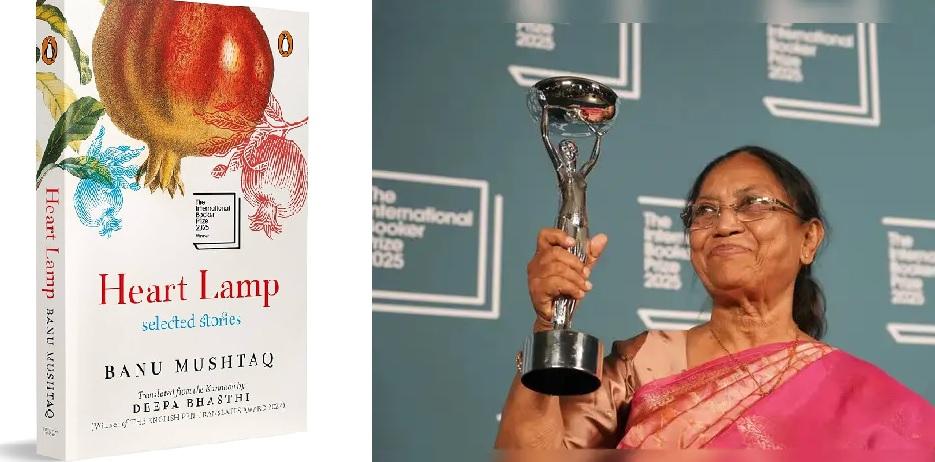
A day before the world would learn that Heart Lamp by Banu Mushtaq had won the 2025 International Booker Prize, a young voice from Bangalore shared a moving, deeply personal review of the book on YouTube. That voice was Priyanka Saha, a literature student who not only read the book but met the author in person, received a signed copy from both Banu Mushtaq and translator Deep Bashi, and offered her sincere wish that Heart Lamp would win the prize.

Priyanka’s review stands out—not for its technical analysis or literary jargon—but for its vulnerability, clarity, and emotional honesty. Her words are not those of a seasoned critic, but of a reader who has been moved.

"A book unlike any other I’ve read."

Priyanka opens her review holding up the signed copy with quiet pride. For her, Heart Lamp is more than a book—it’s a mirror into the lives of Indian Muslim women and a record of struggles that often remain behind closed doors. Translated from Kannada by Deep Bashi, the book is a collection of short stories that offers an unfiltered look at life in interior Karnataka while simultaneously resonating with women across the world.

Priyanka doesn’t shy away from calling the book an “emotionally heavy” read. The title story, which she highlights in detail, paints the picture of Mahun, a woman betrayed by her husband and abandoned by her family. In Priyanka’s telling, Mahun’s story is not just fiction—it is heartbreakingly real, familiar, and reminiscent of women she has known and admired in her own life.

A Chaotic, Crowded, Real India on the Page

What Priyanka found striking was the narrative style—chaotic, overflowing with characters, sensory details, food, sound, and emotion—much like India itself. She compares this storytelling style to the “crowdedness” of Indian life: not linear, not minimal, but bursting at the seams with meaning. One paragraph, she notes, introduces 12 people at once, forcing her to reread it thrice just to keep track. But this disorientation is part of the magic—drawing readers into the protagonist’s crowded world and, by extension, the author’s lived experience.

Mahun’s Despair: A Woman’s Silent Grief

Priyanka recounts how Mahun, once a bright student, was pulled out of school and married young. Now older, physically worn, and emotionally bruised, she returns to her natal home only to be told she’s overreacting. The family's lack of support is painfully familiar: instead of validating her feelings, they suggest her husband might take a second wife, or worse, abandon her entirely. The quiet cruelty of these scenes struck a deep chord with Priyanka, who reflects on similar stories she’s heard growing up.

She recalls one woman who confided in her during her childhood—a woman married off young to a much older man who abused her. Her story, like Mahun’s, lingered in Priyanka’s mind and resurfaced with full force while reading Heart Lamp. “This book,” she says, “is a little tribute to her.”

What Stories Deserve to Be Told?

Priyanka also shares what Banu Mushtaq said at the book launch—how, early on in her writing journey, she grappled with the question of whose stories to tell. Eventually, Mushtaq chose to write about her own community, her people, and the lives behind veiled windows, kitchen walls, and busy courtyards. In doing so, she illuminated the unseen.

And in reviewing Heart Lamp, Priyanka extends that illumination—passing on the glow to new readers, viewers, and listeners.

"You must not have read anything like this before."

That’s how Priyanka sums up the collection. It’s not just a recommendation; it’s a conviction. She ends her video with a heartfelt invitation: “If you want to read something different, read Heart Lamp.”

On May 28, 2025, the International Booker Prize committee echoed that sentiment by awarding Banu Mushtaq and Deep Bashi the prestigious prize—validating voices like Priyanka’s, who saw the brilliance of the book even before the global spotlight did.

Author info

AT News's picture

Assam Times Staff. editor@assamtimes.org

Add new comment

Other Contents by Author

Tinsukia, March 22:  Suspected militants of the banned outfit United Liberation Front of Asom (Independent) (ULFA-I) launched a pre-dawn attack on an Assam Police commando camp in the Jagun area of Tinsukia district, leaving at least four security personnel injured. According to reports, the militants attacked the camp around 2 a.m., allegedly lobbing several grenades and opening fire with automatic weapons. Security forces retaliated, leading to an exchange of fire that lasted for several minutes before the attackers fled the scene. The injured personnel were later shifted to a hospital in Dibrugarh for treatment. Following the attack, Army and police units launched a joint...
WWF-India, in collaboration with Samagra Shiksha Assam, felicitated five top-performing schools under the ‘Mission Prakriti’ programme for 2025–26 at a ceremony in Guwahati. The initiative promotes environmental awareness among students through themes like biodiversity, water, waste, food, and energy. In Assam, the programme covers over 4,700 schools across all districts. The award-winning schools include Natun Fatasil Town HS (Kamrup Metro), Sakai Khangia High School (Jorhat), Bishnu Jyoti MES (Sonitpur), PM Shri Jamira HS School (Hailakandi), and PM Shri Gossaigaon Girls HS School (Kokrajhar). Tinsukia district was also recognised as the best-performing district. Officials...
Jorhat: Tirtha Prasad Saikia, Director of the North-East Affected Area Development Society (NEADS), an indigenous civil society organisation based in Jorhat, Assam, has been appointed as the Constituency Focal Point for the People Affected by Conflict and Disaster Constituency of the Asia Pacific Regional CSO Engagement Mechanism (APRCEM). APRCEM is a regional civil society platform that brings together organisations across Asia and the Pacific to engage with intergovernmental processes on sustainable development, particularly the implementation and review of the 2030 Agenda for Sustainable Development and the Sustainable Development Goals (SDGs). Through this organisational role,...
SHILLONG, Mar 11: The Meghalaya government has postponed the elections to the Garo Hills Autonomous District Council (GHADC) that were scheduled to be held on April 10, 2026, following violent clashes in West Garo Hills that left two people dead. Chief Minister Conrad K. Sangma announced the decision on Wednesday, saying the state government reviewed the prevailing law-and-order situation in the Garo Hills region before deciding to defer the polls. The unrest erupted during the nomination process in Chibinang in West Garo Hills, where clashes broke out between groups supporting and opposing the participation of non-tribal candidates in the GHADC elections. Two persons were killed...
The Meghalaya High Court has set aside a controversial notification that made possession of a Scheduled Tribe (ST) certificate mandatory for candidates contesting the upcoming elections to the Garo Hills Autonomous District Council (GHADC). Delivering the judgment on March 10, Justice H. S. Thangkhiew ruled that the February 17, 2026 notification issued by the GHADC Executive Committee lacked legal authority and did not follow the procedure required under the Assam and Meghalaya Autonomous Districts (Constitution of District Councils) Rules, 1951. The court observed that the notification effectively barred non-tribal voters and candidates from participating in the council elections...
TURA, Meghalaya – March 11, 2026: Tensions surrounding the upcoming elections to the Garo Hills Autonomous District Council (GHADC), scheduled for April 10, have triggered violent clashes in the West Garo Hills district of Meghalaya, leaving two people dead and several others injured. The unrest has also resulted in widespread vandalism and arson in several areas of the district. The tensions stem from a controversial notification requiring candidates contesting the council elections to possess valid Scheduled Tribe (ST) certificate documentation. The rule has effectively prevented many non-tribal residents—particularly Bengali-speaking Muslims living in the plains belt areas such as...
North East Affected Area Development Society (NEADS), a grassroots development organisation based in Jorhat working with people’s struggles and community development initiatives, observed International Women’s Day at Chumoni Chapori village under the Jhanjimukh area in Jorhat district on Sunday, bringing together local women, community leaders and youth to celebrate the achievements and contributions of women in society. The programme was organized with the participation of women from riverine communities who shared their experiences, challenges and aspirations for greater social and economic empowerment. The event focused on raising awareness about women’s rights, gender equality and...
A significant milestone for literature from Northeast India has been marked with the publication of The Yellow Metaphor, a collection of poems by Assamese poet Jiban Narah, now released by Penguin Random House India. The book is a translated anthology of Narah’s poetry and is considered a rare achievement for the region. It is reportedly the first translated poetry collection by a single poet from Northeast India to be published by Penguin, and among only a handful of works in a regional Indian language to receive such recognition from the global publishing house. The Yellow Metaphor brings together 99 selected poems written over a span of 33 years, reflecting Narah’s long poetic...
Sivasagar, March 6: A meeting of organisations associated with the religious and intellectual affairs of the Tai-Ahom community was held on Thursday (March 5) at the public auditorium of Bakata Parijat Panchayat in Sivasagar district. The meeting was chaired by Jibeshwar Mohan Deva, founding principal of Tingkhang College. Several prominent personalities attended the meeting, including Manaranjan Baruah, president of the Mohan-Deodhai-Bailung Sanmilan; Vidya Phukan, president of the Mohan-Deodhai-Bailung Pandit Parishad; former president of Phra-Lung-Moung Assam Golap Gohain; secretary Pranjal Mohan; noted Tai cultural researcher Kamal Jyoti Mohan; Tai-Ahom scholar Nripen Mohan;...
Guwahati, Feb 28: The Assam government’s decision to seek a 5 per cent stake in Oil India Limited (OIL) has triggered discussion on the State’s long-term approach to the oil and gas sector in the Northeast. The proposal, under which Assam has sought a minority share in OIL — where the Government of India holds 56 per cent — will be examined by the Centre, Union Petroleum Minister Hardeep Singh Puri said. Chief Minister Himanta Biswa Sarma stated that the State is extending full cooperation to oil sector companies and urged that shares be allocated to Assam to support smoother functioning and stronger coordination. Reacting to the development, Shantikam Hazarika — former Chairman of...