Skip to content Skip to navigation

Climate Compatible Development Film fest held

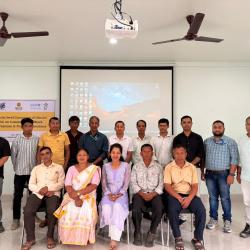
The Climate Compatible Development Film Festival kickstarted the first of its regional screening in Guwahati on Friday December 19. Three  films produced by the Climate & Development Knowledge Network (CDKN), and in partnership with Television Trust for Environment and the Assam Times Foundation, the film screening’s objective was to galvanise discussion around climate change, it’s impact on indigenous communities in the North East, lack of representation of women in climate change negotiations and the power of film to spur discussion and action on climate change, especially amongst youth groups. 

The 3 films: For a safer future – Insights on climate resilience from India; The forgotten women in India’s climate plans; Climate change and migration in Bangladesh – Living on the go, tell stories on the impact of climate change on diverse communities from Uttarakhand to Karnataka. Loss of livelihoods, distress migration, destruction of crops and fisheries, is the reality that many face on a day-to-day basis. And yet there are inspiring change strategies adopted by communities, such as in Gorakhpur, Uttar Pradesh, where different stakeholders, such as government, communities, and civil society have come together to create climate compatible development. 

The panel discussion following the film screenings facilitated in bringing the diverse environmental and climate change issues in Assam and the North East. Sanjin Sanbapandit states that “we should not get ‘panicky’ about communities cutting trees”, in drawing attention to the livelihoods of forest dependent communities and also stating that felled trees should be re-planted, and that in contrast the 100,000’s of vehicle on Guwahati’s road were doing more damage. In taking individual responsibility for mitigating climate change, Mubina Akhtar, Environmental Journalist and Activist, also demanded critical reflection from the middle class who cannot even take minor power cuts.  

Today’s auditorium at NEDFi House was full with a largely young audience who enthusiastically engaged with speakers on the role of civil society in climate change, the changing landscape of the North East and the lived realities of people’s lives in Dhemaji district. A member from Dhemaji district informed the audience of how he spent 4-5 years living on the embankment of the River Gai as a result of having been displaced due to flooding. Increased sand deposition in the district has led to drastic changes in the geography and the livelihoods of the district. 

Yet, despite the seriousness of the impact of climate change and environmental issues on people’s livelihoods and women, these largely remain outside of mainstream media. Dr. Shalini Sharma of Department of Ecology & Environment, Tata Institute of Social Science, Guwahati, put the issue on the table in saying that “environment is a hardcore political issue” and explained that media houses and institutions in the region were disinclined to cover serious environmental issues, something that needs to change as we move to facing the realities of climate change. 

Dr. Shalini Sharma also highlighted the politics of women’s participation in climate change negotiations and the need to open up ‘political corridors’ for women’s representation in these spaces. Dr Polly Vauquline, Women’s Studies, Gauhati University, highlighted the need for more informative research on the gendered dimensions of climate change and in particularly representing the diversity of North Eastern women. The film screenings drew consensus from the audience that similar films were needed to showcase the impact of climate change on the women of the North East and the role of oral storytelling in bringing women’s perspectives in climate change policies. 


Author info

Bg Gogoi's picture

Journalist, Coder, Traveler. Facebook: https://facebook.com/gogoi

Add new comment

Other Contents by Author

When Zubeen Garg stepped onto a stage, whether in a packed Guwahati stadium or before a modest rural crowd, something remarkable happened: the air thickened with anticipation, and the moment he sang, generations sang with him. On September 19, 2025, that voice — at once fiery, tender, and uncontainable — was silenced forever in Singapore under tragic circumstances. He was 53. For Assam and the Northeast, Zubeen was not simply a musician; he was a living cultural movement, a heartbeat that synchronized with millions. A singer, composer, lyricist, actor, and filmmaker, his career spanned over three decades and encompassed songs in more than 40 languages and dialects. His music shaped...
In a chilling reminder of the dangers faced by the press, Hornbill TV reporter Dip (Deep) Saikia was shot in Manipur’s Senapati district on Saturday evening, just a week after being publicly threatened by Nagaland Deputy Chief Minister Yanthungo Patton. The brazen attack has sent shockwaves across the Northeast, raising urgent questions about political intimidation and the safety of journalists. Saikia, a young reporter from Assam’s Jorhat district, had travelled to Laii village to cover the Zinnia Flower Festival when he was targeted. Witnesses say an assailant opened fire, striking him in the leg and underarm. Villagers quickly subdued the attacker, who was reportedly carrying an air...
When Shri PVSLN Murty, Chairman and Managing Director of the North Eastern Development Finance Corporation Ltd. (NEDFi), speaks about entrepreneurship in the Northeast, it does not sound like the language of a banker. It sounds more like the voice of someone who has walked the muddy lanes of remote villages, spoken with women artisans at their looms, and listened to farmers struggling to sell their produce. In his recent television interview, Murty painted a picture of a Northeast alive with ideas, but constrained by access. His reflections move beyond institutional reports and into a larger vision: finance not merely as credit, but as liberation, dignity, and futures being rewritten...
This week, I’ve been swept away by three songs from very different worlds—but each one touched something deep inside me. They tell stories of life, struggle, hope, and joy in their own unique ways. And I want to share how these songs became a part of my own story. Rose in My Garden — Lou Majaw’s New Video, A Dream Finally Realized The highlight of my week—and honestly, a moment I’ve been waiting for—is the official music video release of Rose in My Garden by Lou Majaw, my all-time favourite musician and a true living legend of Northeast India’s rock scene. Written back in 1993 on a lazy summer afternoon in Shillong, this song has been a quiet companion in my life for years. But...
A massive protest was held in the Boroduar Bagan region of the Goalpara district, where Indigenous communities came together to assert their rights over land they have long inhabited. With banners stating "The land belongs to those who occupy it—first give us the land, then give it to the traders," local men and women from various tribal communities rallied to protect their ancestral land from external forces trying to seize it. Since early morning, Indigenous people from far-flung villages have gathered to resist the threat of losing the land they have occupied for decades. Amid growing fears of displacement, many workers, shopkeepers, and farmers have left their fields to join the...
Assam, one of India’s seven biodiversity rich northeastern states, presents a landscape of lush evergreen forests and grasslands that is home to a great diversity of species including many of the rare cat species. Of the magnificent felines--while the tiger enjoys the lion share of all conservation efforts--the leopard however, continues to remain neglected. A Scheduled I species under the Wildlife (Protection) Act, 1972 and listed as vulnerable on the International Union for Conservation of Nature (IUCN) Red List, the survival of the leopard (Panthera pardus) in Assam is under threat due to an expanding human population and accompanying development and habitat fragmentation.  “...
Anjali is my friend. She lived in Guwahati for nearly three years. I didn't know she was researching this book! I love to read books. Recently, I read her book, "Keeping in Touch." It's a love story set in today's world. The story is about Keteki, a designer, and Ved, a businessperson. Once I started reading, I couldn't stop. The story begins with Keteki and Ved meeting at an airport. Ved is going to Assam to see a special lightbulb factory. Keteki is coming back home to Guwahati after an art show in London. Their chance meeting leads to a love story that goes beyond borders and takes them on adventures in Assam and other places. What I liked about "Keeping in Touch" is how Anjali...
During the Covid-19, a few brave Assamese boys and girls sailed offshore in search of their destiny, braving heavy odds like the lack of flights, lack of appointments for visas and uncertainty in foreign land. In the most unprecedented times in the history of mankind, now when the world goes through spells of complete lockdown, the youth were clueless about how to deal with this situation. Nevertheless, some brave-hearts embraced challenges with the right spirit and converted them to opportunities. Dewang Rajkakati is one of them. He left India during the height of the Corona Pandemic in December 2020 after completing B Tech from SRM University. He studied MS from the State...
KOKRAJHAR: An encounter incident took place in the Ultapani forest area along the Indo-Bhutan border area of Kokrajhar district on Thursday night that reportedly killed a person who was allegedly involved with extremist activities recently in Chirang district. The deceased was identified as Sanjula Wary, 26, of the Sapkata area of the Gossaigaon subdivision. Police arrested Sanjula Wary(26) of Kashiabari Dulagaon under Gossaigaon police station on Thursday. as per police, he was earlier a member of the NLFB Udalguri camp and had formed an extremist gang of about 10-15 members who were personally involved in the recent dacoity and firing incident at Bithani village under Amteka in...
Guwahati: An orgy of "encounters" triggered no less uproar in the state assembly on Monday, where the government denied any such case of an encounter by police. According to the government, there is nothing new in a few incidents of deaths of criminals in police firing in the state. Opposition legislators alleged a mysterious rise in the number of deaths in police firings since the new government was installed in Dispur. Senior minister Piyush Hazarika tried to pacify the legislators by saying that there is no such word as "encounter" in the Assam police manual. He said that police can’t remain idle if a criminal tries to flee from custody.  “It was during the erstwhile...