

Anupam Andhar: The Beauty of Darkness

Throughout history, humans have aimed to eliminate darkness, both in a literal and metaphorical sense, as it is crucial for the advancement of our civilization. We are naturally drawn to light and strive to move in its direction. Is it then possible for us to embrace or find value in darkness? However, human life is incredibly intriguing and remarkably varied. In the short span of life, people discover various behaviors and many thoughts and ideas. The variety found within human nature often leaves people in a state of astonishment and wonder. This may explain why human existence is so intriguing, endearing, and compelling to experience.
In the vibrant theatrical landscape of Assam, renowned playwright Arun Sarma occupies a distinguished position. Only a person of his intellectual calibre can conceptualise unconventional themes, such as the notion that darkness possesses inherent value and merit. Regardless of whether one actively pursues it, there exists a necessity to appreciate it. Among Sarma’s most widely discussed dramatic works, Anupam Andhar, translated as Dark is Beautiful, stands out as a significant contemporary Assamese play, first published in 2013. It stands out as one of the last major full-length scripts in his remarkable literary career. As a playwright, Arun Sharma has distinguished himself through his work here, which invites considerable reflection.
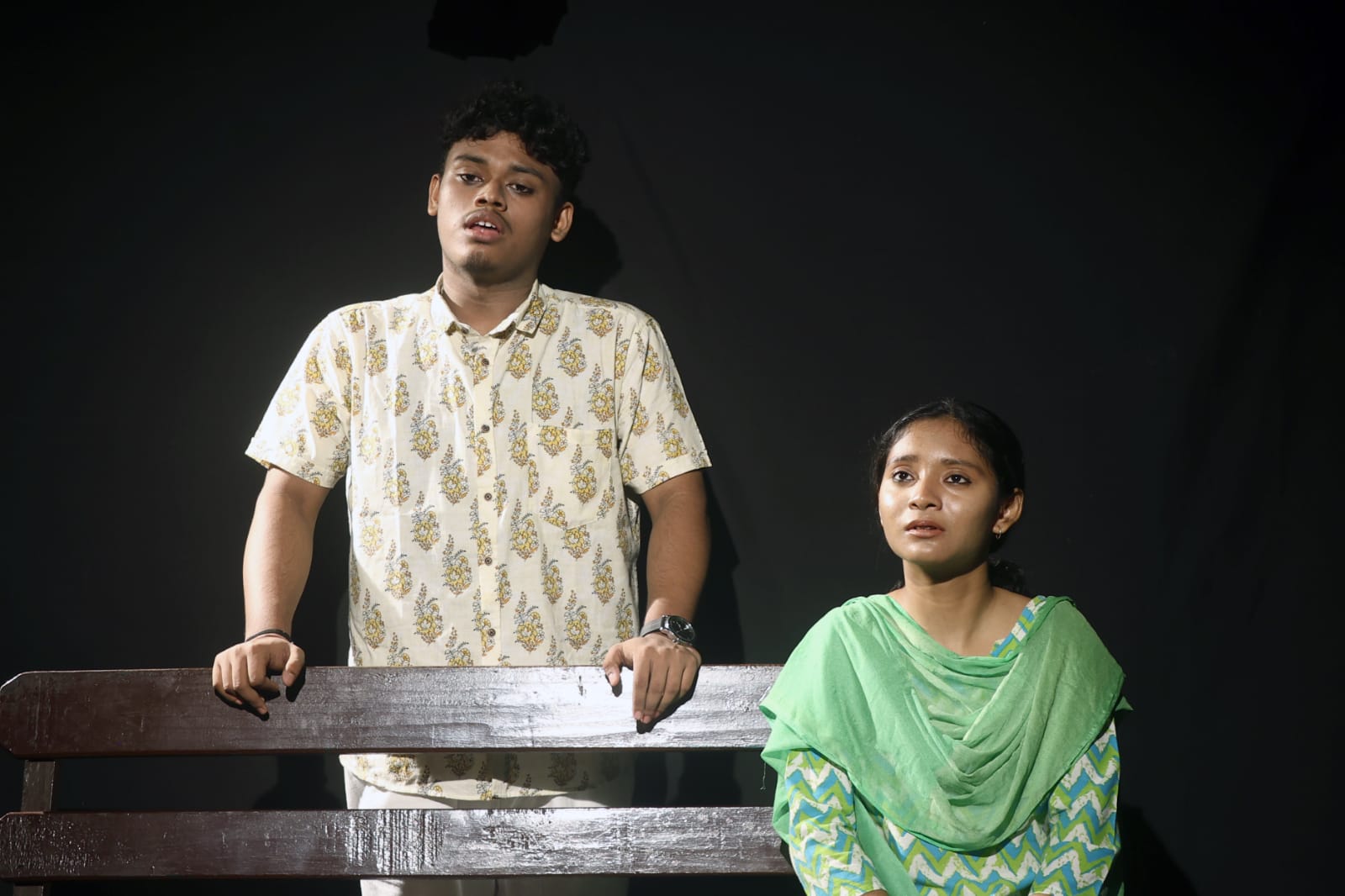
In the waiting room of a busy railway station, Suman, accompanied by his elder brother, takes a seat. His elder brother then steps outside, leaving Suman behind. Hailing from Duliajan, Suman has a passion for music and is a big fan of Bob Marley. He has arrived in Guwahati to take part in a music competition. At that moment, Anita enters the waiting room accompanied by her uncle and seats herself on the bench occupied by Suman. Subsequently, the uncle departs to procure refreshments. Suman engages in an introduction with Anita. As their conversation progresses, the initial awkwardness gradually dissipates, and they become increasingly comfortable with one another. Anita, a student of classical music, holds a profound regard for Dr. Bhupen Hazarika. Both individuals converse primarily about music, while a range of everyday domestic topics also arises in their discussions. They exchange compliments and speak favorably of each other, reflecting their recent transition out of adolescence — one is in the twelfth grade and the other in the tenth. In the course of these interactions, a mutual attraction gradually and inadvertently develops between them.
Noted theatre director Manik Roy recently staged the play Anupam Andhar at the Surjya Club Auditorium, presented by the Guwahati Sishu Natya Vidyalaya (GSNV), a prominent theatrical institution. The production featured only two characters from the original, character-rich play, and was executed in an intimate manner. Both performers are, in fact, adolescents. His choice of two capable actors has considerably eased the directorial challenge. Sustaining audience engagement for approximately 55 minutes with just two characters is by no means simple, especially given their limited opportunity to fully utilise the stage space. Nevertheless, the performances of Mriganga Raj Roy as Suman and Atrayee Gogoi Dutta as Anita were outstanding.
In Anupam Andhar, we observe two adolescents dwelling within darkness, yet both yearn to lead lives of their own and to revere beauty. The dramatic irony inherent in the play lies in the fact that both the characters are, in actuality, visually impaired. Nevertheless, neither character possesses awareness of this condition. Each character assumes that the other perceives the world, yet both inhabit an identical reality — that of darkness.
The crucial aspect to consider is the reaction of these two visually impaired adolescents upon discovering that both of their experiences are shrouded in darkness. Within the framework of the play, it could be articulated as chiefly an intellectual dramatic inquiry focused on perception, existence, reality and feeling. The methods of production, use of stage language, and character handling in the play make it a notable representation of contemporary theatrical ideas.
As the audience waits for the play to begin, theatrical reality emerges through sound, light, and the setting of the railway station. This approach reflects immersive theatricality in modern theatre, wherein the audience is integrated into the performance rather than remaining detached viewers. The protagonists, who are visually impaired, shape the world of the play through sensation, sound, touch, and intuition. The play’s reality is therefore not an ‘objective reality’ but a ‘subjective reality’, and the audience encounters it through the perceptions of the two central characters. The play relies on suggestion, silence, and absence rather than direct depiction, leaving much to the audience’s imagination. The bond between the characters is not rooted in physical attraction but rather in a ‘bridge of darkness’, fundamentally a bridge of events.
The emotional bond that develops between these two isolated, self-aware adolescents is an invisible bridge, yet it is acknowledged in a profoundly real sense. In Anupam Andhar, the characters embrace their blindness, perceiving it not as a limitation but as a distinctive aspect of their identity.
By the conclusion of the play, the arrival of the train symbolises both time and destiny. The railway station waiting room functions as a powerful metaphor for an intermediate stage of life, where strangers briefly meet, share conversations and emotions, and then continue on their separate paths. However, the play quietly suggests that even the most transient encounters leave lasting impressions at the emotional level.
The revelation that Suman and Anita will board the same train subtly suggests fate at work, showing how people on separate journeys can arrive at the same emotional destination.
Mriganga Raj Roy and Atrayee Gogoi Dutta have fully immersed themselves in their roles, demonstrating a deep dedication to authentically representing individuals with visual impairments. Their performances effectively convey the experience through various physical and behavioral elements, including the blank stare, the turning of the face toward sound, and deliberate pauses in speech. These subtle actions prove to be more impactful than the spoken dialogue itself. In Anupam Andhar, an aesthetic quality is established through the elements of silence and restraint. The absence of melodrama and overt expressions is replaced by solitude, anticipation, and a unique tenderness. The individual responsible for this remarkable achievement is Manik Roy, who has adeptly conceived and directed the play. The efficacy of the director’s character creation in the context of performance endures beyond the conclusion of the play.
Anupam Andhar is co-directed by Runumi Devi, with music composed by Diganta Sarma and Akash. The lighting is managed by the director Manik Roy, while the vocal performances are delivered by Uttam Kumar Deka, Dhiraj Mazumder, Akash, Rajib Lochan Gogoi, and Nisthawali Madhukalya.
Comments (0)
No comments yet. Be the first to share your thoughts.
Leave a Comment