

Did We Repaint Guwahati for a Visitor Who Never Arrived?

The cancellation of the proposed visit of the Japanese Prime Minister to Assam has triggered a familiar political ritual. The debate has quickly descended into a blame game. One side points fingers at protests. Another blames administrative mismanagement. Yet another sees it as evidence of Delhi's continued centralisation of power and diplomacy.
But perhaps we are asking the wrong question.
The question is not why the Japanese Prime Minister did not come to Assam.
The question is: what did Assam become in anticipation of his arrival?
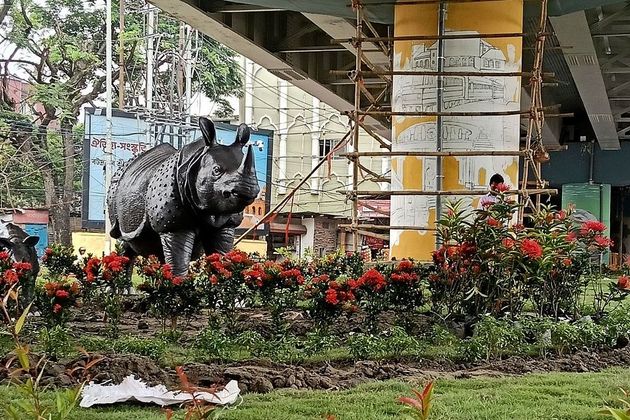
For weeks, Guwahati was transformed into a city preparing for inspection. Roads were repaired in haste. Walls were repainted. Medians were decorated. Concrete surfaces were drilled to plant saplings. Public spaces were rearranged. The city was being prepared not for its citizens but for a distinguished visitor.
This is not unique to Assam. Across the world, governments often beautify cities before international summits. Yet the Guwahati episode exposed something deeper about our understanding of development, public space, and democracy.
The most visible controversy emerged under the Ganeshguri flyover, where a mural of Assam's beloved artist Zubeen Garg was painted over as part of the beautification drive. Public outrage followed. The mural was later restored. Protests erupted. Traffic was disrupted. Reports suggested that a visiting Japanese delegation encountered significant delays.
Almost immediately, a narrative began to take shape. The protests, it was argued, had embarrassed Assam. Some even suggested that such incidents contributed to the cancellation of the Japanese Prime Minister's visit.
There is little public evidence to support such a claim. The official explanation for the cancellation remains logistical and scheduling constraints. The India-Japan summit itself was never conceived as an Assam-specific event. It was an annual bilateral summit between two nations that was planned to be hosted in Guwahati before being shifted back to New Delhi.
Yet regardless of the reasons for the cancellation, the controversy reveals something important.
When a mural of Zubeen Garg becomes expendable in the pursuit of showcasing Assam, one must ask: whose Assam is being showcased?
Is it the Assam of its people, artists, rivers, cultures, and public memories?
Or is it an Assam carefully curated for diplomatic photography?
The removal of the mural touched a sensitive nerve because Zubeen Garg is not merely a singer. For many Assamese people, he embodies language, identity, culture, and a collective emotional landscape. The public reaction was therefore not about paint on a wall. It was about the erasure of a symbol that people felt belonged to them.
What followed exposed another contradiction.
In the name of creating greenery, concrete and bituminous surfaces were reportedly drilled to accommodate plantation drives. Such actions raise a basic ecological question. Can sustainability be manufactured through last-minute cosmetic interventions?
A tree planted for a photograph and forgotten a month later does not create a greener city. Real urban ecology requires planning, soil health, groundwater recharge, biodiversity corridors, maintenance budgets, and long-term stewardship.
The number of saplings planted is not the measure of success.
The survival of those saplings five years later is.
Similarly, the repainting of walls does not make a city sustainable. A sustainable city is one where drainage functions, wetlands survive, public transport works, rivers remain healthy, and citizens participate in shaping public spaces.
Beyond questions of sustainability, the larger issue is public expenditure.
How much money was spent on these beautification works?
Which departments sanctioned the projects?
Which contractors received the contracts?
How many of the works were part of existing urban plans, and how many were accelerated because of a proposed VIP visit?
Who benefits economically from these sudden transformations?
These are not anti-development questions. They are accountability questions.
If public money has been spent, citizens have a right to know what assets remain after the event is cancelled.
The irony is striking.
The city was beautified to impress visitors from Japan, a country that is globally respected not because of decorative landscaping but because of disciplined planning, maintenance, public accountability, efficient urban systems, and long-term investment in civic infrastructure.
A Japanese visitor is unlikely to be impressed by freshly painted walls alone.
They are more likely to notice whether a city manages its waste, protects its rivers, maintains its public spaces, and respects its own cultural heritage.
The cancellation of the visit has therefore left Assam with a valuable opportunity for reflection—not only about urban governance but also about Assam's place in India's diplomatic imagination.
For decades, Northeast India has been described as India's gateway to Southeast Asia. The region is repeatedly invoked in discussions of the Act East Policy and Indo-Pacific strategy. Yet when schedules become tight or priorities shift, major diplomatic engagements often return to Delhi.
This raises a fundamental question.
Is the Northeast truly being treated as a centre of strategic engagement, or is it still largely a region to be showcased when convenient?
The answer cannot be found in painted walls, ornamental plantations, or ceremonial visits.
It lies in whether the region receives sustained investment, meaningful participation in decision-making, and respect for its people and institutions.
Cities are not stages.
They are living ecosystems.
Their purpose is not to impress dignitaries for a day but to serve citizens for generations.
If the events surrounding the proposed Japan visit teach us anything, it is this: genuine development cannot be painted onto a wall. It must be rooted in accountability, ecology, culture, and public trust.
Everything else is scenery.
Comments (0)
No comments yet. Be the first to share your thoughts.
Leave a Comment