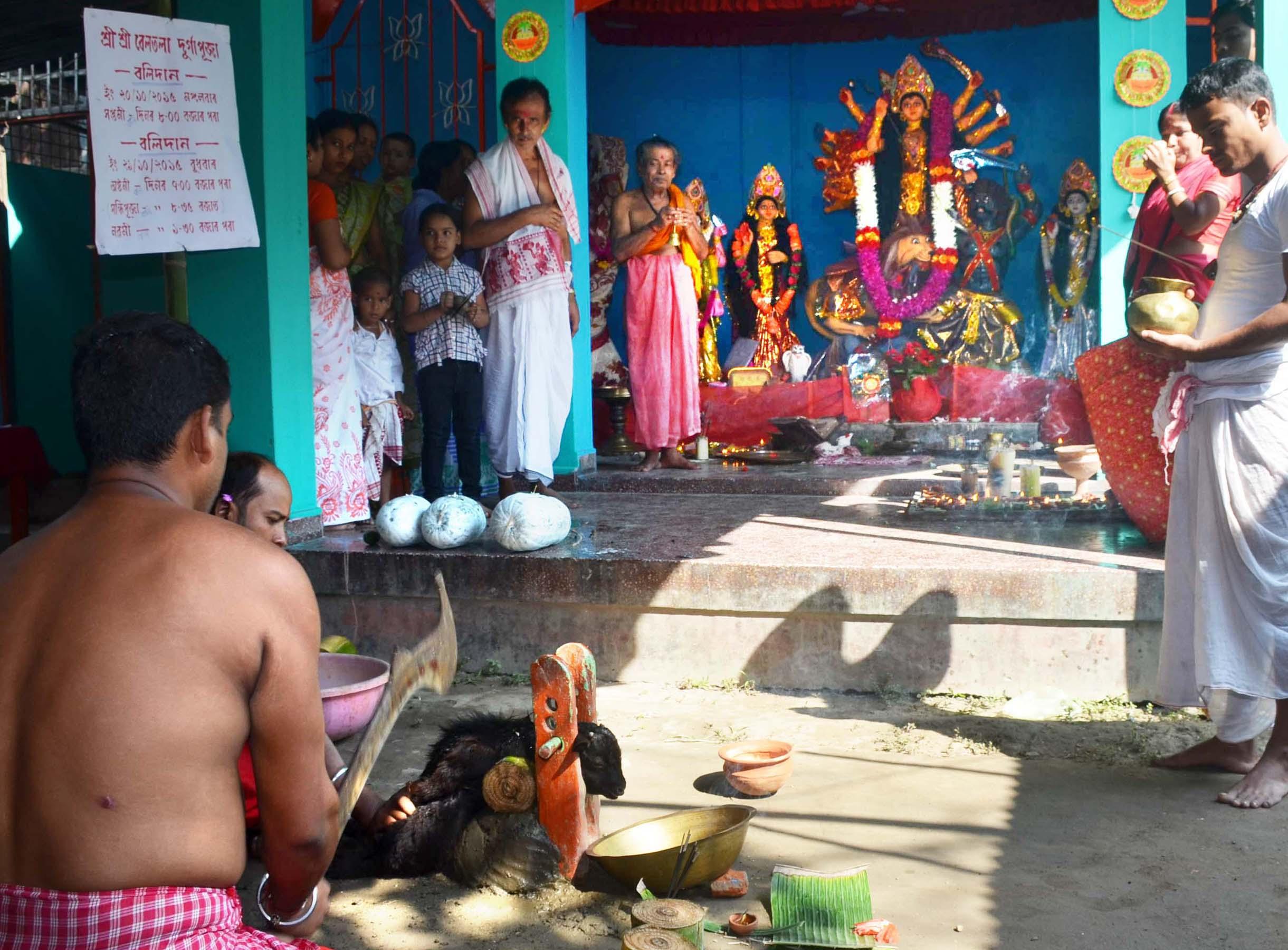
Animal sacrifice in Durga puja strikes no less shock and anger among many organizations and individuals across the state.
Dozens of buffalos and goats are being sacrificed in many temples in the name of Durga puja from Tuesday. A glimpse of the buffalos, goats, ducks and pigeons being kept for sacrifice at the historic Kamakhya temple premises really shocks the animal lovers. Same it is in many places where the same shocking tradition is allowed in Durga Puja.
“We are helpless. We have been dead opposed to the tradition of animal sacrifice. But the organizers have been refusing to read our campaign. This is a matter of grave concern,” said Shailen Saikia from Sivasagar district who has been campaigning againstanimal sacrifice.
Juli Chutia from Kakojan area in Jorhat told Assam Times that the people must understand the reality. “The things have undergone a sea change now. Everywhere change reigns supreme. But we don’t understand why we are still stick to this tradition. Our minds need to be changed.”
“It would take time to end the tradition of animal sacrifice. If 1000 buffalos and 5000 goats were sacrificed ten years ago, now 50 buffalos and 100 goats are being sacrificed,” said Pranjal Bora from Nagaon.
Bora who is running a non governmental organization told Assam Times over telephone that a massive campaign is the need of the hour againstanimal sacrifice which has yet to take place. “The campaign should have taken place at least 3 months before the commencement of the Durga puja. People from the nook and corner of the state should be aware of it. But I do hope that after 20 years the tradition of animal sacrifice would die down,” he said.
PermalinkSubmitted by amlesh on Wed, 21/10/2015 - 14:34
I think it is time to do away with animal sacrifice. It is a barbaric practise.It should stop both for hindu festivals as well as for other religions like for bakrid.
PermalinkSubmitted by Jaishankar Babu on Mon, 25/09/2017 - 13:38
About 150 years back it was a 'religious custom' in India to force widows to get burnt on their husband's funeral pyre (Sati) today we consider it a barbaric tradition. Similarly, years from now, our future generations will look back at us and call us barbaric.
A god who wants the blood of an innocent animal to satisfy him/her cannot be called a god. It can only be a devil/demon. Rather the people who sacrifice animals (be it Bakr Id or Durga Pooja) are devils who sully the name of their god with their crime of killing innocent animals.
Veteran journalists blamed a section of national media, political leaders and the people in the distant Delhi for allowing the north east only to remain a printed map when they held an eye opening session in the Guwahati Lit Fest on Saturday.Veteran journalist Sanjay Hazarika deplored lack of courage of the north east people to raise voice against burning issues that has been confronting the region.“Do we know how many people are put behind the bars who committed gruesome killings? We have to face the reality what wrong goes with us,” said Hazarika.
Veteran writers in the Guwahati Lit Fest agreed that the north east women poets are a great force in the region’s literature. They occupy a prominent place in the pages of Assamese literature.Their wonderful creative poems truly reflect the beautiful north east and its people beside bridging the gap with the readers. This was the message of the session organized at part of the festival on Saturday.Moderated by noted poet and writer Harekrishna Deka, the session was attended by Rabin Ngangom, Kynpham Sing Nongkynrih, Gyan Pujari, Sameer Tanti, Nilim Kumar, Anupama Basumatary and Tapati Baruah Kashyap participated the session.
Capitalism has been taking literature into the market. Only the readers can only stop this growing trend of literature in the market. This was what more or less of what the writers spoke when they met a crucial session of the Guwahati Lit Fest on Saturday. Moderated by journalist and writer Prasanta Rajguru, the prolific writers said that literature is one of the reliable vehicle of expressing one’s social commitment and identity.Award winning writers Ravi Thapa, Arupa Patangia Kalita, Debobrata Das, Rabin Sarma, Bipul Khataniar and Prasanta Kumar Das participating in the eye opening discussion.
Literary contributions of Indira Goswami got yet another focus when writers remembered the award winning litterateur at the Guwahati Lit Fest on Saturday.Chaired by writer Namita Gokhle, the session had a livelier discussion on the literary giant that left a glorious chapter in the history of Assamese literature. Prolific writer Mitra Phukan delivered the key address on Mamaoni Raisom Goswami.
Stereotype writings have both positive and negative aspects. But these writings are not very encouraging for the north eastern region. This is more or less of what the noted writers said at a session of Lit Fest in Guwahati on Saturday.Noted writer Arup Kumar Dutta who moderated the session stressed need of more and more creative and informative writers to resist the stereotype writers in the north eastern region.Moderating a discussion on the “Resisting Stereotype Writings in the North East” as part of the Guwahati Lit Fest on Saturday, the veteran writer blamed a section of the audio visual media in the country for the rampant stereotype writings in the region.He said that authentic...
Experts in the field of history deplored the decreasing importance of history in the school level. The said that history unites people and that it would only create historical reality in the society.Noted writer Namita Gokhle, historian Pushpesh Pant, journalist Samudra Gupta Kashyap and Dibrugarh University Professor Chandan Sarma participated in the session after the opening session at NEDFi House on Saturday.
A critical approach on history came up for a livelier discussion when a panel of experts had a brainstorming session as part of the Guwahati Lit Fest on Saturday.Noted expert and former JNU professor Puspesh Pant, author Namita Gokhle, The India Express journalist Samudra Gupta Kashyap and Dibrugarh University professor Dr Chandan Sarma threw some lights on a few aspects on the distortion of historical facts and figures. Gokhle moderated the discussion much to the benefit of the students of history.
Renowned journalist Sir William Mark Tully on Saturday stressed translation of regional literatures into English calling it a need of the hour. In his address at the opening session at the Guwahati Literary Festival on Saturday, the former BBC correspondent said that nobody should take resort to the killer languages.
Eminent litterateur and Asom Sahitya Sabha president Dr Dhrubajyoti Bora expressed grave concern over the recent carnage in Kokrahar and Sonitpur districts.Opening the Guwahati Lit Fest on Saturday, Dr Bora said, “it is not time to tolerate all forms of terror acts that stifle the society.” He further asked the government to diagnose the disease.
Eminent journalist and former BBC correspondent Sir William Mark Tully, scholar Pushpesh Pant, prolific writer Namita Gokhle and Asom Sahitya Sabha president Dr Dhrubajyoti Bora are dignitaries who shared the dais. Dr Bora opened the festival.The first summit began at the NEDFi House in Dispur condoled the carnage in Kokrajhar, Sonitpur, Chirang districts by holding a one minute silent prayer. This was followed by a bogreet by award winning singer Tarali Sarma. Assam Times is giving its viewers the live updates of the 3 day long festival.







Comments
I think it is time to do away
About 150 years back it was a
Pages
Add new comment