
Skip to content Skip to navigation

Unceremonious departure of a popular Assamese weekly
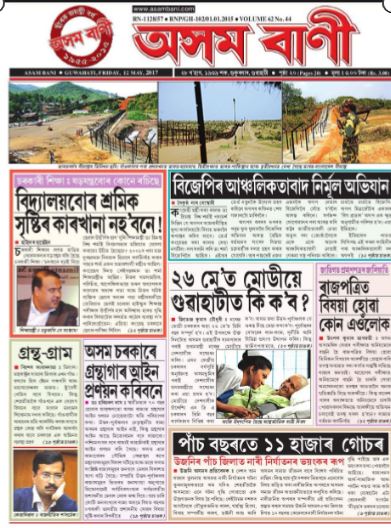
Amid an existential crisis in the Guwahati-based Assam Tribune group of newspapers, which worsened after the Covid-19 pandemic, a popular Assamese weekly newspaper lost its publication in the latter part of 2025. Asom Bani, once a mainstream weekly for Assamese readers for decades, stopped hitting the stands from September last year, as the management lost interest in continuing its printing every Friday. Even though the seven-decade-old Assamese-language weekly was lost from the media market, the management did not make any statement about Asom Bani’s fate. Prior to its departure, the weekly was merged with Dainik Asom, an acclaimed Assamese daily from the prestigious media house, as its Friday supplement.

Once edited by prominent Assamese journalist-authors namely Satish Chandra Kakati, Tilak Hazarika, Phani Talukdar, Nirod Chowdhury, Homen Bargohain, and Chandraprasad Shaikia, the weekly had Dilip Chandan as its last editor, who served Asom Bani for nearly three decades. Launched on 1 July 1955 by legendary Assamese entrepreneur Radha Govinda Baruah, the weekly witnessed and reported various important socio-political developments, including the Assamese-medium (instruction in schools) movement, the Assam anti-influx agitation, the abrupt rise of separatist-influenced insurgency, social unrest, the emergence of regional politics, and its diminishing popularity, with all sincerity to the indigenous population.

As the pandemic severely affected the circulation of all newspapers published by the Assam Tribune group, the subsequent impact was observed in shrinking advertisement revenues from commercial entities. Like many other media institutions across India, the Assam Tribune group also faced a severe financial crisis, which started reflecting in irregular salary disbursements to employees, including working journalists. The employees’ union came out in public with various difficulties, including unpaid dues meant for retired employees. The union leaders also made allegations that the group was not receiving a huge amount of money from the State Information and Public Relations Directorate against published advertisements.

Soon, rumours spread over the probable sale of the entire media group to another city-based television house. However, the Assam Tribune management strongly denied this, terming the reports as false portrayals. In an official statement, the management assured its firm commitment “to its editorial independence, journalistic integrity, and continued services to its readers, advertisers, and stakeholders”. The management even urged all concerned to “disregard such baseless speculation and refrain from spreading misinformation”. Needless to mention, its primary news outlet, The Assam Tribune, which came into being on 4 August 1939 (with Lakshminath Phukan as its first editor), continues to be the highest-circulated English daily in the north-eastern region.

But assurances of the management led by Prafulla Govinda Baruah (second son of R.G. Baruah, who died on 14 December at the age of 93) did not prevent the handing over of the responsibility of Dainik Asom, now over six decades old, to a different media group owned by young entrepreneur Kishor Borah, who runs the Assamese satellite news channel ND24. The deal was made public on 17 September last year, following which the new management took responsibility for publishing Dainik Asom, but did not prefer to take care of Asom Bani (which had already ceased to be an independent publication). As a supplement of Dainik Asom, the weekly hit the stands on 12 September 2025 for the last time.

The new management of Dainik Asom did not absorb all engaged media employees, and on a single day, on 18 September, over 70 employees (many of whom were enjoying extended tenures with a monthly lump-sum payment) lost their jobs. The Assam Tribune management assured them of all legal dues within a few weeks, but this did not materialise. Having no other options, they approached the labour court demanding their dues, which seemingly amount to around rupees six crores altogether. It is unfortunate that the media house, which was India’s first institution to implement the recommendations of the statutory Majithia Wage Board in 2010, has now taken the route of escapism by avoiding legal payments to retired employees.

Media observers believe that the Tribune house usually maintained its credibility while disseminating information, editorial viewpoints, and other articles, but in recent times, the same principles were largely compromised. Its prime mover (The Assam Tribune) lavishly supported the anti–Citizenship Amendment Act movement that broke out in 2019, where it provided huge space to the public uprising that denounced the Union government’s initiative to politically support persecuted Hindu, Sikh, Buddhist, and Christian families coming from Pakistan, Afghanistan, and Bangladesh to India. The chaos engulfed the Brahmaputra Valley of Assam for weeks, with the narrative that the new citizenship law would discredit the Assam Accord (signed in 1985 to culminate the six-year-long anti-foreigner agitation).

Moreover, the people of Assam remember when the newspaper produced a series of voluminous reports on the backdrop of a city press club election with little credibility, where the editorial focus was exposed as biased, unprofessional, and marred by character assassinations of a particular press club official, putting its integrity at stake. The present financial status of the Assam Tribune group remains pathetic, but it was not entirely orchestrated by the pandemic alone. Rather, the situation was made more complicated by a section of arrogant media professionals who enjoyed all due benefits only to create disorder within the media house, where, shockingly, the management turned out to be a mute spectator.

Author info

Nava Thakuria's picture

Senior journalist based in Guwahati.

Add new comment

Other Contents by Author

Bangladesh, which recently witnessed turmoil following the demise of a young radical leader Sharif Osman Bin Hadi amid anti-India rhetoric, now gradually returns to normalcy, as the south Asian nation also prepares for its next general election scheduled  for 12 February 2026. The highly sought after polls, as the sitting Prime Minister Sheikh Hasina faced an overthrow in the backdrop of a student-led mass uprising in July-August 2024, however misses the participation of Hasina’s party Awami League, which used to rule the Muslim majority country of 170 million people for several years. The ousted premier along with thousands of  her party men continue to stay in neighbouring...
It may be amazing but true, that the largest democracy on Earth continues waiting for a fully functioning government-sponsored media watchdog for more than a year now. Press Council of India (PCI), a quasi-judicial body, which was initiated to safeguard and nurture the freedom of press in the country, remains almost a non-functioning entity as the term of PCI’s 14th council  expired on 5 October 2024. Since then various initiatives to constitute the statutory 15th council to carry forward its prescribed activities confronted different hurdles. Currently the PCI has its chairperson and secretary along with only five members representing Rajya Sabha, University Grants Commission, Bar...
An initial sadness and grief following the unforeseen death of Assam’s cultural icon in Singapore at only 53 have slowly turned into outrages with a sole demand for justice to  Zubeen Garg, as millions of his fans and admirers got convinced that something wrong had happened to their prince of melody during an unplanned sea-yacht outing in the southeast Asian nation. The heart-breaking news that brought the India’s north-eastern State with  3.3 million people to a standstill turning its capital city into a sea of humans weeping, sobbing, crying and exclaiming why Zubeen was put to die in the islands nation, thousands kilometer away from his motherland, on 19 September 2025. The...
The heartbroken news arrived from Singapore in multiple media outlets, which baffled the people of Assam, but immediately in outrages among the young generation, who were born in eastern India and brought up with the melodious voice of iconic singer Zubeen Garg. The sadness and melancholy soon turned into outrages with a vital question, why Zubeen was taken to Singapore as he  was not physically well for months. Millions of his fans were annoyed when they encountered some clippings of videos on social media, where the singing sensation was seen swimming in the seawater (without a life-jacket), whereas he was cautioned by the doctors in Guwahati to avoid the fire and water body. The...
Guwahati: Since 1  February  2005, Assam government has implemented the National Pension Scheme (NPS) for the government employees. All Assam Government NPS Employees’ Association terms it an anti-employee policy and a mockery in the name of pension. The Union government, instead of restoring the Old Pension Scheme (OPS), has taken initiatives  to replace the NPS with a new one named Universal Pension Scheme (UPS). The third biennial conference of the association, held on 24 August at Rupnagar in the city strongly opposed this move and demanded the reintroduction of the OPS. President Achyutananda Hazarika and general secretary Apurba Sharma announced that from next month...
The natural gas leakage from Bhatiapar  crude oil well continues for 15 days, even though  the Oil and Natural Gas Corporation (ONGC) along with an expert team from USA continue working for full dousing of the RDS-147A under  Rudrasagar oilfield in Sivasagar district of eastern Assam. The blowout began on 12 June 2025 and uncontrolled leakage compelled nearly 350 families to leave their places for safety reasons. Besides the local villagers living near the old well, the high pressure gas flow impacted the surrounding environment heavily. Lately, the ONGC issued a statement claiming that ‘a significant progress in controlling the well at RDS 147A’ was made. It also added the...
When hundreds of media workers died of  Covid-19 complications across India, a few people thought the corona disaster would also devastate the print media with sharply declined circulation figures resulting in shrinking advertisement revenues. Many established newspaper-publishing groups either closed many of their editions in the post-corona period or drastically reduced the number of employees to cope up with the hard situation. Some newspapers were shut down forever and many owners were compelled to sell their publications. The troubles are now brewing for the oldest media house in north-eastern region after a Dimapur-based English daily recently ceased its publications. The...
Guwahati: Amid stained bilateral relations between India and Bangladesh, Prime Minister Narendra Modi and the head of Dhaka-based interim government Dr Muhammad Yunus exchanged warm greetings on the occasion of Eid-ul-Azha. In an official letter (dated on 4 June 2025), PM Modi on behalf of the people and government of Bharat conveyed good wishes to Dr Yunus and the people of Bangladesh on the auspicious occasion of the Islamic festival. This holy festival is an integral part of the rich and diverse cultural heritage of India and is celebrated with immense joy and fervour by millions of people of Islamic faith across the country. It reminds us of the timeless values of sacrifice,...
In the decisive war against Pakistan in 1971, India won and a new nation was born, but a small State in eastern part of Bharat had to pay a heavy price with millions of East Pakistan refugees, for which Assam  still cries but nobody cares. With an absorbent border with Bangladesh and unconvincing political will from the government, augmented by continued callous attitude of majority Asomiya people, the situation remains grim even today. New Delhi supported the Mukti Bahini (the freedom aspiring Bengalis of East Pakistan) in their movement against West Pakistan and finally the atrocious Pakistan forces had to surrender on 16 December 1971. But the newly born sovereign country was not...
The current interim government of Bangladesh, led by Nobel laureate Professor Muhammad Yunus, remains busy pursuing the final reports by a number of reform commissions with their proposals and subsequent discussions with the political party representatives. Even after nine months of its formation in Dhaka, the situation across the south Asian nation continues to be murky. Needless to mention that a sense of joy and expectation surfaced among nearly 170 million Bangladeshi nationals, when the caretaker government was constituted following a massive student-led uprising compelled sitting Prime Minister Sheikh Hasina to resign and flee (to India) on 5 August last year. Enjoying the...