
Skip to content Skip to navigation

Regional Meet of State Legal Services Authorities conclude

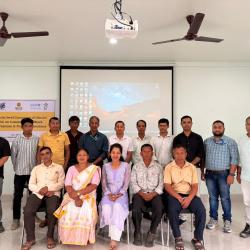
The regional meet of the all the North-Eastern States Legal Services Authorities under the aegis of the  National States Legal Servives Authorities was held at Shillong on September 27 and was inaugurated by Hon'ble Mr Justice Ranjan Gogoi, Judge, Supreme Court of India & Executive Chairman, National Legal Services Authority.The Meet  which saw the participation of the Chief Justices and Judges from the states of Arunachal Pradesh, Assam, Manipur, Meghalaya, Mizoram, Nagaland, Sikkim and Tripura accompanied by the Judicial Officers of the respective states commenced with the inaugural programme by the delivery of welcome address by Hon'ble Mr Justice Sudip Ranjan Sen, Judge, High Court of Meghalaya & Executive Chairman, MSLSA and a speech by Justice Dinesh Maheshwari, Chief Justice, High Court of Meghalaya & Patron-in-Chief, MSLSA.

The conference comprised of two technical sessions which discussed on several issues on "Evaluation and Review of the Work-Performance of SLSAs on, Legal Aid, National Lok Adalats and Implementation of NALSA Schemes" and also "Identification of the areas for expansion of the SLSAs activities under the NALSA Schemes".  Justice Ranjan Gogoi stressed on the role of the Legal Services Institutions to carry out the schemes of NALSA by emphasising the fact the role of the Legal Services Institutions goes beyond the scope of only giving legal aid, but the very fact that access to justice for all means that justice has to be meted out to all those who are in need of justice.

Justice Gogoi also stated that the role of the SLSAs is spelt out in the object of the scheme itself and further emphasised that the activities of the SLSAs should be given more publicity so that the executive is aware of the ground reality and the works carried out by the Authority to make the beneficiaries informed about the various legal schemes and also to constantly monitor the Schemes on the ground. He stated that the implementation of the various schemes is the need of the hour which needs commitment on the part of the authorities in order to reach out and sensitize the people at the grassroots level and that the Lok Adalats are not the only means of providing access to justice but the real purpose of the Legal Service Authority is to get the response and be able to transform the thinking of the people in the Executive and to make effective use of the resources available including Para Legal Volunteers as the main source of manpower available in the states concerned. 

In the later session, Justice Gogoi raised a question to the participants with regard to the quality of the assessment of the Para Legal Volunteers carried out and stated that the recruitment of PLV's must be carried out meticulously. 

Touching on the various aspects of how the functioning and role of Legal Service Institutions can be more effective in bringing justice to those in need, who are hitherto not been able to knock on the doorsteps of justice, Justice Gogoi exhorted those present to rise to the occasion and said that the Legal Services Institutions are placed at an advantageous position in as much as it has the fund required, the support of the Executive and the backing of the Judiciary to implement all the schemes in the quest for access of Justice for all.


Add new comment

Other Contents by Author

The third day of The Anti Trafficking-in-Persons Conclave 3::Moving Forward Together had three engaging sessions that endeavored to discuss on the partnership of Civil Society in addressing Trafficking-in-Persons, the Role of Service Providers in addressing protection of human trafficking survivors and the experiences of the Civil Society Organizations. The conclave successfully ended with the formation of a Draft Action Plan. The role of Civil Society in preventing Trafficking-in-Persons is a critical approach that needs cooperation from all actors in the anti trafficking field to be able to offer their support to other actors. An engaging participation and exchange of opinions took...
Session V: Mature Media- Responsible Response towards Human Trafficking moderated by Arijit Sen, Senior Editor, CNN-IBN followed with an interactive panel of media practitioners like Sein Win (Myanmar), Kunal Majumder, Thomas Lim, Editor, Meghalaya Times, Mrinal Talukdar, Joint Editor, DY365, Amit Patro, Editor, Sikkim Express, Syed Sajjad Ali, Editor, Indigenous Herald and Appu Gapak, Sub Editor, Arunachal Times.Describing the success of carrying stories of human trafficking in Assam, senior panelist Mrinal Talukdar, Joint Editor, DY365 said that trafficking stories does not sell in Assam because the tea one drinks is the result of the 40 lakh people who have been trafficked to Assam from...
The Government of India in the Ministry of Home Affairs, in association with the United Nations Office on Drugs and Crime (UNODC) has initiated a two year project for training of Law Enforcement Officers on human trafficking in four States, namely Maharashtra, Goa, West Bengal and Andhra Pradesh.The Anti Trafficking-in-Persons Conclave 3::Moving Forward, Session IV: huddled to explore the Lessons Anti Human Trafficking Units of Northeast India.B. R. Rana, IPS, IGP (CID), Meghalaya speaking on anti human trafficking said, “The law enforcement initiatives and the resources in place to deal with anti human trafficking are pathetically limited. That is why once in a while the Government of...
Chief Minister Tarun Gogoi in his address on the second day of Anti Trafficking-in-Persons Conclave 3: Moving Forward organized by the American Center, Kolkata and Impulse NGO Network at NEDFi House, Guwahati said, “Anti trafficking offers serious challenges whether it is in South Asia, East Asia or anywhere else. Even in Assam with borders along Bangladesh, Myanmar and Nepal the issue of trafficking is on the rise without doubt. The Government of India has shown it concerns on the matter and it is our obligation and duty to ensure that everybody lives with full dignity, every child, every woman, every individual. They must enjoy human rights and live with honor which is the basic objective...
The first Session of the Anti Trafficking-in-Persons Conclave 3 took off at Hotel Brahmaputra Ashok Conference Hall Thursday evening. The Conclave is the third in the series which seeks to explore and replicate best models to address Trafficking-in-Persons in Northeast India and its bordering countries.The Asian Centre for Human Rights identified Guwahati as the main transit point for trafficking of women from North Eastern states to other parts of the country, particularly Siliguri, Kolkata and New Delhi. According to the US State Department millions of women and children are trafficked in India annually which is a source, destination and transit country for men women and children...
The American Center, Kolkata Thursday announced the "Anti Trafficking-in-Persons Conclave 3: Moving Forward Together" in Guwahati. The Conclave will be organized in association with the Impulse NGO Network an organization which has been working to combat the problem of Trafficking in Persons in North East India for over 15 years.The two day international conclave commencing December 6 aims to establish and expand collaborative partnerships in India, Bangladesh, Nepal, Bhutan and Myanmar to prevent the exploitation of women and children and protect the victims of human trafficking, while enhancing border trade relations. The first two Anti Trafficking-in-Persons Conclaves were held in...
Keeping with the U.S.' interest in India's Look East Policy the American Center, Kolkata for the first time organized an Alumni Entrepreneurship Road Show & Mentorship Program in the city capital recently. It aims to forge a long-term relationship with the alumni of the U.S. State-Department’s professional exchange programs and encouraging young leaders and entrepreneurs.India's Look East policy was framed to cultivate extensive economic and strategic relations with the nations of Southeast Asia in order to bolster its standing as a regional power and a counterweight to the strategic influence of the People's Republic of China. Initiated in 1991, it marks a strategic shift in India’s...
The Assam Government Tuesday made a forceful plea for reopening  the Stilwell Road which is capable of handling 20-25 per cent of Sino-Indian bilateral trade. It said there is need to push for a Northeast-Kunming Trade Corridor to strengthen economies. Stilwell Road, formerly called the Ledo Roadis a 769 kilometer long route that links Northeastern India with the Burma Road, which runs from Burma to China. During World War II the Stilwell Road was used as a strategic military route. The Ledo Road was intended to be the primary supply route to China and was built under the direction of General Stilwell from the railhead at Ledo in the state of Arunachal Pradesh.Inaugurating a national...
Several environmentally ‘unfriendly’ projects in Assam and other Northeast Indian States are being touted as sustainable, receiving funds under the United Nation’s Clean Development Mechanism, wreaking havoc to the ecosystem and the people in its vicinity.A majority of such projects involve renewal energy projects like dams, solar energy projects and fugitive emission from fuel.  However, a large number of projects in Assam and North East have not yet been cleared by Clean Development Mechanism (CDM) and the 30-day window period provided by United Nations Executive Board can be used to register complaints and objections against the project, which can be scrapped if enough public...
Assam Governor Janaki Ballav Patnaik in his inaugural speech at a two-day seminar titled: 'Autonomy and Devolution of Powers: Can it fulfill people's aspirations in Northeast India,' organized by the Centre for Development and Peace Studies here said that the tribal communities in Assam and those in the rest of Northeast India must be empowered with the means to determine their own destinies, livelihoods, security dignity and self respect as equal citizens of our country so that they can be equal participants in the process of social and economic development.He said that the Indian Constitution aims at a fully integrated nation, but is flexible and has ample provisions for devolution of...