
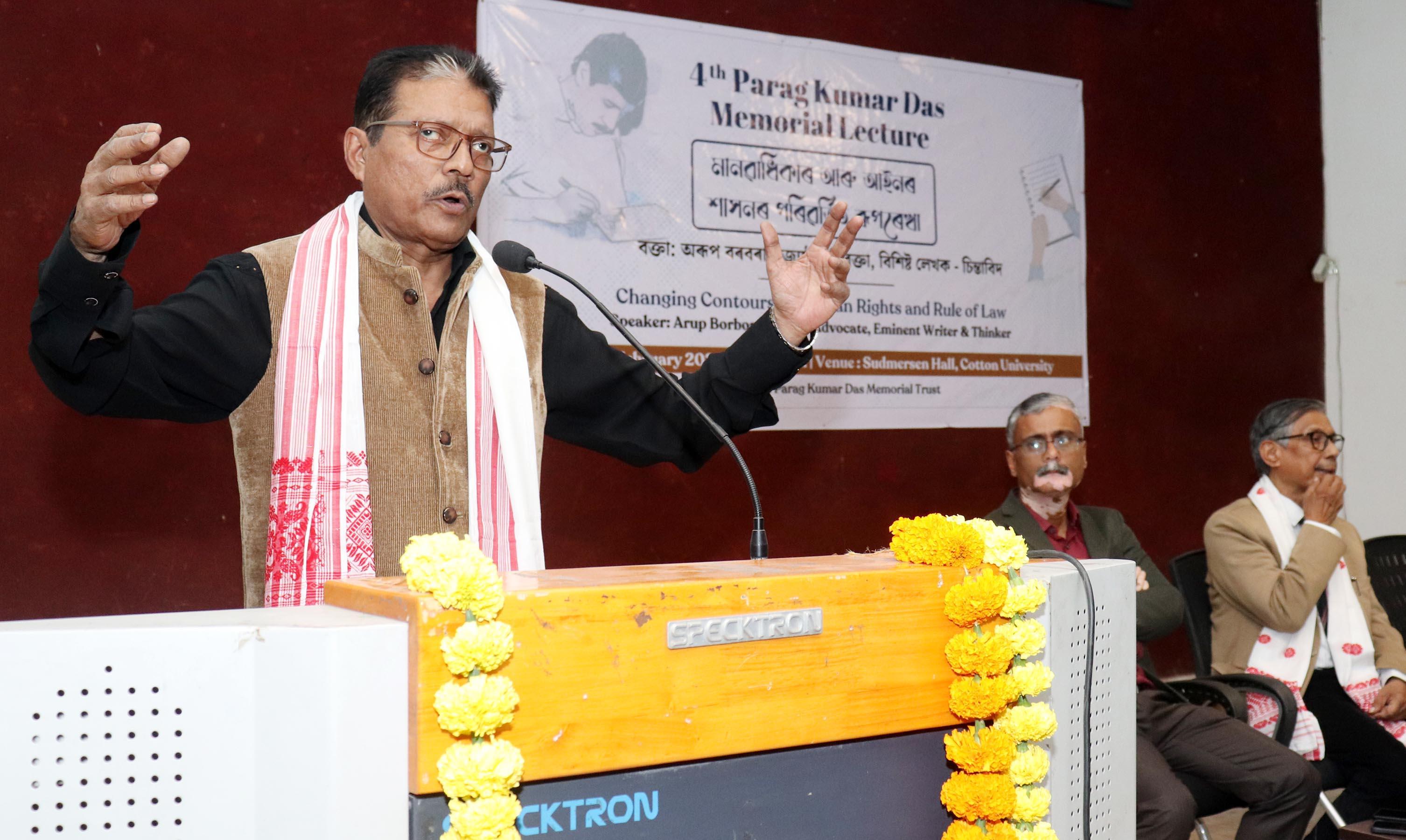
In a thought-provoking lecture on Monday, invited speaker Senior Advocate and Eminent Writer Arup Borbora explored the evolving landscape of human rights and the rule of law, emphasizing their importance in shaping modern societies. Reflecting on historical developments and contemporary challenges, Borbora highlighted the significance of safeguarding civil, political, and economic rights, particularly in the context of Assam and India. He underscored the ongoing need for reform and the preservation of democratic principles amid growing concerns over human rights violations and governance.
4th PARAG KUMAR DAS MEMORIAL LECTURE
Speaker: ARUP BORBORA: Senior Advocate, Eminent Writer and Thinker
CHANGING CONTOURS OF HUMAN RIGHTS & RULE OF LAW
Since the topic of the lecture embraces two important concepts human rights and rule of law, it would be proper for me to delve into the meanings, connotations, perspectives and ambits in respect of both. In addition to brief narration of the development of these two ideas in the modern times, I would try to discuss as to how, by whom and in what manner they are infringed.
There was no institutional or organized concept of human rights in the medieval world. Many kings and emperors ruled over different regions of the world with disquieting arbitrariness underpinned by whims and fancies. Subjugation of the concerned populace by mighty rulers was virtually all pervasive and the same was mostly accepted or acquiesced by the people. Any person protesting against any form of subjugation was essentially held as traitor and was either imprisoned or killed by the rulers.
It was only from about late eighteenth century that organized and democratically effective movement for, what is called, civil liberties started coming to the fore mainly in the ultra-colonial nations like England, France, Spain and Portugal. The liberal section of French people started to vouch for liberty, equality and justice in the late 18th century. In 1898, the `League of Rights of Man' was founded with a membership of over 1,60,000 and an annual Congress of the League was held every year. A French Association laid down the principles of liberty, equality and justice in the `Declarations of the Rights of Man' of 1789 and 1793. The League intervened on every occasion where an act of injustice was perpetrated against individuals, associations and the people. Its action consisted in appeal to public conscience, presentations to public authorities, petitions to Parliament, publication of literature and holding conferences and demonstrations.
In fact, the concept of civil rights in any clear form arose first out of the French Revolution. It originated in Bastille where countless men were subjected to unbearable torture and suffering. Thus, there evolved a basic essence of the principle viz. Men are born to live free and equal before law". This concept civil liberty, first rolled by the French League eventually led to the terminology of 'human rights'. Of course the concept of civil rights is wider and is extended to and interspersed with the parallel concept of human rights.
It was after the World War-II that the intrinsic postulations, ambit and grandeur of 'human rights' evolved all over the world and nationalities. In fact, in any mode, method or system of governance by modern nations, the phrase human rights came to be embodied in codified or covenanted forms. After World War-II, the initial 'League of Nations' having been rendered non-starter, the 'United Nations' was established as a global institutional platform for upholding, promoting and protecting human rights of every individual irrespective of nationality. On 10th December, 1948, the General Assembly of the United Nations (UN) adopted and proclaimed the historic `Universal Declaration of Human Rights'. Ever since its first proclamation, almost 200 countries endorsed this till date. India is one to endorse, meaning thereby that as a member country, its government will abide by the 1948 covenants as subsequently expanded by the UN from time to time.
In a simpler way, these Declarations on Human Rights can be broadly classified in two parts: ‑
- International Covenant on Civil and Political Rights: (1966)
- International Covenants on Economic, Social & Cultural Rights. (1966) with Covenant on Elimination of all Forms of Racial Discrimination (1966).
In the collective and community wise perspectives, the covenants and their postulations also underline 'Peoples' right to Self-determination'. Article 1, item 1 is as follows: -
"All people have the right of self-determination. By virtue of that right they freely determine their political status and freely pursue their economic, social and cultural development." Thus, if the underlying concept of self-determination of people as a group is not secured, then the basic right of each human being in the community will not be secured.
Hence, it will be a very narrow perception if we confine ourselves to the cause of life, liberty of every individual while talking about individual rights. It is basically the preservation, existence and unhindered growth and existence of both civil, political, economic and cultural rights of the community that covers every individual's personal human rights too. The rights of every individual is always inextricably interspersed with the macro level of human rights of the community as a whole. Of course, any individual's subjugation and atrocities inflicted upon is bound to be concern for his or her communities' subjugation and civil-criminal false indictments by the rulers, without basis or by way of any arbitrary state action!
The evolution of human rights and the rule of law reflects humanity's ongoing pursuit of justice, fairness and dignity. While significant progress has been made, challenges remain in ensuring equal rights for all, particularly in authoritarian regimes, conflict zones, and areas affected by economic inequality. India's journey in human rights and the rule of law has been shaped by historical, colonial and post-independence developments. Assam, with its unique socio-political context, has played a crucial role in this evolution, especially regarding indigenous rights, migration issues and autonomy movements.
Human rights and the rule of law in India including Assam have faced various challenges over the years.It has been a persistently ticklish issue in the state. While India is a democratic country with a robust legal framework to protect human rights, there have been allegations of violations, particularly concerning freedom of speech, minority rights, police actions and government policies.
Now, coming to the phraseology of 'rule of law', it stands against any form of anarchy and it pertains to any reasonably decent governance of any country where everything is governed and guided as per law. The word —rule - means an established standard, guide or regulation, a principle set up by authority prescribing or directing action or forbearance! It is always guided by the rules of a legislative body, public offices, courts established under law and of course, by ethics of good governance. Rule of law basically means rule against perpetuities. Rule of law is the principle that all individuals, institutions and governments are subject to and accountable under the law. It ensures that laws are applied fairly, consistently and without bias, protecting individual rights and preventing abuse of power. It underlines the supremacy of law and its intended application and definitely not its misplaced application or abuse by the ruling dispensations. It has to preserve the rights and privileges of the citizens rather than subjecting them to exploitation, miseries and discrimination. It must be applicable to the rulers and the ruled alike.
The constitution is the basic document for any sovereign nation like India which outlines the basic features and prescribes the basic tenets for the parliament, and various legislatures, the executive and all other constitutional institutions, undertaking and overlooking the various exercises relatable to various functional fields. While the power to make laws vests with the legislatures, they are however, bound to be in accordance with the constitution and preservation of the various fundamental, constitutional rights of the citizens. There have been good and bad laws. It is the Supreme Court and the various High Courts which can always judicially scrutinize the validity of any legislation and in given cases, can declare any law as invalid i.e. bad law whenever such laws are found to be in violation of the fundamental vis-à-vis constitutional rights of the people.
Now, the fundamental rights under the Indian constitution, clearly specifies the rights of citizens to equality, right to life and liberty, right to expression and movement, right against any racial, class or religious discrimination. These are virtually in consonance with the broader human rights movement in the Universal Declaration of Human Rights, 1948. India being a signatory to this UN Declaration is bound to follow various types of human rights as enumerated in Articles 1 to 29 of the 1948 Declaration, in all legislations and codes governing various fields in the country to protect and preserve all such rights of the people and not otherwise.
Despite constitutional guarantees, India and more particularly Assam has witnessed innumerous instances of human rights violation and challenges to the rule of law. These infringements stem from factors like security concerns, political instability, ethnic conflicts and systematic inefficiencies.
Now, let me proceed to discuss the most crucial word of the topic for today's lecture of mine. Yes, this is about rough contours of human rights and rule of law! Here again drawing reference to incidents of rights violation all over the world would be a limitless exercise to be undertaken in a Memorial Lecture. Better it would be, if I limit my speech to the Indian perspective with special reference to Assam so far as flagrant infringements and aberrations of human rights and rule of law are concerned. Obviously, I leave aside infringements during wars between two or more countries including the ones involving India.
In a sense, infringement of human rights is essentially against the rule of law in any civilized and democratic country. They are basically against the constitutional and democratic basic principles which govern and guide a country like India. The extent of individual rights and privileges for people governed under super-centric countries like North Korea, China, Russia, the Emirates are different from that of open democracies like America, UK, India etc. which are strictly governed by their respective written or unwritten constitutions and will entail a comparative study of the basic features of constitutions of other developed and developing democratic nations of all the continents of the world.
Well, the political leaders, the ruling Government of India and their proponents have always described India as the largest democracy in the world. To me, such a claim is absolutely in the quantitative sense and not necessarily in true qualitative sense. India, with the highest population figure as against that of all other countries including China, may be the largest in terms of magnitude of electoral franchise by the people. But it never means that just because of the highest population, it is the best democracy in the world.
One thing is for sure. Although the framers of the Indian Constitution visualized a meaningful yet liberal and quasi-federal democratic nation while presenting the Constitution to the people of independent India, its value based applicability and adherence came to be diluted and even transgressed gradually. In fact during an eighteen months of national emergency in 1975-76, and thereafter, especially during the last one and a half decade, the Indian rulers have been making a mockery of various constitutional tenets and juxtaposed them by sheer autocratic, super-centric exercises of both executive and legislative powers to the detriment of peoples' collective and individual human rights and rule of law.
Broadly, the human rights violations in India are both with regard to
1. Civil and political rights
2. Social, economic &cultural rights. In addition to individual or groups' human rights these are always the collective rights whereby every individual is recognized and treated as a participative stakeholder in the country or the states of India.
The present ruling dispensation in India and constituent states like Assam have to a great extent curtailed various civil and political rights (except the voting rights in elections), in a systematic autocratic design. The examples are galore. A few of them are —
- A totally disturbing electioneering followed by unsettling and even
overpowering many elected governments by deceitful exercise of horse-trading, and enticed floor crossing of elected representatives through threats and allurements resulting in formation of a ruling Government against the mandates given by the voters. Such mischiefs defy the true political rights of the electors. - Bizarre gubernatorial appointments made by the ruling party in power whereby batches of incumbents having direct nexus with the ruling dispensation are allowed to occupy the governor's palatial houses as the second chamber for all political gaming for the ruling party. These governors nowadays decide crucial issues such as formation of a state government in a hung mandate or approving or withholding a genuine bill by an opposition ruled state.
- Using various hitherto autonomous crucial organizations like the CBI (Central Bureau of Investigation), ED (Enforcement Directorate) and different State Vigilance Cells against the political rivals at the slightest pretext and at opportune and politically suitable moments.
- A timid and toothless Election Commission of India and the very questionable manner in which the current Election Commission of India was constituted even against the judicial suggestions made in this regard by the Supreme Court of India. This is against the spirit of fair elections envisaged by the constitution.
- The most dangerous and autocratic governmental hegemony for the last one and a half decade is about religious discrimination and contemptuous treatment meted out to the Muslims in India. Till the other day, it was a hidden agenda of the present government to isolate, discriminate the Muslims living in India since before the partition of the country. But of late, the same has assumed the open yet non-statutory action plan of isolating the Muslims as if they are the hindrance for modern Indian existence. India for several hundred years has evolved as a country of people with various castes and religions living side by side. This basically is the glorious history of India. This cannot be re-written by omitting anything that existed and bore historical existence of the Muslims, their faith, their places of worship, the monuments and structures and names of villages, townships, public roads etc. One coming to power in the 21st Century India, just cannot re-write the last seven hundred years' history by merely changing the names of cities, townships, streets and railway stations! Any future non-BJP government will be likely to put such names to their original identities. Well, this is not the way of putting in place the manifestations of good governance!
All these relate to the direct or indirect violation, insult and infringements of collective socio-cultural religious rights of a multi-religious nation's 140 crore population at the hands of a camouflaged yet fundamentalist ruling class of India as is existing today.
vi. To talk about the collective economic rights of the Indian citizens and the socialist fabric of the Indian Constitution, the national wealth and resources belonging to the 140 crore citizens have been allowed by the present Central Government to fill/load the coffers of a handful of corporate entities in various vital public sectors as service providers and extractor of mineral reservoirs. This led to a situation where 70% of national wealth is now concentrated in the hands of less than 1% wealthiest persons leaving only the remaining 30% of national wealth to the common people of which 60% are living in the Below Poverty Line (BPL)! This is all about violation of the collective economic rights of masses in India.
As against all such collective basic human rights violations, the aberrations and infringement of day to day individual or small or medium community wise rights violations actually and with all imports and purports depict India via-a-vis some of the states such as Assam as a repressive, autocratic super centric and anti-people ruling entities. Let me explain how both in India's vis-à-vis Assam's scenario of widespread violation of human rights and defiance of the rule of law have been accentuated and perpetuated to the miseries, exploitation of innocent citizens:‑
For the Indian and more particularly the Assamese populace, the phrase human rights were hardly in use or propagated till the fag end of the loth Century, if not earlier. During national emergency in 1975-77, when thousands of political activists and trade unionists were booked under the preventive detention laws like MISA (Maintenance of Internal Security Act) and DIR (Defense of India Rules), the opposition spokespersons termed this as an autocratic and repressive onslaught against the people but the phrase human rights and their violations were hardly used as popular slogan for mass mobilization, awareness campaign and agitation. Even during the six yearlong Assam Movement in which more than 85o persons were killed by the state machineries, people called it a repressive state action. But yet, the terminology of human rights violation was not in vogue. In fact, it was in the early 1990's, when in the name of combating the ULFA, the police and the Indian army resorted to indiscriminate arrest, detention, custodial killings of innocent citizens in the garb of some military operations that the terminology of human rights (Manabadhikar) was put to popular domain by some activists including journalists like Parag Kumar Das in Assam. This awareness led to the formation of organized human rights groups and organizations for the first time in Assam.
Barring a handful of draconian and repressive laws (Acts), most of the statutes enacted after independence by Indian ruling dispensation apparently contain provisions commensurate with democratic principles and fair procedures! Be it various penal laws, the primary one being the IPC (Indian Penal Code,1860) now replaced by BNS (Bharatiya Nyaya Samhita, 2023) and the corresponding criminal procedure codes.
Some laws, at their threshold, are not in consonance with the basic principles of civil rights or human rights, as covenanted by the Universal Declaration of Human Rights. For example, the preventive detention laws which empowers the state to detain and put in jail any person merely on apprehension that he/she may indulge in activities detrimental to the security of state, public order or law and order. This is based on apprehension/presumption of the state against the person even without any track record of criminality. These laws have been used for decades mostly against political critics and activists, academicians, writers, journalists and even lawyers! Indian preventive detention laws as against the judicial trial based system of imprisonment is one of the inhuman legislations not to be found in any truly democratic nations elsewhere in today's world.
When the draconian repressive and exploitative and yet 'valid' Indian Laws including some penal laws pave the way for their unhumanistic state action, they can still be termed as source violation of human rights of many forms and parameters.
Pertinently, both the per-se draconian laws and the normal penal laws have long resulted in massive human rights violation and been contrary to rule of law because of one simple phenomenon. There is no dearth of Central and State statutes governing the field of criminality and peoples' rights and privileges. Unholy State actions over the decades have mostly because of the mis-application or abusive application of the laws rather than their proper applications in true earnestness by the ruling machineries. Apart from the Preventive laws, there have been some draconian penal laws, the application or rather misapplication of which resulted in massive and widespread human rights violations in Assam too.
No one also can overlook the hard fact over the decades that in many states like Assam, violation of human rights has also been perpetuated by non-state actors even though there may be failure of on the part of the respective Governments to save people from attacks by such non-state actors.
First, let's see how the preventive detention laws have been blatantly used as a political tool to repress and gag the voices of democratic critics both during the emergency (1975-1977) in the entire country and even thereafter. Even without any internal emergency, hundreds were detained under the NSA during the six-year period of the Assam Movement. That all such detentions were results of misapplication of even the preventive law, was amply proved by the fact that more than 9o% of such detentions were judicially held to be illegal and unsustainable by the High Court during the relevant period.
Then came the TADA (Terrorists & Disruptive Activities Prevention Act, 1987) under which several thousand people were arrested in 1990-1992 in Assam, in the name of combating the ULFA. Not even 1% of the arrested persons under TADA could be even chargesheeted before the appropriate Court, let alone convictions after trial.
Assam has been under the Armed Forces Special Powers Act (AFSPA), 1958 for decades allowing the army to act with near total impunity. This act has been always backed by another repressive statute viz. The Assam Disturbed Areas Act, 1955.There have been numerous reports of fake encounters, disappearances and sexual violence by security forces not to overlook the custodial violence and police brutality resulting in custodial deaths despite Supreme Court guidelines.Ethnic clashes and displacement cannot be ignored too.
Another colonial provision regarding detaining and jailing non-combatant civilians and democratic critics in the name of sedition persisted till the other day and still in existence in camouflaged avatar under the latest BNS. Similarly, the penal provisions of 'staging war against the nation' have been non-ostensibly applied for decades against democratic critics of ruling dispensation. In a most autocratic and vindictive political consideration, consecutive governments in India including Assam resorted to indiscriminate applications of statutory and executive powers to democratic critics that includes political opponents, journalists, lawyers, academicians and innocent citizens for decades!
The innumerous and blatant violation of human rights vis-a-vis rule of law in the last few decades under consecutive rulers have resulted in following categories of incidents - all against the rule of law and the prevailing statutes :‑
- Search and seizure by law enforcing agencies at odd hours in private households even without a search warrant issued by a Court of Law.
- Custodial torture and even death in innumerous instances many of which were declared as abusive state actions by the Courts where exemplary costs were imposed on state organizations with persons in uniform.
- In recent years, fake encounters have assumed such a magnitude in Assam that very recently the Supreme Court sought for an explanation with tangible queries from the present state government.
- Use of bulldozers have, of late, been a latest vindictive methodology adopted by state governments in U.P., Maharashtra, Assam, etc. in respect of the premises of any accused. The Supreme Court, having found fault with it, has given very serious observations against each such autocratic and vengeful state action.
- Gagging of democratic critics, journalists, academicians has been the most volatile and violative infringements of both human rights and the spirit and essence of rule of law in India, particularly in last ten to fifteen years. Free and fearless journalistic exercises in last about a few decades have been allegedly deprecated and silenced through overt or covert State actions as widely alleged by their own fraternity. Right from Gauri Lankesh to the Kashmiri editor of local newspaper/journals fell victim to this.
- Even the centuries old food habits by non-Hindu population of India have been abusively interfered with by a Hindutva agenda culminating into bizarre legislations with regard to cow slaughter/ purchase and sale of cows. Well, some of the latest bizarre enactments in this regard are based on fundamentalist religious agendas rather than / as opposed to the centuries old secular and customary civilizational existence of Indian populace of diverse faiths and customs. These precisely violate the human and customary rights and also rule of law for a diverse and multi-religious, multi-customary tradition.
G. Even the overall inhuman conditions of Indian jails including those in Assam depict an absolutely inhuman and uncivilized/unlivable conditions of all jail inmates ranging from convicts, under-trial and political prisoners.
Infringement of human rights also include: ‑
- Custodial violence and police brutality such as extrajudicial killings, torture and deaths in police custody continues despite legal safeguards.
- Freedom of speech and internet restrictions which include arbitrary arrests under sedition laws and the Unlawful Activities (Prevention) Act (UAPA) and internet shutdowns specially in Kashmir and during protests (e.g. CAA-NRC protests, farmers' protests) being manifest infringement on digital rights, have raised concerns.
- Communal and caste based violence.
- Gender based violence.
- Forced displacement and Environmental Rights which include large scale evictions for infrastructure projects without proper rehabilitation violate housing rights. Also industrial projects causing pollution and ecological damage impact that impact marginalized communities.
The country's, particularly Assam's experience with human rights and the rule of law reflects broader national challenges — balancing security, migration, and indigenous rights within a democratic framework. While legal protection exists, ensuring their fair implementation remains a work in progress.
While security and governance challenges exist, addressing human rights violations and ensuring the rule of law requires:
- Fair and transparent citizenship verification processes.
- Reform of detention and tribunal systems.
- Accountability for police excesses.
- Protection of indigenous and minority rights.
To conclude, the incidents/phenomena of violation of human rights both individual and collective have increased multifold in India including Assam in the recent years. So also, the defiance of rule of law in vast socio-political vis-à-vis other important ingredients for a true democracy, like freedom of expression and peoples' right to question governmental executive misadventures and misrules.
It is basically therefore, a challenging task for rational, secular and democratic populace, political or apolitical entities and the younger generation in particular to create awareness about preservation of human rights and the rule of law and the will to resist any violation at any level thereof.
--
- 10081 reads





Add new comment