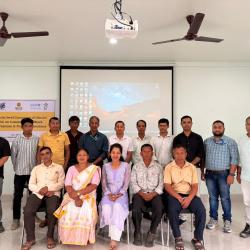
Various aspects of impacts of climate change on the water resources of the NE region as well as results from contemporary research relevant to the region and especially the Upper Brahmaputra basin area were in focus in a one day workshop on ‘Adapting to Climate Change Impacts on Water in the Upper Brahmaputra basin in Northeast India’ that was held at the Shankardev Sabha Kakhya of the Dibrugarh Hanumanbux Surajmal Kanoi (DHSK) College on November 17th, 2012.
The workshop was organised by Aaranyak (Guwahati), premier environmental research and advocacy organisation of India in collaboration with the DHSK College (Dibrugarh) with financial support from the India Water Partnership (New Delhi), according to Press communiqué issued by Aaranyak.
The workshop started with Dr Sanchita Barua, Associate Professor of Department of Zoology of DHSK College welcoming the participants after which Dr. Rajee Konwarh, Principal DHSK College inaugurated the workshop with her inaugural speech.
Dr. Partha J Das, Programme Head of the ‘Water, Climate and Hazard Programme’ of Aaranyak provided the background and the context of the workshop in his presentation. He informed the audience that this workshop was a part of the three workshop series that Aaranyak is organising for the Global Water Partnership-India on different aspects of water issues of Assam. He revealed that Aaranyak is having plans to collaborate with some educational institutions and civil society organisations of the upper Assam region to promote awareness and research on climate change impact, water induced hazards and water governance.
The technical session began with a presentation of Prof. Chandan Mahanta of IIT-Guwahati. Prof Mahanta elaborated on various aspects of impacts of climate change on the water resources of the NE region and highlighted various results from contemporary research relevant to the northeast India and especially the Upper Brahmaputra basin area. He also suggested various adaptation measures to be taken up to deal with the changes and impacts triggered by climate change.
Prof. J.N. Sarma of Department of Geology, Dibrugarh University spoke at length on water resources of NE region, focussing on the Brahmaputra basin. Prof. S.P. Biswas, Department of Life Sciences, Dibrugarh University pondered on the impact of climate change on aquatic biodiversity of eastern Brahmaputra basin, in Assam especially on the fish fauna and how peoples’ livelihoods are getting affected.
Mr. Rajeet Dutta, District Agriculture Officer of Dibrugarh demonstrated to the audience how the agriculture sector of the region has been affected by erratic rainfall and rising temperature concluding that climate change can also lead to gains in crop productivity on some occasions.
Dr. Tullika Goswami Mahanta, of the Assam Medical College, Dibrugarh illustrated about the proliferation of various vector borne diseases like dengue, malaria, black fever, as well as different water borne diseases as a result of possible impact of climate change.
The post lunch session was dedicated to an open house discussion and interaction with the resource persons on various aspects of climate change impact on the water sector in general and people’s lives and livelihoods in particular. Both the resource persons and the participants suggested various strategies of adaptations and coping to the changes an impacts induced by climate change in the eastern Brahmaputra basin region.
Dr. (Mrs.) Arati B. Barua a US based engineer and a columnist in Assamese news paper addressed the audience as a special guest. She dwelt upon a range of issues such as irregular rainfall, increasing river sedimentation to impacts of large river dams which are becoming complicated due to climate change. She emphasised on reviving traditional ways of life to deal with environmental changes. The workshop ended with a vote of thanks by Dr. Partha J Das and Sanchita barua.
If magh bihu comes can community fishing be far behind? From early in the morning people in several places across the state are landing in community fishing a few hours before the feasting festival. Armed with the various traditional weapons, people, mostly, living near the rivers and water bodies are engaged in fishing.“It is our tradition of fishing on Uruka day. I have a good catch of fish half an hour after I landed in this water body. I need no longer to stay here,” Jiten Barman told Assam Times in Nalbari who joined the fishing early in the morning.Tridip Das a local resident of Jalukbari area is equally happy after he caught a fish during the community fishing in deepor beel, a well...
Braving a biting chill, the entire state is soaked in Magh bihu festivity on Wednesday. Every household is busy with the last minute preparations a day before the much vaunted festival of feast.Today is uruka, the day of feast festival. Shops and markets are teeming with people for last minute shopping for the evening feast. Fish, meat and vegetables are flooding in the markets from early in the morning. Apart from feast a series of cultural programmes are lined up on the occasion.After the whole night celebration, the bihu would take place on Thursday morning by liting up the wooden made meji to offer puja to the god of fire. Governor PB Acharya, chief minister Tarun Gogoi along with many...
Only a day is left for Magh Bihu, the much vaunted festival of feast and merriment. But soaring prices seem to have embittered the real taste of the festival. Shops and markets are teeming with the people for bihu shopping. But a sudden price hike makes it difficult for the common to buy the commodities in the shops and markets.“Beaten rice is available in the markets. But the price stands at Rs 60 per kg. We the common people can hardly afford cream. Price of curd, pulse, coconut and molasses are also going up,” said Ananta Saikia in Ganeshguri.Jina Devi, a housewife in Beltola told Assam Times that a tight purse has not allowed them to buy more commodities in the market. She said, “We...
The North East Research and Social Work Networking (NERSWN), an NGO of Kokrajhar base observes its 10th foundation day with two day long progrmme from Monday at Gwjwn Dera NERSWN Complex, Chnandrapara in Kokrajhar. Deputy Commissioner Themeswar Malakar inaugurated the Children’ Mela where the different types of Science Exhibition, Magic Show, Sports, Literarily and cultural by the student children displayed. Children from different schools of lower Assam participated and displayed their talent in the field of science, arts, Technologies etc.A Seminar on “Civil Society Space in Promoting peace and Reconciliation in Zone of Conflict” was also organized the seminar was...
Senior bureacrate Himanshu Sekhar Das took oath as chief commissioner of RTI on Monday. Governor JB Patnaik administered Das the oath of office and secrecy at a brief fuction at the Raj Bhawan in the morning. Chief Minister Tarun Gogoi was also present in the function.
The Assam Government will confer Sukapha award to noted lawyer KN Saikia on Tuesday. The former Supreme Court judge will receive the award from chief minister Tarun Gogoi at a function at Rabindra Bhawan in the afternoon.
A total of 702 tribal families were given away land pattas, covering 300 bighas of forest land under the Scheduled Tribes and Other Traditional Forest Dwellers (Recognition of Forest Rights) Act, 2006 under Chirang Forest Division at a function held at Dhunabari Lower Primary school in Chirang Tuesday. BTC chief Hagrama Mohilary handed over the papers in the presence of BTC Deputy Chief Kampa Borgoyary, Deputy Commissioner, Chirang, Virendra Singh Mittal, DFO, Chirang, Subash Chandra Brahma and Project Director Deba Kumar Kalita. BTC Speaker Paniram Brahma and former Transport Minister, Government of Assam, Chandan Brahma were also present in the meeting.
Prime Minister Dr Manmohan Singh put in his papers before the President on Saturday. Dr Singh, who represents Assam in the Rajya Sabha, rushed to president Pranab Mukherjee at the Rashtrapati Bhawan at 12.30 in the afternoon where he tendered his resignation letters. Mukherjee accepted his letter and requested Dr Singh to continue the office till the next candidate takes over as the prime minister. Dr Singh, a professor and economist and former RBI governor was inducted in the Narasimha Rao cabinet as finance minister in 1991. In 1992, he was elected to the Rajya Sabha from Assam. Later in 20 04, when the party regained power he was sworn in as prime minister. He continued the office when...
Chief minister Tarun Gogoi said that he would quit taking moral responsibility of his party's dismal show in the Lok Sabha polls. Talking to Assamtimes at his Koinadhara residence on Friday, a visibly Gogoi said that he would send his letter to Sonia Gandhi seeking her consent. Same this was what APCC president Bhubneswar Kalita said after his party was trailing behind BJP in 8 seats.







Add new comment