Skip to content Skip to navigation

Remarkable turnaround: No Amur falcon hunted in Doyang roosting site this season

Over a month since the migratory Amur falcons’ arrival in Nagaland, not a single bird has been killed in their roosting site in Doyang Reservoir, reports the Amur Falcon Protection Squad (AFPS) – a group of former hunters, who along with the Nagaland Forest Department staff are patrolling these areas to keep the birds safe.  

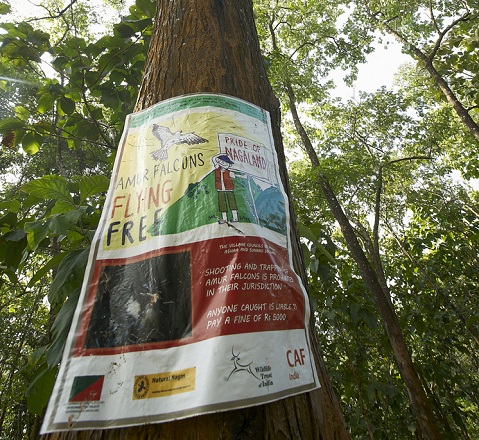
This remarkable turnaround - considering tens of thousands of falcons reportedly hunted last year - was brought about through joint initiatives implemented by the local communities, the Forest Department and NGOs including the Natural Nagas and Wildlife Trust of India (WTI). This includes daily patrol by the Forest Department staff and AFPS along the Doyang reservoir.

“Nagaland is a safe haven for Amur falcons,” declared T Lotha, Chief Wildlife Warden, Nagaland. “This year too, millions have come in the Doyang roosting area, and we have taken appropriate steps to ensure that no killing takes place, working together with various agencies – the local communities, the police, administration, Forest Department and NGOs. And we succeeded.”

WTI and Natural Nagas have been working with the local communities and the Forest Department since November last year, through a sustained Rapid Action Project supported by CAF-India Limited, to help save the falcons.

“Our first initiative was to spread awareness among the local communities on the issue,” said Sunil Kyarong, Regional Head – WTI. “For months, beginning in November last year, numerous meetings and consultations were held with the people of Pangti, Ashaa and Sungro   - three villages around the Reservoir, where the birds come to roost.”

These discussions culminated in signing of an agreement between the village councils, Natural Nagas and WTI, in August this year. The village councils accordingly declared hunting of Amur falcons illegal in their jurisdiction, imposing a fine of 5000 rupees for offenders. The creation of the Amur Falcon Protection Squad subsequently followed to assist the Forest Department and the village councils to ensure effective enforcement. 

“What we are doing here is being done right at the grass roots, interacting with the people here including hunters and the village council members who are also the representatives of respective groups of public, and in coordination with the Forest Department. The benefits are being given to people who need it and who have supported the conservation of the falcons. This way, we have created a successful model, which we are sure will be replicated in other areas within the state too,” said Ronchamo Shitiri, Chairman of the Pangti village council.

“The villagers are sacrificing their land for the falcons, so we are working to extend the livelihood support,” added Lotha. “This will not happen overnight, as this requires proper planning to ensure that this is sustainable as the birds will return again, and we need to arrange for resources. Once this season is over, we will work on analysing the villages’ strengths and weaknesses and continue our efforts to improve the economic status of the local people, so that the falcons are safe in the coming years too.”
Add new comment

Other Contents by Author

Elephant Health Camp jointly conducted by IFAW-WTI and Manas National Park Authority inside  Manas National Park (MNP) on Wednesday, 29 January 2014. All together thirty nine (39) departmental captive elephants engaged in wildlife monitoring and patrolling duty were jointly investigated by the specialised veterinary team of IFAW-WTI along with veterinary team of Manas National Park.
Two sub-adult rhinos, Gopal and Hari have been shifted to Manas National Park from the Centre for Wildlife Rehabilitation and Conservation (CWRC), Kaziranga today. The rhinos will be released in the wild following a period of in situ acclimatisation in the UNESCO World Heritage Site. They follow the five rhinos - three females and two males that were hand-reared at CWRC and rehabilitated in Manas since 2006; the three females gave birth last year.CWRC is a wildlife rehabilitation facility jointly run by Assam Forest Department and International Fund for Animal Welfare - Wildlife Trust of India (IFAW-WTI).The two rhinos moved today - Gopal and Hari, both male, were less than a month old when...
Mayodia model Village popularly known as Tiwari Gaon which is far away from regular power connectivity is empowered with solar energy equipments by Wildlife Trust of India (WTI) in collaboration with the Department of Environment & Forest, Arunachal Pradesh with support from Europaeische Tierschutzstftung (ETS) on Sunday. This facility will reduce the long term power and electricity crisis faced by the villagers. This is for the first time that an NGO like WTI is providing the solar equipments to a model village in the vicinity of Mehao Wildlife Sanctuary (Mehao WLS) in Arunachal Pradesh in India.The beneficiaries received the solar equipment which was a total solar energy based...
The International Fund for Animal Welfare - Wildlife Trust of India (IFAW-WTI) in collaboration with Assam Forest Department is organising a four day ‘Disaster Relief Workshop and ERN meet’ for animal rescuers and rehabilitators from across the country, beginning today.  “Preparation, and quick and coordinated action are key priorities to save lives during disasters, whether for humans or animals,” said Shannon Walajtys, Animal Rescue Manager, Disaster Response & Risk Reduction (DRRR), IFAW. “This workshop will not just train rehabilitators individually but will also strengthen the fraternity to mobilise coordinated action during disasters,”- she also added. The ERN...
Maheshwar Basumatary aka Ontai, an animal keeper with the International Fund for Animal Welfare - Wildlife Trust of India (IFAW-WTI)’s Greater Manas Conservation Project has been honoured with this year’s prestigious Sanctuary Asia Wildlife Service Award for his contributions to conservation in Bodoland. (The award will be given to him this evening at an event in Mumbai.)Born in the autonomous district of Bodoland in Assam, Ontai grew up amidst political unrest that afflicted the district till early 2000s. He got married at an early age of 19 without any job in hand. Soon after, unfortunately he lost his way and fell in company with the wrong crowd helping the poachers as trackers.“Those...
As part of the International Fund for Animal Welfare-Wildlife Trust of India (IFAW-WTI) Animal Action Education Programme, the young boys and girls of Kahitama High School, Bahbari High School and Manas M E School joined their teachers, local artists and members of theDepartment of Education, Bodoland Territorial Council (BTC) as they made their school walls explode with colour while painting their favourite animals all over them. The objective- to spread awareness on the plight of wildlife in Manas National Park. Already three schools have been covered under the campaign.The International Fund for Animal Welfare's Animal Action Education programme (IFAW-AAE) is operational in 18 countries...
Continuing efforts of conserving the last of India’s apes, the International Fund for Animal Welfare-Wildlife Trust of India (IFAW-WTI) team in collaboration with the Arunachal Pradesh State Forest Department successfully captured and released two eastern hoolock gibbons, over a two-day period, from the village of Dello to a safer and more suitable habitat in the Mehao WIldlife Sanctuary.Ipra Mekola, Arunachal Pradesh State Wildlife Advisory Member, who was part of the release team yesterday, remarked on the project’s efforts saying “Gibbons essentially live in strong familial units. Capturing every family is extremely difficult to begin with and the more complex the terrain, the more...
Under the IFAW: WTI Wildlife Crime Prevention Training programme, a total of 100frontline forest staff of Manas National Park, Manas Reserve Forest, Kachugaon Reserve Forest and Ripu Reserve Forest in Greater Manas are targeted to be trained and equipped in partnership with the Assam Forest Department and Bodoland Territorial Council (BTC). The first batch of 32 trainees among the four batches from all the three ranges of Manas National Park is undergoing training from Sunday.Greater Manas is a critical wildlife habitat along the Indo-Bhutan border in Bodoland, Assam, supporting a wide range of flora and fauna including the endangered Asian elephant, Royal Bengal tiger, greater one-horned...
The Wildlife Conservation Division of Bhutan along with the International Fund for Animal Welfare – Wildlife Trust of India (IFAW-WTI) have launched a month-long training for around 450 forest rangers for effective wildlife crime prevention in the landlocked country.The skills learned will help the rangers deal with a wide range of issues to protect the country’s natural heritage including the tiger. Each staff will also be equipped with field kit sets (rucksack, winter jacket, rainsuit, water bottle, cap, sleeping bag) to help them in their daily duties, including specially-made kits for frontline staff working 5000 masl protecting the rare snow leopards.Sonam Wangchuk, Chief of the...
Three smooth-coated otter pups rescued from the floods in Kaziranga National Park last week are currently being hand-reared at the Centre for Wildlife Rehabilitation and Conservation (CWRC).The pups, all male, yet to open their eyes, were found floating on hyacinth leaves by local people in Mahpora (Dagaon) from the fringes of the National Park, last Friday.“The people apparently found the pups while they were fishing. They handed over the pups to the Forest Department staff, who called us to collect them as they could not locate the mother or their den,” said Dr Anjan Talukdar, International Fund for Animal Welfare – Wildlife Trust of India (IFAW-WTI) veterinarian.The pups are being bottle...