

Beyond Health Camps: Rethinking Medical Relief in Flood-Ravaged Assam
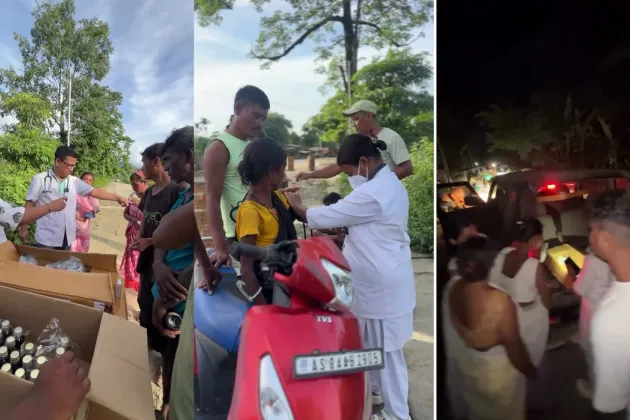

Health camps after Assam's recurring floods have become a familiar ritual. With lakhs of people affected and hundreds of villages inundated during the latest wave of flooding, Sivasagar has once again found itself at the centre of a humanitarian crisis. Born out of the generosity of groups of doctors, clubs, hospitals, institutions and philanthropic individuals, day-long medical camps have appeared across the flood-hit region.
As medical students in the late 1980s and early 1990s, we too were enthusiastic participants, readily organising or volunteering our services. Having taken part in many such camps since then, and having watched the same pattern repeat over the years, I have come to believe that the real story of flood-related illness in Assam is quieter, less photogenic and largely overlooked by this model of relief.
Despite the increase in the number of doctors, advances in medical knowledge and skills, improved accessibility, and the expansion of healthcare facilities over the decades, one is compelled to ask whether the ritual of health camps has itself become stagnant. Teams of doctors, makeshift pandals, banners, a few hundred consultations over several hours, free medicines, photographs—and then departure.
What Floods Actually Do to Health — and the Limits of One-Day Camps
The popular imagination of disaster medicine is dominated by trauma, emergencies, crush injuries and dramatic rescues. In reality, many patients who attend flood relief camps are not suffering from injuries at all. They are people whose chronic illnesses have quietly worsened.
A hypertensive patient whose medicines were swept away. A diabetic who has gone days without insulin. An asthmatic struggling in damp, mould-ridden shelters. A pregnant woman who has missed her antenatal check-up. An elderly patient taking multiple medicines but no longer carrying prescriptions. Such patients often account for a significant share of the medical burden after floods.
Alongside them comes another category of illness directly associated with flooding: diarrhoeal diseases caused by contaminated water, skin infections from prolonged exposure to floodwater, fevers of undetermined origin, respiratory infections, and the persistent risk of leptospirosis and other vector-borne diseases.
A third layer, frequently overlooked altogether, is psychological. Displacement, the loss of homes and livelihoods, and repeated exposure to disaster leave emotional scars that a physician visiting for a few hours is neither trained nor positioned to address. This is where trained counsellors and social workers, working under psychiatric guidance, have a role that almost no one-day medical camp provides.
None of this makes health camps unnecessary. A well-organised team can replace lost medicines, treat acute illnesses and refer serious cases for further care. But many temporary camps share similar limitations. They last only a few hours, with no mechanism to review a patient's blood pressure or insulin dose a week later. They tend to cluster in villages that are easier to reach and easier to publicise, while more isolated and severely affected settlements may receive little or no attention.
They also function outside the local healthcare system. They usually have no access to patients' medical records, no link to the regular drug supply chain, and no mechanism for reporting fever clusters to the disease surveillance system that is expected to detect outbreaks before they spread. Starting or adjusting treatment for chronic illnesses without any follow-up may provide temporary relief, but it remains incomplete care.
The result is often not a shortage of medical attention across a district, but an uneven distribution of it.
What Would Actually Strengthen Medical Relief
The uncomfortable truth about disaster medicine is that the interventions with the greatest long-term impact are rarely the ones that attract the most attention.
The first priority should be restoring Primary Health Centres and their medicine supply. Assam's PHC network already exists. Although many facilities remain under-staffed and under-stocked, restoring their functionality after floods allows patients with chronic illnesses to resume treatment while acute illnesses can be diagnosed, treated and reported through an established public health system.
The second priority is ensuring safe drinking water and sanitation. This is arguably the single most important public health intervention after a flood. Investment in chlorination, boiling, solar disinfection and the repair of wells is likely to prevent a large proportion of post-flood illnesses because many of these diseases originate from contaminated water and poor sanitation rather than from the absence of doctors.
Nowhere is the mismatch between visible generosity and lasting impact clearer than in the distribution of bottled drinking water. Truckloads of one-litre plastic bottles certainly meet immediate needs. But where water sources remain contaminated for weeks, bottled water is neither scalable nor cost-effective. It must be purchased and transported continuously while also generating large quantities of plastic waste in areas already struggling with sanitation.
It also leaves behind little lasting capacity. Once the bottles stop coming, the underlying problem of unsafe drinking water remains.
The more durable investment is helping communities make their own water safe through local treatment systems and training volunteers to maintain them after outside teams leave. It may not produce compelling photographs, but it is far more effective in breaking the transmission of diarrhoeal diseases and leptospirosis during the weeks that follow a flood, when the risk remains high but public attention has often shifted elsewhere.
The third priority is transport. A well-equipped Primary Health Centre serves little purpose if patients cannot reach it. Ambulance services, boats and reliable road connectivity often determine whether critically ill patients receive timely treatment.
The fourth priority is disease surveillance and rapid outbreak response. Early detection of unusual clusters of illness prevents localised outbreaks from becoming wider public health emergencies. Mobile medical teams—including volunteer groups—are likely to be far more effective when integrated into the district health administration. Working alongside ASHA workers, PHC staff and local authorities allows medical services to reach underserved areas while avoiding unnecessary duplication.
Volunteer camps and specialist teams should therefore fill clearly identified gaps rather than operate independently according to their own schedules. This is precisely the kind of preparedness that disaster management plans are expected to deliver before calamity strikes. The recent floods have simply shown us where the gaps remain.
Directing Goodwill, Not Just Giving It
The usual defence of health camps is that they do no harm and that people are grateful to see a doctor. Both statements are true, but neither is sufficient.
The more important question is whether the doctors' time, medicines and transport devoted to a one-day camp represent the best use of limited resources. A truckload of medicines delivered to a single camp is also a truckload that is not available to restock a Primary Health Centre, which may continue serving the same population long after volunteers have returned home.
This is not an argument against goodwill. It is an argument for directing goodwill where it can have the greatest impact.
Health policy in disaster-affected regions does not usually fail because of a shortage of willing hands. It fails because of inadequate coordination. A medical camp that shares patient records with the local PHC, refers patients into the existing health system, and works where the district health authorities identify genuine gaps contributes far more than one operating independently, however well intentioned it may be.
Restoring primary healthcare, ensuring access to safe drinking water, and detecting outbreaks early will never make for dramatic photographs. Yet, as floodwaters continue to test districts such as Sivasagar, this quiet work is what is most likely to prevent a second public health crisis.
Outside assistance is at its most valuable when it strengthens the existing public health system. It becomes far less effective—however generous the intention—when it operates alongside that system rather than through it.
Comments (6)
Very nicely captured the ground reality. Good write-up 👍
Great analysis
If only, the issues mentioned in the article are addressed in a systematic way, by the Govt. and NGOs, the casualty and aftereffect of the flood could be brought down. The article gives an insight of how to tackle the issues post flood.
Great job.
Very true Ahad da. O fully agree with your analysis and ideas given. If we can establish a tubewell along with few mobile RO plant, we may solve the drinking water crisis to a great extent. Same way as you said taking the local health set up on board along with restocking of drugs as well as also with volunteer doctors for few days in rotation may serve a better purpose then an one day camp. Please keep contributing with your constructive ideas.
Well described the ground realty, keep writing
Leave a Comment