

Restoring Forest Food Sources to Address Goalpara’s Human-Elephant Conflict
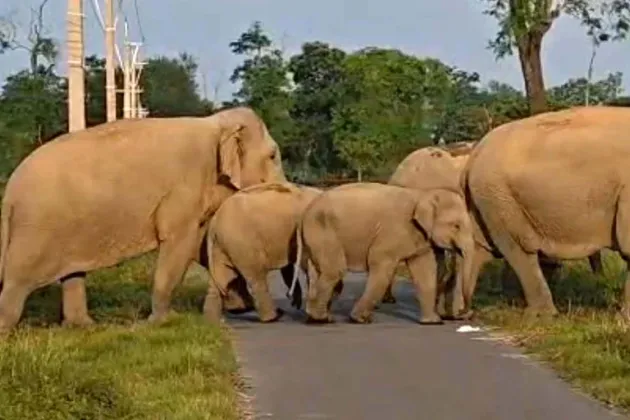

Goalpara is one of the districts of Assam known for its lush green landscapes, particularly along the highways that pass through the district. Forests cover nearly 22.73% of its geographical area, although they are scattered in patches. Despite having considerable forest cover, Goalpara has witnessed a serious human-elephant conflict in recent years. This calls for a deeper examination of the issue from a scientific and ecological perspective.
The forests of Goalpara may broadly be classified into two categories: natural mixed forests and mono-Sal forests. Over the past few decades, a significant portion of the natural mixed forests appears to have gradually transformed into mono-Sal forests, with some areas such as Ajagar Hills, Pancharatna Hills, Paikan forest, Sri Surya Hills and Ghagra forest retaining greater diversity.
This transformation has affected biodiversity and, importantly, the availability of food for wildlife. Understanding how this change has taken place is therefore essential to understanding the growing human-elephant conflict in the district.
Forest fires and ecological degradation
Forest fires occur in many parts of the world due to both natural and human causes. From the geographical and climatic characteristics of Goalpara, it may be argued that many of the forest fires in the district are human-induced. Several factors may contribute to their occurrence, including clearing of the forest floor for hunting and firewood collection, burning to facilitate the growth of Sal trees, and the careless disposal of flammable materials on dry forest floors.
The major forest fires in Goalpara and adjoining areas of Kamrup generally occur during the extremely dry months of February and March. Such fires often begin in the evening and may continue throughout the night, affecting large stretches of forest.
These recurring fires can have several ecological consequences.
First, smaller plant saplings, medicinal plants, herbs and other vegetation are destroyed, while mature Sal trees and Sal saplings may survive because of their relative tolerance to fire. Repeated burning can therefore favour the spread of Sal at the expense of other plant species, gradually reducing the diversity of the forest.
Second, the destruction of vegetation reduces the availability of food and shelter for wildlife. As natural food sources decline, animals may be forced to move outside their traditional habitats in search of food.
Third, repeated burning also affects the natural decomposition of plant biomass. Under normal conditions, decomposed vegetation contributes organic matter to the surrounding soil and agricultural areas. Forest fires disrupt this ecological process.
Fourth, extensive burning of forest floors may affect local environmental conditions, including soil moisture and water availability. These changes can have wider implications for agriculture and the forest ecosystem.
Thus, recurring forest fires can have a significant negative impact on the ecological health of Goalpara's forests.
Food scarcity and the movement of elephants
The loss of plant diversity becomes particularly important in the case of elephants, which require large quantities of food and water. The article estimates that an adult elephant requires, on average, around 150 kg of solid food and 100 litres of water a day.
An elephant may survive without food for several days, but it must eventually move to areas where adequate food is available. With large portions of natural mixed forest gradually becoming dominated by Sal, the availability of diverse food sources is reduced.
This scarcity can push elephants towards adjoining villages and agricultural fields, where crops provide an easily accessible source of food. The movement of elephants into human settlements and farmland increases the possibility of encounters between people and elephants and, consequently, crop damage, property loss, injuries and deaths.
The situation can become particularly serious when repeated encounters generate fear, economic losses and retaliatory actions on both sides.
Possible solutions
If declining availability of natural food sources is a major factor contributing to elephant movement into human-dominated areas, improving food availability within forests should be an important component of any long-term strategy.
1. Prevent forest fires
Since recurring forest fires contribute to the degradation of forest diversity, their prevention should be given priority across the district's forest areas. Strict enforcement by the civil administration and Forest Department, supported by local communities and social organisations, could help reduce the incidence of forest fires.
Allowing natural regeneration would also help restore ecological diversity over time.
2. Restore food-producing vegetation
Plantation drives in mono-Sal forests could focus on regenerating native and other suitable food-producing plants. The author identifies species such as fig, elephant apple, jackfruit, Ejar (Pride of India), bamboo and banana, along with Napier, as potentially useful.
Such plantations should be planned scientifically, taking into account local ecological conditions and elephant movement patterns.
3. Speed up compensation
Faster compensation for crop damage, loss of property and human casualties could help reduce economic distress among affected communities. Timely compensation may also reduce frustration and the possibility of retaliatory action against elephants.
4. Consider crop insurance mechanisms
The inclusion of elephant-related crop damage under suitable agricultural insurance mechanisms, including the Pradhan Mantri Fasal Bima Yojana (PMFBY), could provide an additional layer of protection to farmers in areas regularly affected by elephant movement.
The applicability and current coverage provisions, however, need to be examined in the context of existing PMFBY guidelines.
5. Protect elephant corridors and water sources
Encroachment into elephant corridors and areas containing ponds and other water sources used by elephants should be prevented. Additional water bodies could also be created at suitable locations to improve the availability of water within or near forest habitats and potentially reduce movement towards human settlements.
6. Promote bio-fencing and alternative crops
Bio-fencing and the cultivation of suitable spice or other less-attractive crops in highly affected villages could help reduce crop losses in areas frequently visited by elephants. Such interventions should be selected based on local conditions and community participation.
7. Use technology for early warning
Modern technology can play an important role in tracking elephant movement and warning communities about approaching herds. Local WhatsApp groups and other communication networks can also facilitate real-time information sharing among villages and other stakeholders.
Existing interventions
Several NGOs and community organisations have been working for years to reduce human-elephant conflict through different interventions. However, according to the author, comparatively less attention has been given to increasing food availability within forests and preventing forest fires.
The Forest Department has undertaken plantation of food-producing plants in areas where eviction drives were recently conducted in Paikan Reserve Forest and Dohikota Reserve Forest. However, according to the author, plantation activities have not yet been undertaken on a comparable scale in the core areas of mono-Sal forests along elephant migration routes and corridors.
The Goalpara Photographic Society (GPS), an environmental group, has undertaken awareness activities on the harmful effects of forest fires. It has also initiated plantation of food-producing plants inside mono-Sal forests with the support of nearby villagers and nature lovers.
The author has also published articles on the relationship between forest fires and human-elephant conflict in Goalpara in souvenirs brought out by social organisations in the district.
Krishi Vigyan Kendra, Goalpara, the district's scientific extension organisation, has also undertaken awareness activities among farmers through its field programmes.
The Gaja Mitras appointed by the State Forest Department have played an important role in monitoring elephant movement and communicating updates from different parts of the district. Several WhatsApp groups dedicated to reporting elephant movement are also currently active in the district.
Conclusion
Human-elephant conflict in Goalpara has become an increasingly serious concern. One important factor identified in this article is the decline in the availability of diverse food-producing vegetation in forests dominated by Sal.
Recurring forest fires during the dry months of February and March can contribute to the gradual loss of plant diversity and the transformation of natural mixed forests into more homogeneous Sal-dominated forests. Preventing forest fires should therefore form an important part of efforts to restore the ecological health of the district's forests.
At the same time, large-scale and scientifically planned regeneration of food-producing vegetation in suitable forest areas, particularly along elephant movement routes and corridors, could help improve the availability of natural food sources.
The civil administration, Forest Department, scientific institutions, NGOs and local communities all have important roles to play. NGOs and other organisations working on human-elephant conflict could also consider complementing preventive measures with greater emphasis on habitat restoration, forest-fire prevention and the regeneration of food sources.
A combination of ecological restoration, community participation, timely compensation, protection of elephant corridors, early-warning systems and scientific monitoring could contribute to reducing conflict while restoring healthier forests that provide food and shelter for elephants and other wildlife.
Comments (0)
No comments yet. Be the first to share your thoughts.
Leave a Comment