

Resilience Starts at Home, But Who Pays for the Crisis?
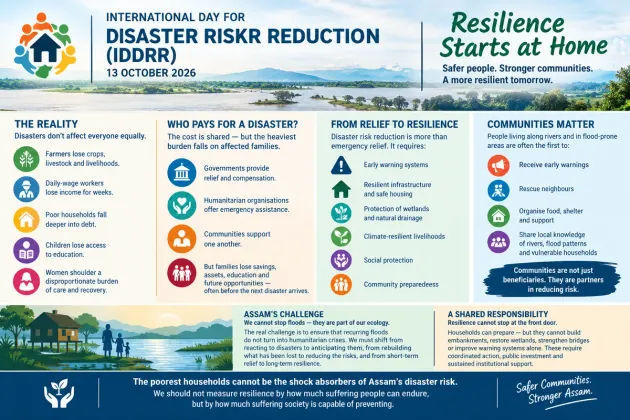

Every year, October 13, observed as the International Day for Disaster Risk Reduction (IDDRR), provides an opportunity to look beyond the immediate destruction caused by disasters and examine why some communities suffer far more than others. The 2026 theme, “Resilience Starts at Home,” is particularly relevant to Assam, where floods have become a recurring reality for millions of people. It also raises an important question: how much of the responsibility for resilience can households reasonably be expected to bear?
The devastating floods across Upper Assam this year have once again demonstrated that the burden of disasters is not equally shared. For a farmer, a flood may mean the loss of an entire season’s crop and livestock. For a daily-wage worker, it can mean weeks without income. For a low-income household, repairing a damaged home or replacing essential belongings can push the family deeper into debt. Children may lose access to education, while women often shoulder a disproportionate share of caregiving and household recovery.
Who actually pays for a disaster?
Governments provide relief and compensation, humanitarian organisations offer emergency assistance, and communities support one another. Yet a substantial and often less visible share of the cost is borne by affected families themselves. Their savings, livelihoods, assets, education and future opportunities are gradually eroded by repeated shocks. For the poorest households, recovery from one disaster may remain incomplete before the next one arrives, trapping families in a cycle of loss and vulnerability.
This is why disaster risk reduction cannot be limited to emergency relief. Relief is essential, but it cannot replace preparedness or prevent future losses on its own. Investment in early warning systems, resilient infrastructure, safe housing, the protection of wetlands and natural drainage, climate-resilient livelihoods, social protection and community preparedness can reduce the damage caused by recurring hazards.
The experience of the July 2026 floods also highlights the importance of local communities in disaster preparedness and response. People living along rivers and in flood-prone areas are often among the first to receive warnings, rescue neighbours and organise food, shelter and other support. Their knowledge of local rivers, flood patterns and vulnerable households is an important resource for disaster management. Communities should therefore not be viewed merely as beneficiaries of disaster response, but as active partners in identifying risks, preparing for emergencies and building long-term resilience.
For Assam, the objective should not be to create a “flood-free” state. Floods are an integral part of the ecology of the Brahmaputra and its tributaries. The greater challenge is to ensure that recurring floods do not repeatedly turn into humanitarian crises. This requires a shift from reacting to disasters to anticipating them, from simply rebuilding what has been lost to reducing the risks that cause those losses, and from short-term relief to long-term resilience.
This shift also requires a clearer understanding of what resilience means at the household level. Families can prepare emergency supplies, protect important documents, save what they can and learn evacuation procedures. However, they cannot independently build and maintain embankments, restore wetlands, strengthen bridges, improve public warning systems or adequately protect their livelihoods against increasingly uncertain hazards. These responsibilities require coordinated action, public investment and sustained institutional support.
The idea that resilience starts at home is important. But responsibility for resilience cannot stop at the front door. Households need the resources, infrastructure, information and institutional support to prepare for disasters and recover from their effects. Without these, calls for greater household preparedness risk placing the burden of resilience on those least equipped to carry it.
The question before us, therefore, is not simply whether communities are resilient. It is whether our systems are doing enough to ensure that people do not have to repeatedly prove their resilience by suffering the same losses.
The poorest households cannot continue to be the shock absorbers of Assam’s disaster risk. We should not measure resilience by how much suffering people can endure, but by how much suffering society is capable of preventing.
Comments (0)
No comments yet. Be the first to share your thoughts.
Leave a Comment