

Book Review | Mapping the Living Landscapes of the Brahmaputra

GUWAHATI, July 10, 2026 — River valleys are universally acknowledged as dynamic habitats that sustain multiple ecosystems of immense ecological value, yet they remain increasingly vulnerable to a range of global threats. While some attribute these disruptions to natural environmental processes, the prevailing consensus underscores human-induced changes as the primary cause. Within this context, wetlands emerge as particularly fragile and distinctive ecosystems. Their survival—along with the broader health of river valleys—is closely tied to land management practices and the extent of natural resource exploitation.
In today’s world, truly pristine river valleys have become rare, often bearing visible imprints of human interference. Yet, amidst this reality, there are encouraging signs. Certain landscapes such as chars and marshy lands have witnessed reduced human pressure in recent years, opening up opportunities for ecological restoration and conservation. Parallelly, advancements in environmental management have fostered the development of scientific tools and strategies aimed at regulating resource use more sustainably.
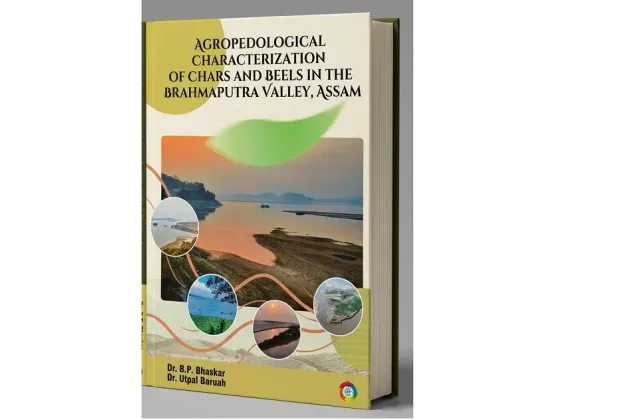
Against this backdrop, the book Agropedological Characterization of Chars and Beels in the Brahmaputra Valley, Assam, authored by Dr. B.P. Bhaskar and Dr. Utpal Baruah, is a significant contribution to this evolving discourse.
Both authors, distinguished scientists formerly associated with ICAR-NBSS&LUP, bring together decades of research to present a comprehensive and objective-oriented study of soils in the Brahmaputra Valley. The work lucidly explains soil-geomorphic relationships through well-designed illustrations, offering a strong regional perspective essential for understanding river valley ecosystems.
The volume stands out for its rich georeferenced datasets, making it an invaluable resource for soil scientists, geographers and researchers exploring fluvial processes and pedogenesis. The authors have adopted a systematic and rigorous methodology to conduct soil surveys in the challenging and often inaccessible floodplain wetlands. Their work addresses a long-standing gap in understanding the biophysical constraints affecting wetland agriculture.
What makes the book particularly noteworthy is its synthesis of three phases of research, enriched with case studies and insights from on-farm demonstration trials. The inclusion of recent references enhances its academic relevance, while field photographs vividly capture the dynamic nature of the Brahmaputra and the evolving landscapes of chars and beels. These visuals also reflect the enduring resilience of traditional rainfed rice systems that have sustained livelihoods for centuries.
The book is thoughtfully structured into eight chapters covering introduction, regional overview, climate, morphological dynamics, geomorphic processes, hydropedological investigations, agronomic interpretations, and detailed characteristics of beel lands. Each chapter is further subdivided, ensuring depth and clarity in presentation.
Of particular significance are the hydropedological studies conducted in Majuli and the beel areas of Jorhat, which provide valuable insights into the formation of hydric soils classified under Entisols and Inceptisols.
Building on this scientific foundation, the authors propose rice-based cropping systems tailored to the unique ecological conditions of chars and beels. They also address various management challenges and examine both traditional and modern agronomic practices. The concluding sections on river restoration outline practical techniques and critical considerations, making the work relevant not only for researchers but also for policymakers and development practitioners.
Comprising 216 pages, the book includes 54 tables, 41 figures, an extensive list of 258 references, and a comprehensive glossary. Its depth and clarity make it a valuable addition to professional literature and an important educational resource. By bridging soil science with agricultural practice, the authors have created a work that enhances our understanding of river valley ecosystems and their sustainable management.
The book is highly recommended for anyone interested in wetland soils, riverine ecology and sustainable agriculture. It is hoped that such region-specific studies will continue to enrich academic resources and inspire further research, ultimately contributing to improved livelihoods and ecological resilience in the Brahmaputra Valley.
Comments (0)
No comments yet. Be the first to share your thoughts.
Leave a Comment