

New Delhi BRICS Summit: Hoping for a Permanent Indian Presence in the UNSC
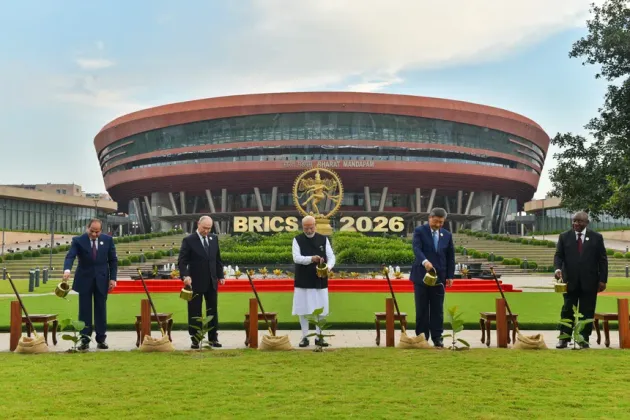
As the world’s largest democracy hosted the 18th BRICS Leaders’ Summit in New Delhi on September 12–13, 2026, under the theme “Building for Resilience, Innovation, Cooperation and Sustainability”, global attention focused on the grouping’s discussions on conflicts, trade, artificial intelligence, food security, technology and cooperation among developing countries.
The participating leaders adopted the New Delhi Declaration 2026, reaffirming their commitment to multilateralism, greater cooperation and a more representative international order. The declaration also called for stronger participation of emerging and developing countries in global decision-making institutions.
For India, the summit was particularly significant because the question of reforming the United Nations Security Council once again came into focus.
A larger BRICS and a changing global order
The BRICS grouping, whose acronym was coined in 2001 to describe Brazil, Russia, India and China, later expanded with the admission of South Africa. The grouping underwent another major expansion in 2024, when Egypt, Ethiopia, Iran and the United Arab Emirates joined as members, followed by Indonesia in 2025.
According to India’s Ministry of External Affairs, BRICS currently comprises 11 member countries and a group of partner countries. The expanded grouping represents a substantial share of the world's population and global economy.
The 2026 summit brought together leaders and representatives of the expanded BRICS grouping as India sought to strengthen cooperation across political and security, economic and financial, and cultural and people-to-people spheres.
Prime Minister Narendra Modi chaired the summit, which was attended by leaders including Russian President Vladimir Putin, Chinese President Xi Jinping, Iranian President Masoud Pezeshkian, South African President Cyril Ramaphosa, Indonesian President Prabowo Subianto, Egyptian President Abdel Fattah el-Sisi and UAE Crown Prince Sheikh Khaled bin Mohamed bin Zayed Al Nahyan.
The UNSC reform question
One of the significant issues in the New Delhi Declaration was reform of global governance, including the United Nations system.
The leaders reaffirmed their support for reforming the UN and other multilateral institutions to make them more representative and responsive to contemporary realities. Prime Minister Modi, while chairing a summit session on inclusive global governance and strengthening multilateralism, said that the Global South remained at the “front row” of global crises but at the “back row” of decision-making. He called for greater representation of developing countries in institutions such as the UN Security Council.
The declaration specifically supported greater representation of developing countries, including those from Africa, Asia and Latin America, and recognised the legitimate aspirations of Brazil and India to play a greater role in international affairs.
For India, this naturally strengthens the case for a more permanent presence in the UNSC.
Yet the distinction is important: the BRICS declaration is a political expression of support for greater representation and reform; it does not itself change the composition of the Security Council or confer permanent membership on India.
The presence at the summit of China and Russia—two of the five existing permanent members of the Security Council—also gave the discussion added diplomatic significance.
India has long sought permanent membership of the UNSC as part of a broader reform agenda. The New Delhi summit therefore offered another opportunity to place that aspiration within the larger Global South demand for a more representative international system.
Guterres and the reform debate
Ahead of the summit, Modi met UN Secretary-General António Guterres in New Delhi. Their discussions covered global conflicts, sustainable development, human-centric technology, renewable energy and food security.
The UN reform question also featured in the discussions, with the need to make global institutions more reflective of present-day geopolitical and economic realities receiving renewed attention.
The 2026 summit also marked two decades of BRICS. To commemorate the occasion, two postage stamps were released by the member countries.
Terrorism and the Pahalgam attack
The New Delhi Declaration strongly condemned terrorism, describing terrorist acts as criminal and unjustifiable regardless of their motivation, location or perpetrator.
The document referred to the April 22, 2025, terrorist attack in Pahalgam, Jammu and Kashmir, in which 26 people were killed and several others injured.
The BRICS leaders reiterated that terrorism should not be associated with any religion, nationality, civilisation or ethnic group and called for those responsible for terrorist activities to be held accountable in accordance with national and international law.
Palestine and West Asia
The leaders also addressed the continuing crisis in West Asia.
The declaration reaffirmed support for Palestine’s full membership of the United Nations and a two-state solution with a sovereign Palestinian state having East Jerusalem as its capital. The leaders opposed the forced displacement of Palestinians and condemned violations of international humanitarian law, including attacks on civilians and civilian infrastructure.
More broadly, the summit called for dialogue, diplomacy and peaceful resolution of conflicts amid continuing instability in West Asia.
Health, AI and climate change
Health security was another major area of cooperation. The leaders highlighted universal health coverage, tuberculosis research, pandemic preparedness and early-warning systems, while endorsing initiatives relating to healthy lifestyles and wellbeing.
Artificial intelligence also received considerable attention. The leaders recognised AI’s potential contribution to economic growth and sustainable development while stressing safety, security, inclusiveness and reliability.
Digital public infrastructure, cybersecurity, research and innovation were identified as areas where BRICS countries could deepen cooperation.
Climate change and climate finance also remained prominent in the declaration, with the leaders calling for stronger international action on adaptation, sustainable development and financing for developing countries.
Guwahati’s BRICS connection
For Assam, the summit had a particular connection through the Guwahati Declaration.
The BRICS Heads of Anti-Drug Agencies meeting held in Guwahati in July 2026 adopted the declaration to strengthen cooperation against illicit drug trafficking and related transnational organised crime. The New Delhi Declaration subsequently welcomed the Guwahati Declaration and its emphasis on operational and technical cooperation among BRICS anti-drug agencies.
The New Delhi document also covered transport, tourism, anti-corruption, digital connectivity and several other areas of cooperation.
Bangladesh's absence
Bangladesh, although neither a BRICS member nor a partner country, had been invited to the summit's outreach process because it was chairing BIMSTEC.
India said Prime Minister Tarique Rahman had received a separate invitation to attend the BRICS summit in his capacity as BIMSTEC chair. Rahman, however, did not attend the New Delhi summit.
The circumstances surrounding the invitation became a subject of discussion between New Delhi and Dhaka. Bangladeshi officials maintained that the invitation was extended to Rahman as BIMSTEC chair rather than in his capacity as Bangladesh’s prime minister. India subsequently clarified that two separate invitations had been issued—one for a bilateral visit and another for the BRICS summit as BIMSTEC chair.
From a regional perspective, Bangladesh's absence meant that an opportunity for Dhaka to present its concerns and priorities before a major Global South forum was not taken up.
Nepal, meanwhile, was not among the summit's outreach invitees in its capacity as current SAARC chair.
Looking beyond New Delhi
The New Delhi summit demonstrated both the possibilities and limitations of BRICS as an increasingly diverse multilateral platform.
The grouping brings together countries with differing political systems, economic interests and positions on international conflicts. Yet the adoption of a common declaration covering global governance, terrorism, Palestine, AI, climate change, health, trade and development indicates a continuing effort to find areas of consensus.
For India, the most important long-term question remains whether the growing weight of the Global South can translate into meaningful reform of international institutions.
A permanent Indian presence in the UN Security Council would require agreement among the UN membership and, ultimately, amendment of the UN Charter. The BRICS endorsement of greater representation for developing countries is therefore an important part of the diplomatic conversation, but it is not the final step.
As BRICS moves towards its 19th summit in China in 2027, the New Delhi declaration provides another platform from which India can pursue its longstanding demand for a more representative global governance system.
For New Delhi, the aspiration is clear: a global order in which the countries representing the demographic, economic and political weight of the Global South have a corresponding voice in the institutions that shape the world's future.
Comments (0)
No comments yet. Be the first to share your thoughts.
Leave a Comment