Skip to content Skip to navigation

Regional workshop on food sovereignty held

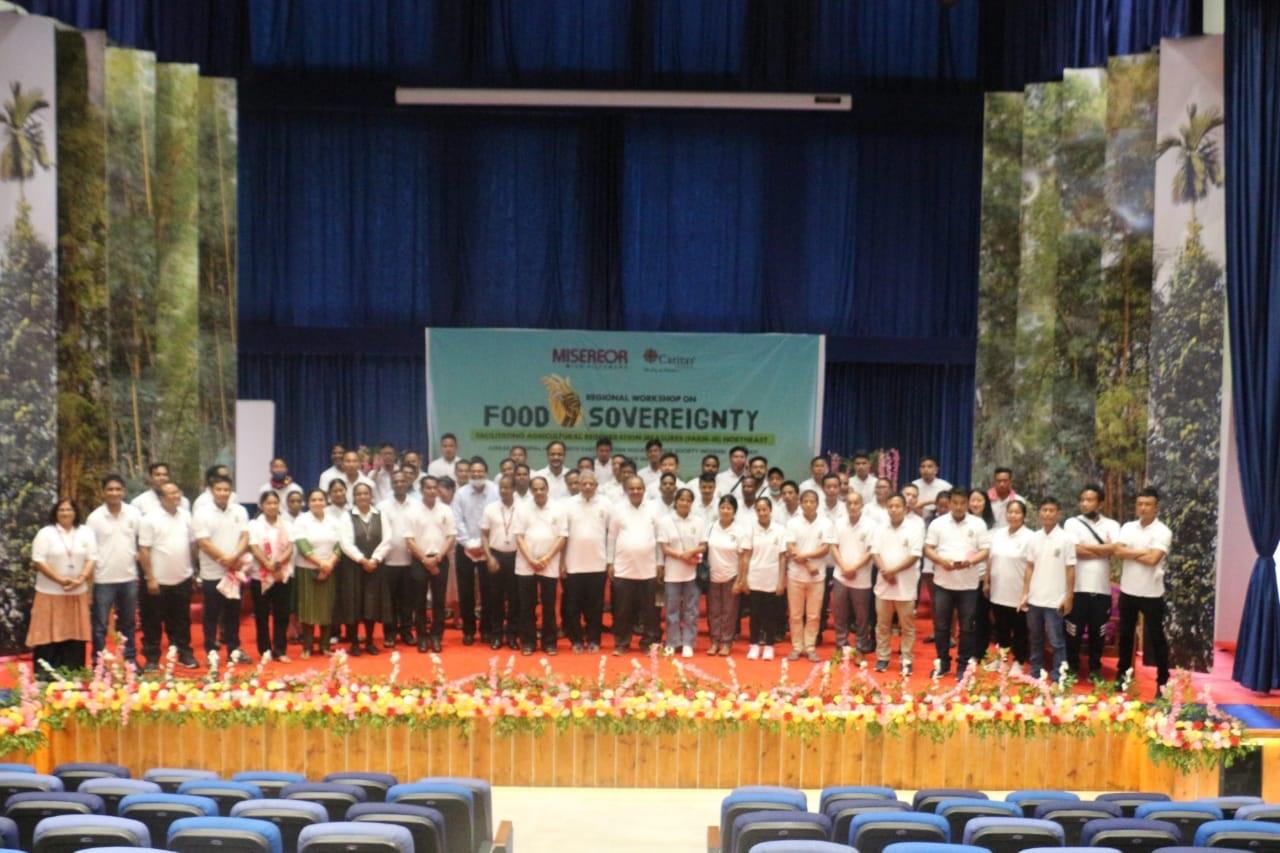
Guwahati: “My home is where my food is grown” was the talking point of two days regional workshop on Food Sovereignty concluded in Guwahati which was held on October 26 to 27 and organized by Caritas India at Silver Jubilee Memorial Conference Hall of Northeast Diocesan Social Service Societies, Guwahati. Altogether 76 participants of 16 partner organisations from all seven states participated. 16 farmers stalls were installed by 16 partner organisations to showcase their organic farm produce as well as wild edibles under the FARM NE banner.

Dr. Rituraj Phukan was the Chief Guest to grace the occasion along with Dr. Pranab Bujarbarua, Assistant Professor, Department of Botany,  Jusmita Borah, Environment Expert, Assam Inland Water Transport Project, Govt of Assam and Mrinal Gohain, Regional Manager ActionAid, Fr. Dr. Sabastian, Director NEDSSS Guwahati. To accompany the honorable guest speakers, Rev Dr Jolly Puthenpura Assistant Executive Director, Devi Kalyani Pattnaik Chief Operations Lead, Pradipta Chand Lead-Climate Adaptive Agriculture and Food Sovereignty along with the Northeast Regional Caritas India team members were among them.

While sharing on the food and climate crisis, Dr Rituraj Pukhan raised concern over the present food habits by quoting a song “My home is where my food is grown” which drew the attention of the participants that we are not eating what we are growing. While sharing his message, he emphasizes the importance of local seasonal food including wild edibles and encourages people to grow their own food. Growing your own food helps to maintain good health by reducing food miles, food waste and external dependency on the market for inputs. He showed the comparison of summer temperature from 1936 to 2021 and showed that the last 7 years were the hottest years.

Rev Dr Jolly Puthenpura shared the current national situation in the context of food and farm biodiversity, where smallholder farmers are among the most vulnerable groups to climate change. They have been hit hardest by climate change considering their small and fragmented landholdings. Scaling-up for resilience and adaptation through smallholder led integrated farming systems, Caritas India has initiated adaptive models considering different agro-ecological climatic conditions of the region in consultation with the relevant regional research stations to ensure smallholder’s production, income, nutrition, resilience, and farmers control in the face of climate threats. Facilitating Agriculture and Regeneration Measures (FARM) is one of those flagship programmes of Caritas India, which is being implemented in 7 states with 12,365 small and marginal farm families. FARM has been able to create a remarkable impact on the lives of small farm families where smallholders are taking the lead in creating sustainable models of agricultural development by enhancing their incomes.

Sharing about the Caritas India’s initiative under the climate adaptive agriculture and food sovereignty theme, Pradipta Kishor Chand has presented three evidence-based models on climate resilient agriculture, community managed food and nutrition and a small-scale value chain of small-farm-agri-food. He shared the relevance, effectiveness, and impact of smallholder owned models experimented with in smallholder adaptive farming and biodiversity networks.

Dr. Pranab Bujarbarua emphasized the promotion of local farm biodiversity by diversifying small farms with maximum local varieties inclusive of cereals, pulses, oil seeds and vegetables to invite pollinators and predators for better farm production. While speaking on this, he also stressed on the wild edibles and leaves having great nutritional values and specific characteristics to be used as bio-pest repellents which are natural and no harm to the local biodiversity. Dr. Jusmita Borah, giving her presentation on resilient communities made participants think about how our resources are going to become extinct. 


Add new comment

Other Contents by Author

Guwahati: The Gauhati Medical College and Hospital (GMCH) has once again landed in controversy, this time over allegations of a newborn baby being swapped. The family of Priyanka Sharma, a woman from Dhupdhara in Goalpara district, has accused hospital staff of replacing their healthy baby with another infant. According to the family, Priyanka was advised a cesarean delivery but ultimately gave birth through normal delivery. After the birth, the family claimed they saw the baby, who appeared healthy. However, soon after, neither the mother nor other relatives were allowed to see the newborn. When the family inquired, doctors assured them that the child was in good health. Shock came...
Mizoram has reaffirmed its stand on the 1875 notification as the only legitimate boundary with Assam, rejecting the 1933 Survey of India map cited by Assam. Home Minister K. Sapdanga told the Assembly that the colonial-era demarcation, drawn after consultation with local chiefs, remains binding. Talks between the two states have stretched across decades, with the last round held in Guwahati in April. The next meeting is to take place in Aizawl, though no date has been fixed. Mizoram has set up a study team to compile archival records to back its claim. On the ground, tensions persist. In mid-August, Mizoram villagers accused Assam officials of damaging nearly 300 rubber plants in...
In a bid to ease tensions along the Assam–Arunachal boundary, senior officials from both states held a joint meeting at Narayanpur in Assam’s Lakhimpur district on Thursday, adopting a series of measures to improve coordination and maintain peace. The meeting was attended by officials from Assam’s Lakhimpur and Biswanath districts and Arunachal’s Papum Pare district. Both sides agreed to stop all new construction and encroachment until the final demarcation of the interstate boundary is completed. To ensure smoother communication, the states will appoint nodal officers as official points of contact, while a dedicated WhatsApp group will be created to allow quick information-sharing among...
Assam has been ranked among the bottom five states of the country in crucial development indicators including health, education and economic growth, according to a fresh NITI Aayog assessment. The report placed Assam 26th in health and well-being, 25th in education, and 23rd in economic development. On gender equality and zero hunger, the state was positioned at 25th and 22nd respectively. The poor performance has raised concern over the state’s planning and budgetary priorities, despite official claims of inclusive growth. Experts have pointed out that school enrolment, institutional health services and poverty reduction continue to remain below the national average. NITI Aayog’s...
Guwahati, August 23: The Rotary Club of Guwahati, in collaboration with the North Eastern Regional Agricultural Marketing Corporation Ltd. (NERAMAC), organized a major plantation and sapling distribution initiative this week. On Tuesday, August 21, a total of 3,000 medicinal and fruit-bearing saplings were distributed among local villagers of Bijoynagar and adjoining areas at the premises of 28 Nahira Primary School and Kongdang Primary School. The program witnessed enthusiastic participation from villagers, teachers, Rotarians, and NERAMAC officials. Continuing the green initiative, a tree plantation drive was also conducted on Friday, August 22, at the NERAMAC office premises...
The Press Emblem Campaign (PEC), a global media safety and rights organization, has strongly condemned the misuse of the “PRESS” symbol by armed combatants in conflict zones such as Syria and Gaza. The PEC expressed deep concern over incidents where individuals posing as journalists have used the emblem as a shield for violent activities. In southern Syria, Islamist fighters were seen wearing jackets marked “PRESS” while vandalizing a Druze household in Suwayda, as shown in a widely circulated video on social media. While PEC cannot independently verify the authenticity of the video, it emphasizes that under no circumstances should the press emblem be used as cover for armed combatants...
The number of journalists killed worldwide has surged dramatically in the first half of 2025, according to the Press Emblem Campaign (PEC). Since January, 86 media workers have been killed across 26 countries, marking a 16% increase compared to the same period last year. Gaza: Epicenter of the Crisis The ongoing conflict in Gaza is the primary driver behind this spike. At least 31 Palestinian journalists were killed in six months by the Israeli army, accounting for more than a third of the global toll. “The Israeli government is directly responsible for this tragedy, which targets civilians reporting on the situation in Gaza. The Israeli soldiers involved in these war crimes must...
Guwahati: – A transformative capacity-building workshop, “Learning from the Land: Participatory Knowledge Harvest from Assam and Meghalaya,” was held at Tata Institute of Social Sciences (TISS), Guwahati Off-Campus, on Friday, June 27, 2025. Organized by TISS in collaboration with UNDP-SGP, the event brought together over 50 NGOs from Assam and Meghalaya to exchange grassroots knowledge and strategies for sustainable land use, agroecological practices, and environmental conservation. The workshop aimed to empower local communities by enhancing skills in biodiversity conservation, land restoration, rural development, sustainability, and climate change adaptation. Prof. Jagannath Ambagudia...
Guwahati: The Assam Pradesh Congress Committee (APCC) has accused the BJP-led state government under Chief Minister Himanta Biswa Sarma of driving tea garden workers into a severe health crisis, with the average worker’s body weight dropping below 50 kg due to malnutrition and anemia. In a press conference on Wednesday at Rajiv Bhawan, APCC Working President Roselina Tirkey, joined by tea tribe leaders Raju Sahu, Etowa Munda, and Pranjal Ghatowar, condemned the government for neglecting workers’ welfare and plotting to dismantle Assam’s tea industry. Raju Sahu emphasized the alarming health decline, stating that malnutrition and anemia have rendered many tea workers unfit to donate blood...
In Assam, the land of the Brahmaputra, tea gardens, and vibrant indigenous cultures, a troubling pattern has emerged. The state’s push for development—solar plants, thermal power stations, cement factories, and urban restoration—has come at a devastating cost to its original inhabitants, the Khilonjiya. These indigenous communities, including Karbi, Bodo, Dimasa, and Adivasi, are being displaced from their ancestral lands to make way for wealthy industrialists and corporate giants like Adani. While rich outsiders are welcomed with open arms, the Khilonjiya bear the burden of uprooted lives, lost livelihoods, and erased heritage. This blog chronicles few recent land disputes, exposing the...