Skip to content Skip to navigation

Dibang dam in morass of controversy

The brouahaha over the mega dam at Gurukamukh refuses to die down. Yet another hydel project in Arunachal Pradesh takes the centre-stage of growing controversy. This time the epicenter is none but the Dibang valley that triggers the fear of disaster in the entire north eastern region over the move to build a mega dam by NHPC to generate more power.

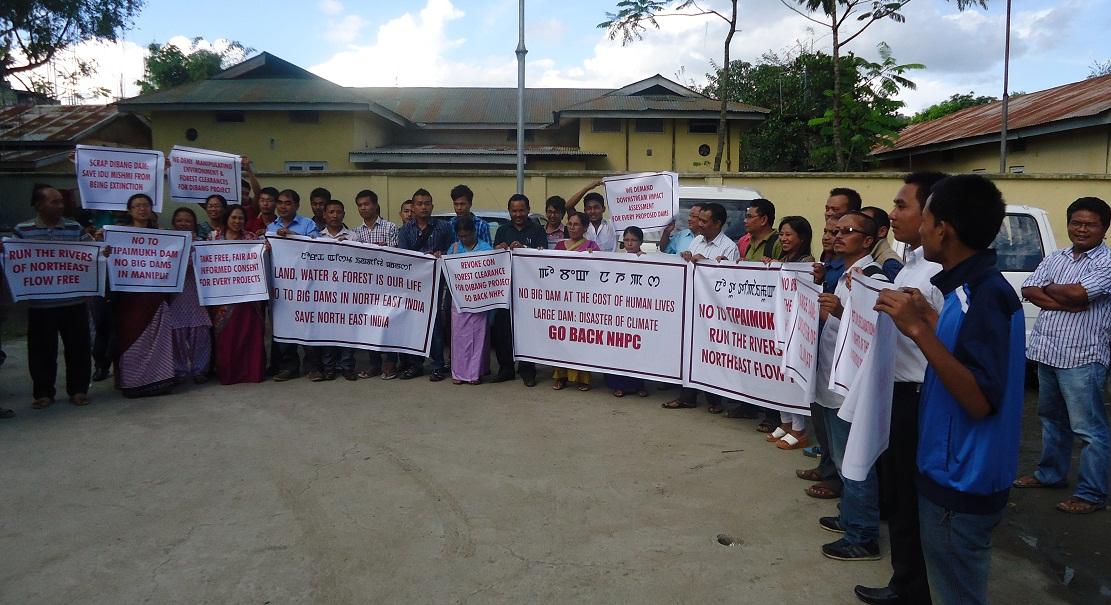
Talking to Assam Times, North East Dialogue Forum secretary U Nobokishore said that the Narendra Modi government at the Centre was believed to have cleared the Asia’s tallest ever mega dam to generate 3000MW of hydro electric power. According to Nobokishore, the Centre has awarded the contract to NHPC even two years after the Manmohan Singh Government refused to clear the project. He said that the controversial project will violate the rights of the indigenous people over the natural resources. The project on the pipeline has posed a serious threat to the Mehau Wildlife Sanctuary as the NHPC is in the process to acquire a huge portion of the sanctuary to build the World Bank-finance mega dam which is racial discriminatory to the north east and its people, said the NEDF leader. He said, “several organizations have been opposing the Dibang Dam fearing downstream disaster. Even these organizations, mostly, were allowed depose before the public hearing at Roing. Is not it an example of violation of UN Declaration of Rights of Indigenous Peoples and ILO convention -107?”

Talking of their demands he said that a high level internal expert penal should be set up against NHPC who was awarded the contract. “The government must respect and protect the rights of the indigenous people over their land, forest, water,” he said. He said,”we demand a research on social, economic and cultural impact on the upstream and downstream areas of the proposed mega dam by engaging neutral expert from Arunachal Pradesh, Assam or Manipur.”

NEDF further charges NHPC and Centre with violating the mandate of UN Special Rapporteur of Indigenous People, UN Committee on Elimination of Racial Discrimination, Special Rapporteur on Business and Human Rights by allowing the mega dam construction. “The government must protect its people against human rights abuses by third parties. The corporate responsibility to respect human rights. This is apart from the access by victims to effective remedy, both judicial and non-judicial. But the government is remaining a mute spectator,” said Nobokishore. Why the Arunachal Pradesh government is unable to provide electricity to the people through mini-hydro project instead of mega dams? What forces it to reach pact with NHPC? Only a thorough probe will clear the doubts, said the rights activist.

Meanwhile, the joint campaign by North East Dialogue Forum, People’s Platform Secretariat, Village Women Coordinating Committee, People’s Action for Development, Social Action Committee against the mega dam seems to have gathered momentum with overwhelming response from the various parties and organizations. Notably, during his stint as Prime Minister, Dr. Manmohan Singh laid the cornerstone of the project on January 31 in 2008. The World Bank was to finance the project for business. But it would force the Idu-Mismi people to sacrifice their rights and interest.

The Dibang dam is planned on concrete gravity, located in the Lower Dibang Valley District of Arunachal Pradesh. Later, it will be the largest and the world’s tallest Concrete Dam, standing 288 metres (945 ft) tall which is expected to provide up to 3000MW of hydro electric power and also assist in flood control in the Dibang Valley. Dibang Multipurpose Project (3000MW) was conceived on Dibang river which originates from the snow-covered southern flank of Himalaya close to the Tibet border at an altitude of more than 5000 metres. The river emerges from the hills and enters the plain area near Nizamghat in Arunachal Pradesh, from where the river flows a distance of 50km to meet the Lohit River. The total catchment area of Dibang up to the Dam site is 11276 sq km which lies entirely in India. The project is located in the Lower Dibang Valley District of Arunachal Pradesh. The submergence area of the dam site is home to endangered birds of the State such as Black Parrot Bill, March Babbler, Manipur Bush Quail, white Winged Duck, Large Whistling, Griffin Vulture, Grey Heron, however, such endangered animals are also going to be effected greatly by this dam.

Author info

AT News's picture

Assam Times Staff. editor@assamtimes.org

Add new comment

Other Contents by Author

A two-day ‘People’s Consultation on Strengthening Humanitarian Response and Climate Resilience in the Brahmaputra Basin’ concluded today at Hotel Clubway Grand, Jorhat, with the adoption of the People’s Declaration for a Resilient Brahmaputra Basin. The event was organised by the North-East Affected Area Development Society (NEADS) in collaboration with the Inter Agency Group (IAG) of Assam and various local humanitarian civil society actors from across the Brahmaputra valley, with support from Start Network. The consultation brought together humanitarian practitioners, climate workers, community leaders, civil society organisations, youth groups and women’s collectives to deliberate on...
Guwahati: Curtains came down on the 9th Chalachitram National Film Festival at the Jyoti Chitraban premises in Kahilipara on 30 November 2025, as distinguished guests at the closing ceremony handed over awards, certificates, and cash prizes to the winning filmmakers in the presence of eminent film personalities, emerging director-producers and cine-goers. Organized by Chalachitram, a subsidiary of Vishwa Samvad Kendra-Assam, the two-day CNFF-25 showcased over 30 short features and documentaries across competitive and screening categories. ‘Koli’, directed by Jyotirmoy Mazumder, was adjudged the best short feature in the Northeast India category, while ‘Joba’, directed by Indira Baikerikar,...
The North-Eastern Hill University (NEHU) on Friday hosted the IIC Regional Meet 2025, drawing more than 500 participants from higher educational institutions across the Northeast. The day-long programme, organised under the Ministry of Education’s Innovation Cell (MIC) and the All India Council for Technical Education (AICTE), was held at the Multi-Convention Hall on the NEHU campus. The event commenced with the traditional lighting of the lamp, followed by an introductory address by Prof. Dinesh Bhatia, SPOC of the Regional Meet. Prof. G. Bez, Chairperson of the Meet, delivered the welcome speech, while Prof. I. Hussain, Dean of the School of Technology, NEHU, offered brief remarks....
Guwahati: Tirtha Prasad Saikia, Director of the North-East Affected Area Development Society (NEADS) — a local organization and an Indigenous Peoples’ Organization member of the International Union for Conservation of Nature (IUCN) based in Assam — has been elected to the Executive Body of the India National Committee (INC) of IUCN, representing the North-East India region. NEADS works at the intersection of humanitarian response, resilience building, climate action and environmental sustainability, adopting a nexus approach to address the human dimensions of environmental crises arising from both natural and human-induced disasters. The organization emphasizes community well-being...
Guwahati: The Pragjyotishpur Literature Festival (PLF) 2025 concluded this evening at Srimanta Sankardeva Kalakshetra, wrapping up three days of rich literary discussions, cultural insights, and powerful storytelling. Organized by the Sankardeva Education and Research Foundation, the festival began on 14 November with acclaimed author Shefali Baidya delivering the keynote address. On the final day, the organizers announced the recipients of this year’s prestigious PLF awards. Eminent researcher and author Moneswar Deori was named the recipient of the PLF 2025 Award, while promising young writer Srotashwini Tamuli, a researcher at Birangana Sati Sadhani State University, was declared the...
As the world gathers in Belém, Brazil, for the 30th United Nations Climate Change Conference (COP-30), the North-East Affected Area Development Society (NEADS) from Assam has stepped onto the global stage to ensure the voices of the region’s flood-affected and climate-vulnerable communities are heard. Representing NEADS as an Observer of the Start Network, Tirtha Prasad Saikia, the organisation’s Director, said the participation marks a crucial moment for the North-East, one of India’s most climate-sensitive regions. “We are here because climate change is not a distant issue for us — it’s our everyday reality,” said Saikia. “Assam’s communities have been battling floods, erosion,...
“Zubeen Garg was not just a singer — he was a phenomenon. A god in human form for millions,” said Manoj Kumar Das, management professional and commentator from Assam, in a heartfelt conversation reflecting on the life and legacy of the late music legend. Das, who had known Zubeen for more than two decades, recalled his early memories vividly. “He was just a simple, soft-spoken boy when I first met him — full of restless energy, always humming tunes. He could pick up any instrument, any rhythm, and turn it into something magical. But what stood out most was his humility. Despite his fame, Zubeen never carried an ego. He could be sitting on the ground with villagers one day and on stage...
Along with the rest of Assam, the people of Nazira observed Kati Bihu today with devotion and traditional fervor. The festival, which marks a crucial phase in the agricultural calendar, was celebrated with prayers for a prosperous harvest and protection from natural calamities. As the sun set, households across Nazira lit earthen lamps (chakis) before Tulsi plants and in the paddy fields, symbolizing hope and reverence for nature’s bounty. The flickering lights illuminated the night, reflecting the community’s collective faith in a good harvest season. Also known as Kongali Bihu, Kati Bihu is a more solemn and reflective celebration compared to other Bihus, emphasizing austerity,...
Students from the North-East (excluding Assam) showcased their passion and knowledge for wildlife conservation at the Wild Wisdom Global Challenge (WWGC) 2025, WWF-India’s flagship wildlife quiz that has been inspiring young minds since 2008. This year’s 18th edition, themed “Incredible Insects”, explored the fascinating world of insects – from butterflies and moths to bees, grasshoppers, mantises, and dragonflies. The challenge, designed for students in grades 6 to 9, combined interactive learning through webinars, informative resources, and a new BioBlitz initiative, encouraging children to connect with nature and understand their role in conserving biodiversity. Over 400,000...
October 14, 2025 - Students from Sarala Birla Gyan Jyoti School emerged victorious in the Assam State finale of the Wild Wisdom Global Challenge, defeating competitors from 109 other schools in what organizers called one of the most competitive rounds in the program's 18-year history. The competition, held at Miles Bronson Residential School in Guwahati, saw participation from 220 students representing schools from across the state. Ashwin Anand of Class 9 and Anubhadipta Boruah of Class 8 from the winning school will advance to represent Assam in the zonal round of India's largest wildlife quiz competition. STATEWIDE PARTICIPATION REACHES RECORD LEVELS This year's competition...