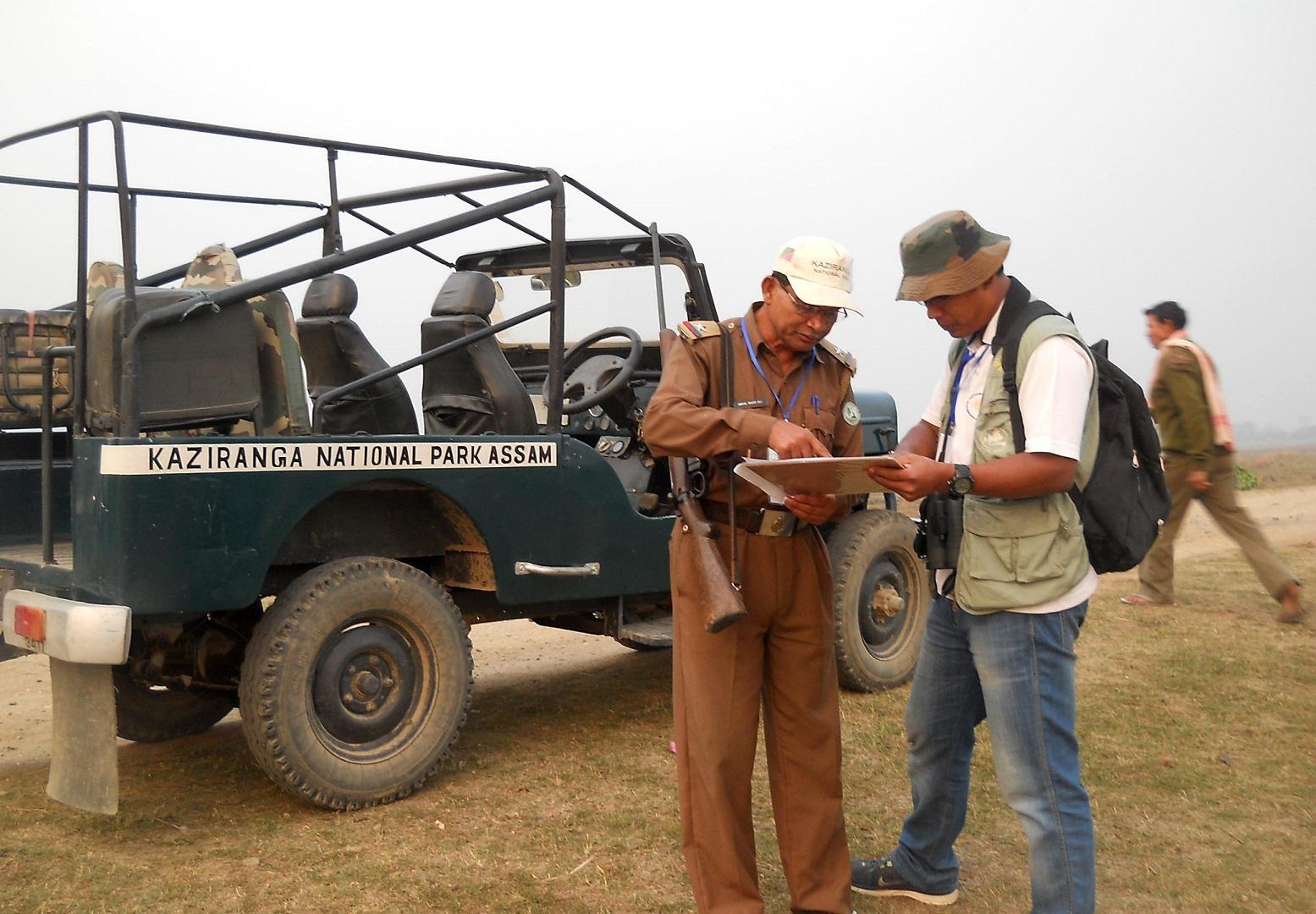
Despite being riddled by unstoppable poaching incidents, the KazirangaNational Park gets a rare dose of good news.
There has been considerable increase in the rhino population in the world heritage site. During the last two years the rhino population figure has gone up to 2,400 which suggests increase of 71 one horn animal.
The park authorities released the figure n Saturday after the end of the two days census operation.
The figure was on expected line as the authorities earlier hoped that it figure be encouraging.
“We began the census operation on Thursday which concluded on Friday. It is an exercise by the authorities which is conducted after a gap of three years,” KNP officials told Assam Times.
In 2012, the national park had 2290 rhinos. The repeated incidents of poaching forced the state government to conduct a special census which also suggested rise in the rhino population. The figure stood at 2,329.
According to the census figure, Kaziranga has 1,651 adult rhinos along with 294 sub adults 251 and 205 calves.
The authorities divided the park into 81 blocks to conduct the two days census deploying 36 elephants involving over 200 forest officials, guards and NGO representatives.
PermalinkSubmitted by Dustin Munro on Sun, 29/03/2015 - 00:30
There are sustainable ways to use elephants,rhinos,and other large mammals to make money without killing them and/or destroying their habitat.GOOGLE this title for a solution being used(by a "paper" company) for the Asian Elephant and Indian Rhino-How to save rhinos? By turning their dung into paper. A possible solution I figured out is:The Real Large Mammal Medicine And Food-Cash CowsIt is not elephant tusks or rhino horn that have medicinal properties or miracle cures.However,there may actually be a real medicine as well as food source from rhinos and elephants and many other large herbivorous mammals in Africa like hippos,eland,cape buffalo,manatees and dugons-without killing them or destroying their habitat!It is their milk! One example was shown in “Durrell In Russia”about people in Russia raising eland for the milk and saying it was good for fighting diseases(I think the examples of diseases were yellow fever and tuberculoses).Therefore the milk from all mammals that are large enough to produce large amounts of milk should be milked for investigation of medicinal qualities like possible malaria immunity and help fight other tropical diseases that the animals in those areas are exposed to and are deadly to people.Of course the milk would probably be great for food products too and help make those animals benefit from high demand.Large herbivorous mammals in Asia could also benefit from high demand too by milking them for use for food products and medicinal properties.Some examples of food products made from and/or using milk are cheese,chocolate,cream,ice cream,mayonaise,butter et.The animals could be captured as mother and it’s young,milk the mother,then release them after milking.That should only be done with mothers that have young that are already eating solid food to avoid the young from not getting enough milk.That would not only make the animals “Cash Cows”without killing them,but also greatly encourage people to breed whatever animals they would be milking for the probable high price of wildlife milk to replace the high price of rhino horn and elephant tusk.Of course the milk used for food products should be tested for toxic plant residue since some animals may eat plants that are toxic to people.
One female rhino was killed by poachers and its horn taken away at the Kaziranga National Park on Sunday. The carcass of the bullet riddled body was found near Amkattoni camp in Bagori range of the national park.
British Museum is going to orgasie conference on "Assam: textile transmission and the performance of dance" on July 8 - 9 2016 at Stevenson Lecture Theatr, London. This two-day conference will respond to the current exhibition in Room 91, Krishna in the garden of Assam: the cultural context of an Indian textile. It will consider Assamese textiles, trade and contact through the Himalayas from north-east India to Tibet, and the performance traditions that connect the ancient Krishna-related textiles with modern Assamese culture. The conference will include an exhibition viewing and reception. ----Assam: textile transmission and the performance of danceFriday 8 July & Saturday 9...
Understanding the endless difficulties and financial limitations faced by the media persons, voices have been raised for a group life & health insurance coverage for the media employees including working journalists engaged with various media outlets of the city. The members of Guwahati Press Club emphasize on a participatory group insurance scheme where the beneficiary-employees, owners of media houses and the State government can contribute equally. Need not to mention that most of the media employees based in the city have no life & health insurance coverage. In regards to the health insurance coverage the statistics may go up to 80% (out of around 5000 media employees) who do...
The mortal remains of Anjan Dutta were consigned to flames on Friday a day after the APCC president died of cardiac arrest in New Delhi. After last respect to the lifeless former minister in Guwahati and Sivasagar, Dutta’s body was taken to Gaurisagar where he was cremated with full state honour in the afternoon. Former Chief Minister Tarun Gogoi and forest minister Pramila Rani Brahma, MP Ripun Bora were prominent among those who were present at the cremation ground. Before that thousands of bereaved Congress men received Dutta’s body at the Jorhat Airport in the morning and was taken to Sivasagar to facilitate his fans to pay their last respect in Sivasagar town and his birth place Gayan...
THE REDEEMER, an English novel written by Dr Sanjib Kumar Borkakoti based on the life of Srimanta Sankaradeva was released on June 11, 2016 in Nagaon Press Club, Nagaon. The novel was released by Dr Ratul Bora, Registrar of Mahapurusha Srimanta Sankaradeva Viswavidyalaya. He compared the author Dr Sanjib Kumar Borkakoti with Dimbeswar Neog in dedication. He said that the author had been single-handedly working to spread the legacy of saint Srimanta Sankaradeva. He opined that the saint is relevant even in twenty first century. Another speaker, journalist and retired professor Dr Abu Hanifa said that Assamese people will be able to elevate their status by making Srimanta Sankaradeva...
21 meritorious performers at various HSLC & HS Board examinations conducted by both CBSE & SEBA were felicitated by the Minority Welfare Society (MWS) at a function held at the Murshidul Alam Memorial Hall at Nabamilan Path Dispur in Guwahati on Sunday. It may be mentioned here that MWS is a social organisation of minority community people who trace their origin to the Barak Valley but are now settled in Guwahati on account of professional or vocational reasons. MWS connects more than 4,000 people through over 350 families who are its members.At the outset, Mukhtar Hussain Ahmed Choudhury, President of MWS and former Jt Commissioner of Taxes, Govt of Assam welcomed all the...
A human chain comprising of around a 100 children raising slogans against child labour was today organized on the occasion of Anti Child Labour Day, by the Centre of Development Initiative (CDI) jointly with the Ferrando Domestic Workers Alliance and National Domestic Workers Movement (NDWM) near Dighali Pukhuri Guwahati on Sunday. The children mostly belonged to the marginalized families , were school going children, some school drop outs and some children of the domestic workers who were members of the 1000 strong, Children’s parliament and Child Friendly Guwahati (CFG) centres spread across the state. “The human chain has been orgainsed to attract attention from the people of the city...
Assam Chief Minister Sarbananda Sonowal called on Prime Minister Narendra Modi on Saturday in New Delhi a day after he reached the capital. CMO sources told Assam Times that Sonowal apprised Modi of the state’s grim financial health and sought immediate help in the form of fund to concentrate on development. He further apprised Modi of the slew of his government’s initiative for overall development. During the 20 minute long meeting, Sonowal handed over to the Prime Minister the white paper on the state’s financial condition justifying his help to salvage the chapter. Same subject dominated his discussion with Union finance minister Arun Jaitley who assured him of help to end the logjam....
Journalist Nand Kishor Gupta (46), breathed his last yesterday in Mumbai was laid to rest today (10 June) after necessary rituals. Mortal remains of Gupta were taken to Guwahati by a morning flight and he was paid last tribute by the members of Guwahati Press Club on way to his city residence. The soft spoken journalist was suffering from gallbladder cancer and referred to Tata Memorial Hospital, Mumbai for his treatment. He went there on 3 June last. Gupta, who worked with various Hindi dailies including Hindi Sentinel, Pratah Khabar and Purvanchal Prahari left behind his mother, wife, a daughter, a minor son besides a host of relatives. Till the time of his death, Gupta was associated...
Senior journalist Nand Kishor Gupta (46) breathed his last at the Mumbai airport around 3.10 pm today (9 June 2016) on his way back to Guwahati. A member of Guwahati Press Club, Gupta was suffering from gallbladder cancer and was referred to the Tata Memorial Hospital, Mumbai for his treatment. He left for Mumbai on June 3 last. Gupta, who worked with various Hindi dailies including Hindi Sentinel, Pratah Khabar and Purvanchal Prahari, leaves behind his wife, a daughter, a minor son besides a host of relatives. Till the time of his death, Gupta was associated with Purvanchal Prahari as a senior sub editor. Guwahati Press Club, which appealed for aids to Gupta’s treatment, expressed shock...







Comments
There are sustainable ways to
Pages
Add new comment