Skip to content Skip to navigation

India using deadly force against #CAA protesters: HRW

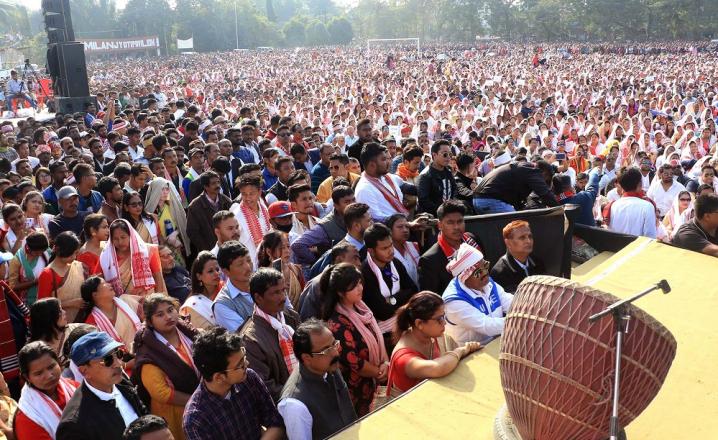
Protester staging a Janata 'Gorjon protest' against Citizenship Amendment Act (CAA) at Chowkidinghèe play ground, Dibrugarh on 24-12-19. Photo by UB Photos

Human Rights Watch (HRW) urges Indian government to "stop using unnecessary lethal force against CAA protesters".

New York:  The Indian authorities should cease using unnecessary lethal force against demonstrators protesting a law that discriminates against Muslims, Human Rights Watch said today. Since protests against the Citizenship Amendment Act began on December 12, 2019, at least 25 people have been killed and hundreds have been arrested.

Police have used excessive force only against demonstrators protesting the law, including many students. All the deaths have occurred in states governed by the ruling Bharatiya Janata Party (BJP): 18 in Uttar Pradesh, 5 in Assam, and 2 in Karnataka. Most of those killed have been Muslims, including an 8-year-old boy in Uttar Pradesh. Scores of police officers have been injured. The authorities have also used a colonial-era lawinternet shutdowns, and limits on public transportation to prevent peaceful anti-citizenship law protests. The police have, however, not interfered with demonstrators supporting the law, including ruling party leaders who have advocated violence.

“Indian police, in many areas, have been cracking down on anti-citizenship law protests with force, including unnecessary deadly force,” said Meenakshi Ganguly, South Asia director. “The authorities should prosecute violent protesters, but they also need to hold police officers to account for using excessive force.”

Most of the violence by protesters and the police has been in Uttar Pradesh state. There, the chief minister vowed “revenge” against protesters, saying, “All properties of those involved in damaging public assets will be seized and auctioned to compensate for the losses.” Soon after, the state authorities cracked down on Muzaffarnagar district and sealed nearly 70 shops without providing a legal basis.

On December 21, Uttar Pradesh police said that they had arrested over 700 people and preventively detained more than 4,500 others, who were released after warnings. Several others have been arrested since then. Those arrested face serious charges including attempted murder, rioting armed with a deadly weapon, unlawful assembly, assaulting public servants, and criminal intimidation.

“Many of us have gone into hiding because the police are tracking down anyone that organized or passed the word to join peaceful protest rallies,” one activist told Human Rights Watch. “They want to crush us into silence.”

Uttar Pradesh police have detained several activists, including Mohammad Shoaib, a Lucknow-based lawyer, and S R Darapuri, a retired police officer. The Magsaysay Award winner Sandeep Pandey was placed under house arrest. His wife, Arundhati Dhuru, and activists Meera Sanghamitra and Madhvi Kukreja were detained for several hours when they went to the police station to inquire about Shoaib. On December 21, the Allahabad High Court, acting on a habeas corpus petition for Shoaib’s release, ordered the state police to produce arrest documents as well as proof that Shoaib was medically examined as per the legal procedures.

Activists allege that Uttar Pradesh police beat up residents in Muslim neighborhoods and some people in custody. Police in Lucknow arrested Sadaf Jafar, an activist and Congress Party worker, while she was videotaping the police on her phone after a protest. Her family has alleged that the officers beat her.

Several students of Aligarh Muslim University whom police detained after protests also alleged that they were beaten up in custody. A report in Scroll.in found that the police in the Muslim-majority Naiza Sarai neighborhood of Uttar Pradesh’s town of Nehtaur forcibly entered several homes, ransacked them, and detained at least four men.

Uttar Pradesh police claim that people died from locally made weapons and crossfire among protesters, and that police only fired rubber bullets and teargas shells. However, a video from Kanpur showing a policeman firing his revolver toward protesters belies these claims.

Meanwhile, the authorities have not taken action against leaders of citizenship law supporters who may have been inciting violence. On December 20, a BJP leader, Kapil Mishra, led a large demonstration in Delhi, chanting that the police should “shoot the traitors,” referring to citizenship law protesters. The slogan was repeated two days later at a pro-BJP demonstration in Maharashtra state.

The authorities have repeatedly shut down mobile internet services in several states as protests spread throughout the country. On December 20, the Ministry of Information and Broadcasting issued a second advisory, warning television news broadcasters to “abstain from showing any content that promotes anti-national attitudes.”

The newly amended citizenship law grants citizenship only to non-Muslim irregular immigrants from the neighboring Muslim-majority countries of Afghanistan, Bangladesh, and Pakistan. Protesters have called for the law’s repeal, saying it is unconstitutional and divisive.

The law was enacted amid the BJP government’s push for a nationwide citizenship verification process, the National Register of Citizens (NRC). Government statements indicate that the NRC process aims to strip Muslims of their citizenship rights while protecting those of Hindus and other non-Muslims. Home Minister Amit Shah said in October “I want to assure all Hindu, Sikh, Jain, Buddhist, and Christian refugees, that you will not be forced to leave India by the Center [government]. Don’t believe rumors. Before NRC, we will bring [the] Citizenship Amendment Bill, which will ensure these people get Indian citizenship.”

Prime Minister Narendra Modi, speaking at a rally on December 22, said his government had never discussed a national register of citizens and denied that that there were any detention centers for irregular immigrants in the country. His statements contradict those by Shah, who has repeatedly said that the Citizenship Amendment Act is a precursor to the national register of citizens. The government has already been building detention centers in Assam and in Karnataka.

Indian authorities should ensure that security forces comply with the United Nations Basic Principles on the Use of Force and Firearms by Law Enforcement Officials. The government should also revoke the Citizenship Amendment Act, which violates India’s international obligations to prevent deprivation of citizenship on the basis of race, color, descent, or national or ethnic origin as found in the International Covenant on Civil and Political Rights (ICCPR) and other human rights treaties.

There have been marches in several cities across the world expressing solidarity with the student protests, and the government’s response has faced increasing criticism abroad.

“The Indian government should address the legitimate concerns over the citizenship law and national register of citizens that will be used to target marginalized groups,” Ganguly said. “The often violent repression of those critical of government undermines any claims that the authorities are responding to the situation in an impartial manner.”

Author info

AT News's picture

Assam Times Staff. editor@assamtimes.org

Add new comment

Other Contents by Author

New Delhi: Senior journalist Sangeeta Barooah Pisharoty has created history by becoming the first woman to be elected President of the Press Club of India (PCI), marking a significant milestone in the institution’s long-standing legacy. Her election is being widely hailed as a landmark moment for gender representation and leadership in Indian journalism. A respected name in the profession, Pisharoty is known for her incisive reporting, editorial leadership and long-standing commitment to press freedom, ethical journalism and the welfare of media professionals. Over the years, she has earned wide credibility for her work on politics, governance and social issues. The Press Club of...
A two-day ‘People’s Consultation on Strengthening Humanitarian Response and Climate Resilience in the Brahmaputra Basin’ concluded today at Hotel Clubway Grand, Jorhat, with the adoption of the People’s Declaration for a Resilient Brahmaputra Basin. The event was organised by the North-East Affected Area Development Society (NEADS) in collaboration with the Inter Agency Group (IAG) of Assam and various local humanitarian civil society actors from across the Brahmaputra valley, with support from Start Network. The consultation brought together humanitarian practitioners, climate workers, community leaders, civil society organisations, youth groups and women’s collectives to deliberate on...
Guwahati: Curtains came down on the 9th Chalachitram National Film Festival at the Jyoti Chitraban premises in Kahilipara on 30 November 2025, as distinguished guests at the closing ceremony handed over awards, certificates, and cash prizes to the winning filmmakers in the presence of eminent film personalities, emerging director-producers and cine-goers. Organized by Chalachitram, a subsidiary of Vishwa Samvad Kendra-Assam, the two-day CNFF-25 showcased over 30 short features and documentaries across competitive and screening categories. ‘Koli’, directed by Jyotirmoy Mazumder, was adjudged the best short feature in the Northeast India category, while ‘Joba’, directed by Indira Baikerikar,...
The North-Eastern Hill University (NEHU) on Friday hosted the IIC Regional Meet 2025, drawing more than 500 participants from higher educational institutions across the Northeast. The day-long programme, organised under the Ministry of Education’s Innovation Cell (MIC) and the All India Council for Technical Education (AICTE), was held at the Multi-Convention Hall on the NEHU campus. The event commenced with the traditional lighting of the lamp, followed by an introductory address by Prof. Dinesh Bhatia, SPOC of the Regional Meet. Prof. G. Bez, Chairperson of the Meet, delivered the welcome speech, while Prof. I. Hussain, Dean of the School of Technology, NEHU, offered brief remarks....
Guwahati: Tirtha Prasad Saikia, Director of the North-East Affected Area Development Society (NEADS) — a local organization and an Indigenous Peoples’ Organization member of the International Union for Conservation of Nature (IUCN) based in Assam — has been elected to the Executive Body of the India National Committee (INC) of IUCN, representing the North-East India region. NEADS works at the intersection of humanitarian response, resilience building, climate action and environmental sustainability, adopting a nexus approach to address the human dimensions of environmental crises arising from both natural and human-induced disasters. The organization emphasizes community well-being...
Guwahati: The Pragjyotishpur Literature Festival (PLF) 2025 concluded this evening at Srimanta Sankardeva Kalakshetra, wrapping up three days of rich literary discussions, cultural insights, and powerful storytelling. Organized by the Sankardeva Education and Research Foundation, the festival began on 14 November with acclaimed author Shefali Baidya delivering the keynote address. On the final day, the organizers announced the recipients of this year’s prestigious PLF awards. Eminent researcher and author Moneswar Deori was named the recipient of the PLF 2025 Award, while promising young writer Srotashwini Tamuli, a researcher at Birangana Sati Sadhani State University, was declared the...
As the world gathers in Belém, Brazil, for the 30th United Nations Climate Change Conference (COP-30), the North-East Affected Area Development Society (NEADS) from Assam has stepped onto the global stage to ensure the voices of the region’s flood-affected and climate-vulnerable communities are heard. Representing NEADS as an Observer of the Start Network, Tirtha Prasad Saikia, the organisation’s Director, said the participation marks a crucial moment for the North-East, one of India’s most climate-sensitive regions. “We are here because climate change is not a distant issue for us — it’s our everyday reality,” said Saikia. “Assam’s communities have been battling floods, erosion,...
“Zubeen Garg was not just a singer — he was a phenomenon. A god in human form for millions,” said Manoj Kumar Das, management professional and commentator from Assam, in a heartfelt conversation reflecting on the life and legacy of the late music legend. Das, who had known Zubeen for more than two decades, recalled his early memories vividly. “He was just a simple, soft-spoken boy when I first met him — full of restless energy, always humming tunes. He could pick up any instrument, any rhythm, and turn it into something magical. But what stood out most was his humility. Despite his fame, Zubeen never carried an ego. He could be sitting on the ground with villagers one day and on stage...
Along with the rest of Assam, the people of Nazira observed Kati Bihu today with devotion and traditional fervor. The festival, which marks a crucial phase in the agricultural calendar, was celebrated with prayers for a prosperous harvest and protection from natural calamities. As the sun set, households across Nazira lit earthen lamps (chakis) before Tulsi plants and in the paddy fields, symbolizing hope and reverence for nature’s bounty. The flickering lights illuminated the night, reflecting the community’s collective faith in a good harvest season. Also known as Kongali Bihu, Kati Bihu is a more solemn and reflective celebration compared to other Bihus, emphasizing austerity,...
Students from the North-East (excluding Assam) showcased their passion and knowledge for wildlife conservation at the Wild Wisdom Global Challenge (WWGC) 2025, WWF-India’s flagship wildlife quiz that has been inspiring young minds since 2008. This year’s 18th edition, themed “Incredible Insects”, explored the fascinating world of insects – from butterflies and moths to bees, grasshoppers, mantises, and dragonflies. The challenge, designed for students in grades 6 to 9, combined interactive learning through webinars, informative resources, and a new BioBlitz initiative, encouraging children to connect with nature and understand their role in conserving biodiversity. Over 400,000...