Skip to content Skip to navigation

Dissecting Assam NRC for better understanding

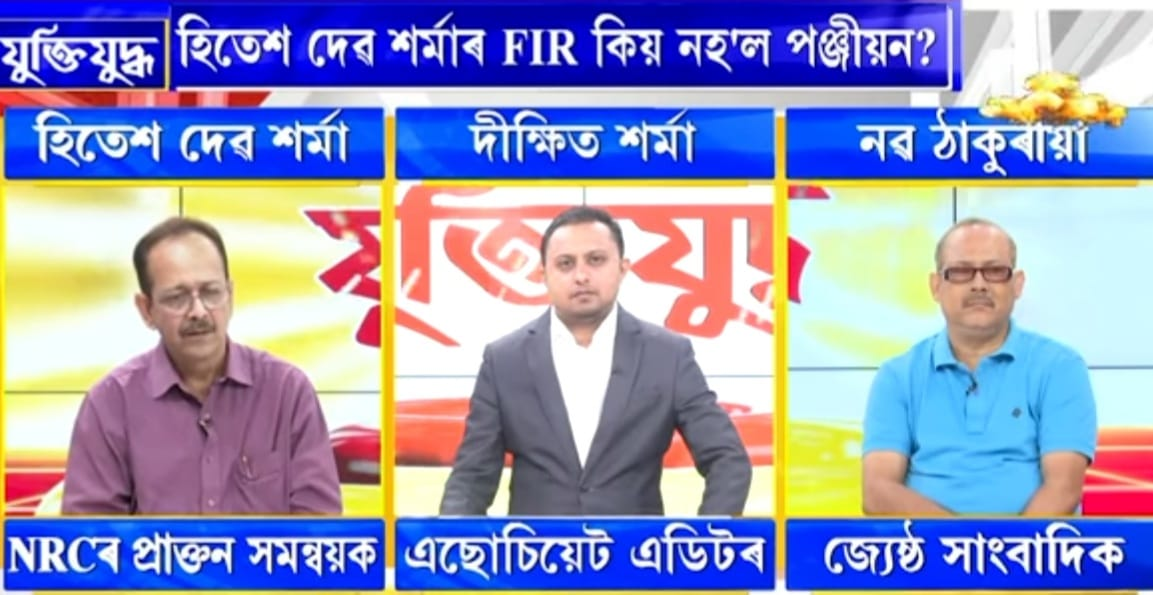
Participating in a debate on satellite television or digital channels needs some homeworks to make the deliberations short and clear. Unless you face an arrogant anchor and unruly participants, the experience in talk shows normally emerges as an intriguing one. It happened to me, as I had recently participated in a digital media discussion on the pertinent issue of National Register of Citizens  (NRC) in Assam, where the prime guest was none other than the immediate past State NRC coordinator Hitesh Dev Sarma. The talk show host Dikshit Sharma put the questions in a clever way so that the issue comes alive and my part was just to interpret Dev Sarma’s version for clarity to the valued audience of Time8.

Dev Sarma, recently retired as an Indian Administrative Services officer, lodged complaint against his predecessor Prateek Hajela, another IAS officer- presently in deputation to Madhya Pradesh, accusing him and the system integrator (Wipro Limited) of engaging in corruption and money laundering while updating the 1951 NRC in Assam. He clarified that the supplementary NRC list, which was released on 31 August 2019 excluding 19,06,657 applicants due to lack of papers, was asserted by Hajela as the final one (but the same is yet to be notified by Registrar General of India). As Hajela’s three-year deputation term is almost completed, he is scheduled to return back to Assam by this year.

The issue of base year for NRC updation in Assam also came to the discussion as the State had to obey 1971 as prescribed in the Assam Accord (unlike the national cut-off year of 1951). The people of Assam are expecting a final verdict on the cut-off year (to identify foreigners in the State) from the Supreme Court of India. Dev Sarma was asked about the implications of a verdict favouring 1951 as the base year for Assam too, where he stated that it would increase more work to the responsible officers and employees, but the common people (except a few) would face no troubles. With stored documents in the NRC directorate, the issue would be resolved amicably, added Dev Sarma.

Speaking about the inclusion of thousands of suspected families in the NRC draft, Dev Sarma claimed that Hajela used a faulty software technology in the process with no cross-checking facility. The provision  for checking family legacy datas (through family tree matching) was deliberately designed in such a way that no superior officers (except Hajela) could go for reverification. So it’s a criminal and anti-national activity, asserted Dev Sarma. On another occasion, Hajela adopted the policy of DMIT (district magistrate investigation team) verification, which was not recommended by the apex court, but surprisingly he did not face any brickbate from the then SC chief justice, reasons best known to Ranjan Gogoi only.

Assam Public Works (original petitioner in the apex court with the demand to update the NRC in Assam) filed a number of police complaints against Hajela and his close aides alleging gross misappropriation of government funds in the process. Lately, APW chief Aabhijeet Sharma lodged another complaint against information technology firm Wipro alleging the misappropriation of public money, where the influential civil rights group made the NRC directorate also a party. Quoting the Comptroller and Auditor General of India’s interim report, it narrated in the FIR that a massive corruption had taken place in the Rs 1,600 crore exercise with the active role of the concerned top officials.

Dev Sarma, who also submitted an affidavit in the apex court, said that the accountant general observed that undue benefit of Rs 155.83 crore was allowed to SI/labour contractor. It also identified an avoidable expenditure to the tune of Rs 10.73 crore in connection with the engagement of third-party monitoring consultants. As per the rules, for expenditure of above Rs five crore, Hajela had to obtain an approval from the empowered committee, headed by the State chief secretary or from the RGI, but he did not do so.

In his formal complaint, Dev Sarma described the anomalies where the Wipro engaged one sub-contractor for providing data entry operators (DEOs) without any prior approval from the authority. It was found that the then State coordinator was aware of the sub-contractor, but did not intervene. Wipro was paid Rupees 14,500 to 17,500 per month per DEO (by the NRC authority), but the DEOs got only Rs 5,500  to  9,100  per month during the years (2015 to 2019). Shockingly, more than 6000 DEOs were denied even the least amount as per the country’s  minimum wages act. Some DEOs even came to the streets demanding their due amounts. They also approached the State labour commissioner for their dues.

My final assertion was that the DEOs must get their legal dues irrespective of the fate of NRC, as they have nothing to do with it. A huge amount of money, meant for them, was grabbed by some individuals with corrupt practices. Unfortunately three Guwahati-based senior television journalists have also been named and shamed on social media as the beneficiaries of NRC scam. Thousands of social media users participated in the discourse and many urged those  media persons to clarify their stand, but they have not made any public statement about the allegation, which is surprising and unusual compared to their smart & energetic personalities reflected in the television screen.

Add new comment

Other Contents by Author

Guwahati: It was an amazing experience to attend the foundation day of a 25 year old press club in central Assam on a lazy Sunday, where a number of senior citizens along with rural scribes and novice journalists were waiting to listen to my speech. It’s easier to address a journalist’s meet- where we can discuss many issues with liberties, but while the audience includes respected senior citizens and young people, it becomes a difficult task to speak to them together. First, the question that arises, how much should I highlight the eroding credibility of the mainstream media around India in general and Assam in particular and secondly what may be the role of social (alternate/digital)...
Guwahati: A year-long celebration of 100 years of sports journalism in Assam begins coinciding on the day while the first ever news related to a football competition is published in Asomiya (a weekly news magazine mentored by Chandra Kumar Agarwala) on 1  July 1923. Assam Sports Journalists Association (ASJA), which is affiliated with the Sports Journalists Federation of India (a national affiliate of the International Sports Press Association), has taken the lead in celebrating the occasion that will culminate on 1  July next year. On Saturday, flags for ASJA and the centenary celebration were hoisted by ASJA’s founder president Balendra Mohan Chakraborty and his successor...
Reactions from the public (sensitive readers) against a news item in any newspaper (also news channel) are usual in India, but outrages against the mainstream media outlets in digital platforms for not covering a particular issue is definitely an unusual phenomenon. The north-eastern state of Assam witnessed such public fury against some of the editor-journalists for avoiding press conferences by opposition political parties where they targeted the state chief minister for his family’s alleged land scam. The organized public uproar in the alternate media was so intense that the celebrity editor-journalists of Assam did not dare to clarify their positions. They preferred to avoid the...
Hyderabad: The Indian Journalists Union (IJU) has strongly condemned the incident of assault on a Manipur journalist and urged the state chief minister, N. Biren Singh, to book the culprits under the law. The National Union of Subscribes also wished for an early recovery of Elangbam Rameshwar, who works as a Thoubal correspondent for the Naharolgi Thoudang regional daily newspaper, which is published from Imphal. Local media hinted that the handiwork was masterminded by some Congress workers in the Thoubal locality of the north-eastern state, who were attacked by a group of 20 to 25 masked men in the morning hours on 24 October. The rural reporter faced assault at his residence in the...
Hyderabad: The national executive committee meeting of Indian Journalists Union (IJU), which concluded on Sunday in the capital city of Telangana, discussed various burning issues concerning the practitioners of journalism across India and emphasized on effective safety & security to journalists, reforms in Press Council of India (PCI) and basic minimum facilities to the media fraternity sustaining the spirit under freedom of the press to serve the largest democracy on the globe. Chaired by IJU president K Sreenivas Reddy, the two-day meeting held at Tourism Plaza in Begumpet locality expressed serious concern over killings of journalists by anti-social elements and filing of cases...
Guwahati: Interviewing a leader of an armed outfit in Myanmar (formerly known as Burma) and publishing its substance through a portal can be termed as a serious offence against the concerned editor. The fate of Khaing Mrat Kyaw, chief editor of Narinjara news portal, based in Sittwe of Rakhine (also known as Arakan) province in western Myanmar indicates the state of media’s freedom in the southeast Asian country. While the world is fighting against Covid-19 pandemic with over a hundred thousand casualties, the Myanmar authorities have framed charges of glorifying terrorism against the editor for uploading an interview with Khaing Thu Ka, spokesperson of Arakan Army, an ethnic revolutionary...
Amidst myriad devastation created by the novel corona virus around the world, news industries might learn to survive with regained credibility, continued authenticity and most sought after accountability in the post Covid-19 pandemic era. Earlier if these principles were necessary for the mainstream media, now it becomes an utmost priority for its survival. Besides the news outlets, working journalists will also face the same heat.  As millions of people are infected with the deadly virus with thousands of casualties across the globe, once a vibrant media fraternity finds itself in an awkward situation as they start losing their readers, viewers, appreciators along with the...
Guwahati: City-based Dispur Hospitals in association with ‘The Heart’, a non-government organization, have organized an awareness rally on the occasion of World Heart Day on 29 September in the morning hours on streets of the pre-historic city, said the organisers in a press meet held in Guwahati Press Club on Saturday. Created by the World Heart Federation, the heart day updates people around the globe that the cardiovascular disease, including heart disease & stroke, remains the leading cause of human death. Moreover it highlights the probable actions for individuals to prevent and control the disease. “Over 17.9 million people die from CVDs worldwide every year and according to...
Dharamshala: Indian supporters for a free Tibet have urged the Union government in New Delhi to confer Bharat Ratna, the country’s highest civilian honour, on the Tibetan spiritual leader His Holiness the 14th Dalai Lama for his immense contributions in creating goodwill for India in the last six decades. In a declaration, adopted in the 6th All India Tibet Support Groups’ Conference held on 15 and 16 June in Dharamshala township of Himachal Pradesh under the chairmanship of Rinchin Khandu Khrimey, national convener of Core Group for Tibetan Cause (CGTC), it was accomplished that the Nobel laureate continues to be a holy ambassador of Indian culture enriched with non-violence, compassion...
Guwahati: City based Barthakur Clinic Hospital conducted a brief media OPD clinic at Guwahati Press Club on Saturday (23 February 2019), where nurses Lucy L Chongloi and Kapila Lama Borah checked blood pressures of the participants. It may be mentioned that the participating scribes have maintained the readings of normal blood pressure in the camp.