
Skip to content Skip to navigation

IJU meet concludes in Hyderabad emphasizing on journo-safety & security, PCI reform, minimum facilities
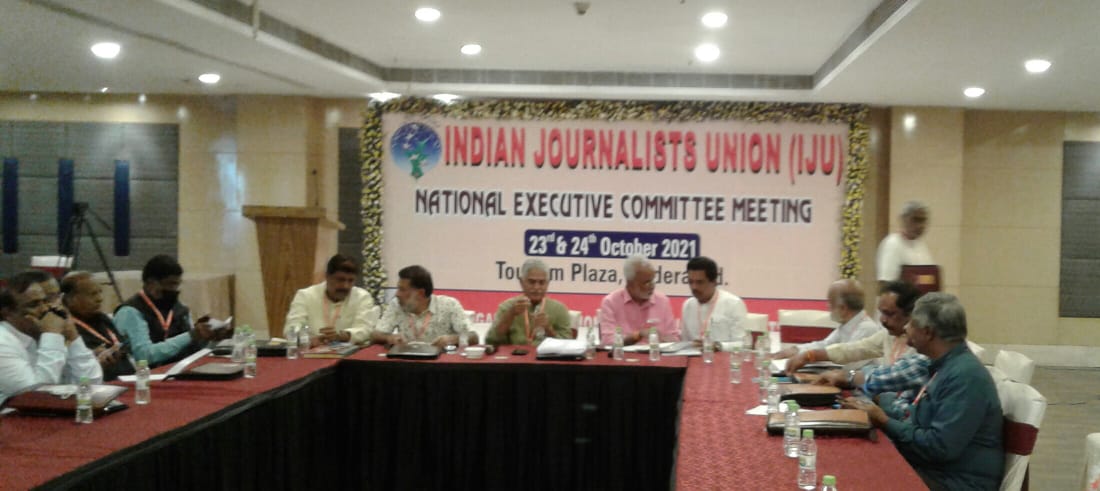
Hyderabad: The national executive committee meeting of Indian Journalists Union (IJU), which concluded on Sunday in the capital city of Telangana, discussed various burning issues concerning the practitioners of journalism across India and emphasized on effective safety & security to journalists, reforms in Press Council of India (PCI) and basic minimum facilities to the media fraternity sustaining the spirit under freedom of the press to serve the largest democracy on the globe.

Chaired by IJU president K Sreenivas Reddy, the two-day meeting held at Tourism Plaza in Begumpet locality expressed serious concern over killings of journalists by anti-social elements and filing of cases against journalists and media houses to give a signal to them to fall in line or face the music. In the presence of representatives from almost all states and union territories including Assam and Ladakh, the meet also expressed concern over a very large number of journalists falling prey to the Covid-19 pandemic.

The IJU urged authorities to probe the murders of five journalists till date in 2021 and provide adequate compensation to the victim's family. It also appealed to the union government to declare working journalists as frontline warriors and sanction compensation to all corona-victims in media across the country, which should be in exclusion from the compensatory amount of money declared by various state governments. The national union of scribes urged the provincial governments, where journalists succumbed to the corona virus invasion, to announce compensatory packages to affected families.

Expressing concern over the growing number of attacks on journalists (where India lost five journalists, namely Raman Kashyap, Manish Kumar Singh, Chenna Keshav, Sulabh Srivastava and Ashu Yadav to assailants) and media organisations in different parts of the country, the IJU meeting demanded a specific law to deal with such situations across India. It also urged the government not to misinterpret or misuse various laws with the aim of harassing media houses and not falling in line.

In a different issue, the IJU has denounced the dictatorial and unlawful activities of the outgoing PCI chairman Justice CK Prasad and demanded the restoration of credibility of the quasi-judicial body with rightful representation to the national unions. Moreover, the IJU reiterated its demand to widen the PCI with the inclusion of electronic & digital media and to rename it as Media Council of India.

The influential union demanded the reinstallation of the Working Journalists Act with more favourable provisions encompassing wages, wage revisions, job security, pension benefits and the whole gamut of working conditions for professional journalists in the country. The meeting, in a resolution passed unanimously, termed the amalgamation of the WJA 1955, into a code where working journalists are bundled along with sales representatives as dangerous to democracy.

As clarified by the Supreme Court of India, freedom of press in the country is inherently laid down in the constitutionally guaranteed right to freedom of expression. A free press, one of the most essential ingredients for safeguarding democracy, is in turn the sacred duty of working journalists and stripping of the rightfully accorded special recognition of a fraternity vested with such weighty responsibility, spells danger to the very fabric of democracy, the resolution stated.

The IJU has felt that in the present complex media scenario, it is all the more important that laws governing media & media persons and regulation of various media are strengthened with a view to promoting free media and buttressing the right to free speech. Instead of resorting to such progressive measures, the Union government has thought it fit to strip working journalists of their special recognition as enshrined in the WJA. The IJU meeting has urged the Centre to rectify the anomaly immediately by reinstalling the concerned act.

Union minister for tourism, culture and DoNER (development of north-eastern region) Gangapuram Kishan Reddy also graced the occasion, where he appealed to the media fraternity to play a proactive role in the growth of the nation. He agreed to initiate support for corona-media victims and pragmatic actions for the welfare and enrichment of journalists across the country. Andhra Pradesh information commissioner Vijay Kumar Reddy also addressed the gathering on the concluding day.

Earlier, Telangana Minister for Tourism, Exercise and Sports V Srinivas Goud graced the opening day programmes and assured all possible support to media persons of the newly created Telangana State. A number of senior journalists including IJU secretary general Balwinder Singh Jammu, IJU former presidents SN Sinha and Devulapalli Amar (presently the national media adviser to AP government), IJU vice-president Ambati Anjaneyulu, Scribes News editor Alapati Suresh Kumar, IJU secretary Y Narender Reddy were present in the meet, which was hosted by the Telangana State Union of Working Journalists.

Author info

Nava Thakuria's picture

Senior journalist based in Guwahati.

Add new comment

Other Contents by Author

After Assam, Keralam and Puducherry (union territory), the State legislative assembly elections are knocking at the doors of  Tamil Nadu and West Bengal in the second half of April 2026. Meanwhile, the millions of voters have shown an extraordinary commitment to electoral politics as they participated in the largely peaceful single-phase assembly polls on  9 April recording a high voters’ turnout. Assam recorded 85.96% voter participation  in 126 assembly seats, where Puducherry showcased over 90% voting in 30 constituencies followed by Keralam (140 seats) with nearly 80% turnout. Assam’s 2.50 crore electorates (including 1.25 crore female voters and 6.4 lakh first-timers...
As Assam goes to the single-phase polling  tomorrow (9 April 2026), nearly 2.49 crore registered voters (including 5.75 lakh young/first time voters) will exercise their franchise to elect 126 representatives for the State legislative assembly. Under the guidelines of  Election Commission of India, all types of campaigning had already came to a halt at 5 pm on Tuesday (48 hours prior to voting) where the authority urged all candidates, political parties, and media outlets to strictly follow the guidelines. The same timeline is made applicable for Kerala and Pondicherry as well, whereas Tamil Nadu will vote on 23 April, and West Bengal going for polling on 23 and 29 April next....
Landlocked Himalayan nation Nepal prepares for its ninth national election  on 5 March, which was necessitated with the collapse of its government in Kathmandu during September last year following an anti-corruption mass uprising, which was initiated by the young people and resulted in the killing of dozens of agitators and injuring hundreds other. The south Asian country of around 30.55 million people, sandwiched between two giants India and Tibet/China, has readied all necessary arrangements for the single day polling through ballot papers under the protection of  nearly 3,50,000 security personnel (with additional armed forces kept ready for an unwanted emergency situation...
Even all political parties, not to speak of millions of fans and well-wishers of Assam’s revered cultural icon  Zubeen Garg, continue preaching for sparing the maverick singer’s name in doing politics, his mysterious death last year in a foreign land may dominate the electoral politics in the forthcoming legislative polls. Indications surface that Assam assembly elections (scheduled for March-April 2026 along with West Bengal, Tamil Nadu, Kerala and Puducherry) will observe a high voltage campaigning on  Zubeen’s unexplained demise in Singapore on 19 September 2025 and subsequent investigation and judicial processes. Even after five months of his final departure, Zubeen continues...
As Bangladesh has constituted a new government under the leadership of  Bangladesh Nationalist Party (BNP) after a largely fair & peaceful national election on 12 February 2026, the people of eastern India (the region virtually embraces the poverty stricken country except a few kilometers in Myanmar and the Bay of Bengal)  hope for a progressive regime in Dhaka enjoying political stability and pursuing economic developments to over 170 million people in the south Asian nation. The Muslim majority country continues to grow as a headache for the north-eastern states, more precisely Assam, for at least two  reasons namely unabated influx of migrants and regional security...
Amid high security arrangements across the country, polling begins this morning at 7:30 am for the highly projected 13th Jatiya Sansad election in Bangladesh, where over 2000 candidates representing 50 political parties along with many independent contestants are in the fray. The Muslim majority nation has over  12.77 crore registered voters including 6.27 crore women and 1,232 third-genders, who are voting for electing   299 representatives (out of 300 seats in the national assembly). Over 42,000 polling centres will facilitate the electorates to exercise their franchise (through  ballots in person) till 4:30 pm (on 12 February 2026). The election will be conducted...
As Bangladesh heads for 13th Parliamentary election and  the referendum on  July National Charter simultaneously on Thursday (12 February 2026), the interim government chief Professor Muhammad Yunus urged all participating candidates to rise above personal and party interests to prioritize greater interest of the Muslim majority nation regardless of the poll-outcomes. Addressing the nation of over 170 million people ahead of the much watched electoral exercises, Nobel peace laureate  Dr Yunus commented that victory as well as defeat is an integral part of democracy and hence after the election, they should dedicate themselves to build a new, just, democratic, and inclusive...
Is it possible to have a quasi-judicial body like the Press Council of India to survive for weeks without its chairperson? Should the largest democracy on Earth put such an example where its government recognized autonomous media watchdog faces an existential crisis as the 15th council of PCI still devoid of a functioning head and 13 seats? How come a press council runs its business without filling these 13 seats, meant for millions of media professionals, for more than a year now, whereas the term of a council is limited to three years only? Many such pertinent questions  emerge among media professionals in the   south Asian nation, as the regular three-year term (as well as...
Amid an existential crisis in the Guwahati-based Assam Tribune group of newspapers, which worsened after the Covid-19 pandemic, a popular Assamese weekly newspaper lost its publication in the latter part of 2025. Asom Bani, once a mainstream weekly for Assamese readers for decades, stopped hitting the stands from September last year, as the management lost interest in continuing its printing every Friday. Even though the seven-decade-old Assamese-language weekly was lost from the media market, the management did not make any statement about Asom Bani’s fate. Prior to its departure, the weekly was merged with Dainik Asom, an acclaimed Assamese daily from the prestigious media house, as its...
Bangladesh, which recently witnessed turmoil following the demise of a young radical leader Sharif Osman Bin Hadi amid anti-India rhetoric, now gradually returns to normalcy, as the south Asian nation also prepares for its next general election scheduled  for 12 February 2026. The highly sought after polls, as the sitting Prime Minister Sheikh Hasina faced an overthrow in the backdrop of a student-led mass uprising in July-August 2024, however misses the participation of Hasina’s party Awami League, which used to rule the Muslim majority country of 170 million people for several years. The ousted premier along with thousands of  her party men continue to stay in neighbouring...