
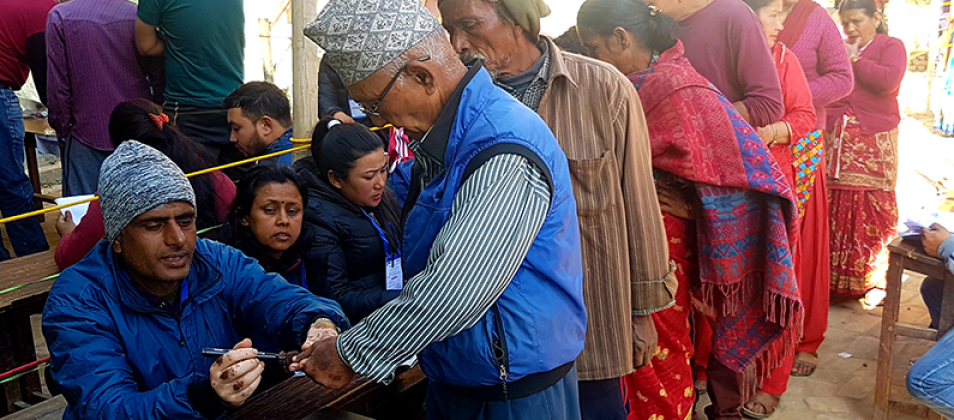
Landlocked Himalayan nation Nepal prepares for its ninth national election on 5 March, which was necessitated with the collapse of its government in Kathmandu during September last year following an anti-corruption mass uprising, which was initiated by the young people and resulted in the killing of dozens of agitators and injuring hundreds other. The south Asian country of around 30.55 million people, sandwiched between two giants India and Tibet/China, has readied all necessary arrangements for the single day polling through ballot papers under the protection of nearly 3,50,000 security personnel (with additional armed forces kept ready for an unwanted emergency situation).
According to the Election Commission of Nepal, the Hindu majority nation has 18,903,689 eligible voters comprising 9,240,131 women, who will elect their representatives to the 275-member House of Representatives (HoR). The fate of 3,484 candidates representing 68 political parties and independent contestants will be sealed inside ballot boxes placed in 10,967 polling stations (comprising 23,112 polling booths) across the republic, currently ruled by an interim government led by former Supreme Court’s chief justice Sushila Karki, who took charge on 12 September 2025 (subsequently the Parliament/HoR was dissolved by President Ram Chandra Poudel) and assured general election within six months.
Nepal follows a mixed electoral system guided by the 2015 Constitution, where the electorates give consent to a candidate of his/her choice with the first ballot (the process named First Past The Post of direct voting system) to elect 165 Parliamentarians. The second ballot records mandates a political party (known as Proportional Representation) to elect 110 members offering space to the minorities and smaller parties in the Parliament. The system usually prevents any political party acquiring most of the seats leaving due space to the opposition.
At least three prime ministerial candidates are in the electoral fray where two contenders are fighting from the same constituency, turning the India bordering locality a place of happening in the last few days. The electorates of Jhapa-5 seat will have the opportunity to re-elect veteran communist leader Khadga Prasad Sharma Oli, who had to resign on 9 September 2025 as the premier following the youth-led massive agitation or make choice in Balendra Shah (popularly known Balen), who was one of the front line leaders in the anti-government agitation. For Oli, leader of the Communist Party of Nepal–Unified Marxist Leninist (CPN-UML), his electoral constituency in eastern Nepal remains a stronghold. After his resignation from the office on 9 September 2025, the four-time prime minister kept hiding for some days, but soon the septuagenarian leader appeared among the people organizing his party workers.
On the other hand, 35 years old structural engineer turned rapper turned politician Balen enjoys a huge popularity among the social media users Nepali citizens. Days back, he resigned as the mayor of Kathmandu metropolitan city and joined Rashtriya Swatantra Party (National Independence Party) led by television journalist turned politician Rabi Lamichhane. Even though there are no opinion polls in Nepal as it’s restricted by the authority, the general opinion indicates him as the front runner for the post of 16th premier (to be installed at Singha Durbar/ PMO in Kathmandu). Balen, who received wide appreciations as Kathmandu mayor for initiatives to expand roads, maintain an efficient garbage management and overall cleanliness drives across the picturesque city, now promises for a corruption-free administration and good governance.
He also promises to create 1.2 million jobs to Nepali youths to prevent their exodus to foreign lands. Needless to mention that over 3 million Nepali nationals study, work and live in more than100 countries across the world. In contrast to the Constitutional guarantees, those non-resident Nepalis even though remain active on social media pursuing electoral preferences but cannot exercise their franchise from their workplaces. Balen drew international media attention as he recently dropped a China-sponsored mea industrial project under the Belt and Road Initiative of Beijing from the election manifesto. Adjacent to the strategically sensitive Siliguri corridor (Chicken’s neck) of India, the Damak industrial park in Jhapa district remained as the headache for New Delhi, since its foundation stone was laid five years back.
The third prime ministerial contender has been floated by Nepali Congress, the country's oldest political party, which was an ally to the Oli-led government that collapsed following the deadly anti-corruption protests, putting its new president Gagan Kumar Thapa to the front. Thapa, 50, replaced five-time prime minister Sher Bahadur Deuba, 79, who decided not to contest in the election. Another former prime minister and senior leader of Nepal Communist Party (UML) Jhala Nath Khanal also did not participate in the polls. Mentionable is that both Deuba and Khanal were targeted by a section of unruly agitators during the violent youth protests.
- 29675 reads


Add new comment