
Skip to content Skip to navigation

Nepal goes for much watched polls this Thursday

x

Error message

  • Notice: Undefined index: DraggableCaptchaAnswer in draggable_captcha_generate_refresh() (line 197 of /home/assam1/web/assamtimes.org/public_html/sites/all/modules/draggable_captcha/draggable_captcha.module).
  • Notice: Undefined index: DraggableCaptchaCodes in draggable_captcha_generate_refresh() (line 197 of /home/assam1/web/assamtimes.org/public_html/sites/all/modules/draggable_captcha/draggable_captcha.module).
  • Notice: Trying to access array offset on value of type null in draggable_captcha_generate_refresh() (line 197 of /home/assam1/web/assamtimes.org/public_html/sites/all/modules/draggable_captcha/draggable_captcha.module).
FIle Photo: Nepal Election

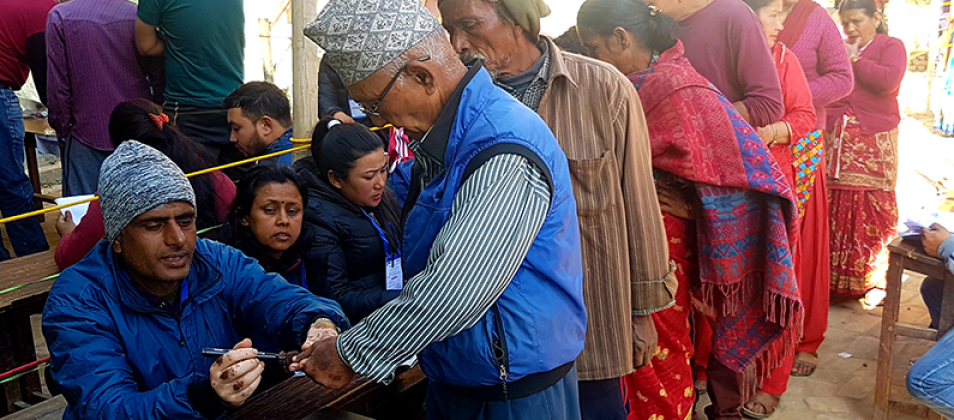
Landlocked Himalayan nation Nepal prepares for its ninth national election  on 5 March, which was necessitated with the collapse of its government in Kathmandu during September last year following an anti-corruption mass uprising, which was initiated by the young people and resulted in the killing of dozens of agitators and injuring hundreds other. The south Asian country of around 30.55 million people, sandwiched between two giants India and Tibet/China, has readied all necessary arrangements for the single day polling through ballot papers under the protection of  nearly 3,50,000 security personnel (with additional armed forces kept ready for an unwanted emergency situation).

According to the Election Commission of Nepal, the Hindu majority nation has 18,903,689 eligible voters comprising 9,240,131 women, who will elect their representatives to the  275-member  House of Representatives (HoR). The fate of 3,484 candidates representing 68 political parties and independent contestants will be sealed inside ballot boxes placed in 10,967 polling stations (comprising 23,112 polling booths) across the republic, currently ruled by an interim government led by  former Supreme Court’s chief justice Sushila Karki, who took  charge on 12 September 2025 (subsequently the Parliament/HoR was dissolved by  President Ram Chandra Poudel) and assured general election within six months.

Nepal follows a mixed electoral system guided by the 2015 Constitution, where the electorates give consent to a candidate of his/her choice with the first ballot (the process named First Past The Post of direct voting system) to elect  165  Parliamentarians. The second ballot records mandates a political party (known as Proportional Representation) to elect 110 members offering space to the  minorities and smaller parties in the Parliament. The system usually prevents any political party acquiring most of the seats leaving due space to the opposition.

At least three prime ministerial candidates are in the electoral fray where two contenders are fighting from the same constituency, turning the India bordering locality a place of happening in the last few days. The electorates of Jhapa-5 seat will have the opportunity to re-elect veteran communist leader Khadga Prasad Sharma Oli, who had to resign on 9 September 2025 as the premier following the youth-led massive agitation or make choice in Balendra Shah (popularly known Balen), who was one of the front line leaders in the anti-government agitation. For Oli, leader of the Communist Party of Nepal–Unified Marxist Leninist (CPN-UML), his electoral constituency in eastern Nepal remains a stronghold. After his resignation from the office on 9 September 2025, the four-time prime minister kept hiding for some days, but soon the septuagenarian leader appeared among the people organizing his party workers.

On the other hand, 35 years old structural engineer turned rapper turned politician Balen enjoys a huge popularity among the social media users Nepali citizens. Days back, he resigned as the  mayor of Kathmandu metropolitan city  and joined  Rashtriya Swatantra Party (National Independence Party)  led by television journalist turned politician Rabi Lamichhane.  Even though there are no opinion polls in Nepal as it’s restricted by the authority, the general opinion indicates him as the front runner for the post of 16th premier (to be installed at Singha Durbar/ PMO in Kathmandu). Balen, who received wide appreciations as Kathmandu mayor for initiatives to expand roads, maintain an efficient garbage management and overall cleanliness drives across the picturesque city, now promises for a corruption-free administration and good governance.

He also promises  to create 1.2 million jobs to Nepali youths to prevent their exodus to foreign lands. Needless to mention that over  3 million Nepali nationals study, work and live in more than100 countries across the world. In contrast to the Constitutional guarantees, those non-resident Nepalis even though remain active on social media pursuing electoral preferences but cannot exercise their franchise from their workplaces. Balen drew international media attention as he recently dropped a China-sponsored mea industrial project under the Belt and Road Initiative of Beijing from the election manifesto. Adjacent to the strategically sensitive Siliguri corridor (Chicken’s neck) of India, the Damak industrial park in Jhapa  district remained as the headache for New Delhi, since its foundation stone was laid five years back.
The third prime ministerial contender has been floated by Nepali Congress, the country's oldest political party, which was an ally to the Oli-led government that collapsed following the deadly anti-corruption protests, putting its new president Gagan Kumar Thapa to the front. Thapa, 50, replaced five-time prime minister Sher Bahadur Deuba, 79, who decided not to contest in the election. Another former prime minister and senior leader of Nepal Communist Party (UML) Jhala Nath Khanal also did not participate in the polls. Mentionable is that both  Deuba and Khanal were targeted by a section of unruly agitators during the violent youth protests.

Add new comment

Other Contents by Author

Guwahati: Since 1  February  2005, Assam government has implemented the National Pension Scheme (NPS) for the government employees. All Assam Government NPS Employees’ Association terms it an anti-employee policy and a mockery in the name of pension. The Union government, instead of restoring the Old Pension Scheme (OPS), has taken initiatives  to replace the NPS with a new one named Universal Pension Scheme (UPS). The third biennial conference of the association, held on 24 August at Rupnagar in the city strongly opposed this move and demanded the reintroduction of the OPS. President Achyutananda Hazarika and general secretary Apurba Sharma announced that from next month...
The natural gas leakage from Bhatiapar  crude oil well continues for 15 days, even though  the Oil and Natural Gas Corporation (ONGC) along with an expert team from USA continue working for full dousing of the RDS-147A under  Rudrasagar oilfield in Sivasagar district of eastern Assam. The blowout began on 12 June 2025 and uncontrolled leakage compelled nearly 350 families to leave their places for safety reasons. Besides the local villagers living near the old well, the high pressure gas flow impacted the surrounding environment heavily. Lately, the ONGC issued a statement claiming that ‘a significant progress in controlling the well at RDS 147A’ was made. It also added the...
When hundreds of media workers died of  Covid-19 complications across India, a few people thought the corona disaster would also devastate the print media with sharply declined circulation figures resulting in shrinking advertisement revenues. Many established newspaper-publishing groups either closed many of their editions in the post-corona period or drastically reduced the number of employees to cope up with the hard situation. Some newspapers were shut down forever and many owners were compelled to sell their publications. The troubles are now brewing for the oldest media house in north-eastern region after a Dimapur-based English daily recently ceased its publications. The...
Guwahati: Amid stained bilateral relations between India and Bangladesh, Prime Minister Narendra Modi and the head of Dhaka-based interim government Dr Muhammad Yunus exchanged warm greetings on the occasion of Eid-ul-Azha. In an official letter (dated on 4 June 2025), PM Modi on behalf of the people and government of Bharat conveyed good wishes to Dr Yunus and the people of Bangladesh on the auspicious occasion of the Islamic festival. This holy festival is an integral part of the rich and diverse cultural heritage of India and is celebrated with immense joy and fervour by millions of people of Islamic faith across the country. It reminds us of the timeless values of sacrifice,...
In the decisive war against Pakistan in 1971, India won and a new nation was born, but a small State in eastern part of Bharat had to pay a heavy price with millions of East Pakistan refugees, for which Assam  still cries but nobody cares. With an absorbent border with Bangladesh and unconvincing political will from the government, augmented by continued callous attitude of majority Asomiya people, the situation remains grim even today. New Delhi supported the Mukti Bahini (the freedom aspiring Bengalis of East Pakistan) in their movement against West Pakistan and finally the atrocious Pakistan forces had to surrender on 16 December 1971. But the newly born sovereign country was not...
The current interim government of Bangladesh, led by Nobel laureate Professor Muhammad Yunus, remains busy pursuing the final reports by a number of reform commissions with their proposals and subsequent discussions with the political party representatives. Even after nine months of its formation in Dhaka, the situation across the south Asian nation continues to be murky. Needless to mention that a sense of joy and expectation surfaced among nearly 170 million Bangladeshi nationals, when the caretaker government was constituted following a massive student-led uprising compelled sitting Prime Minister Sheikh Hasina to resign and flee (to India) on 5 August last year. Enjoying the...
A recent controversy erupted following a social media post by a television journalist, associated with Gauhati Press Club (earlier Guwahati Press Club) in northeast India, brought many questions for the media body, which invited a minister in Assam chief minister Himanta Biswa Sarma’s cabinet for a cultural program, but shockingly ‘faced derogatory comments’. The particular post was generated by the journalist working for a satellite news channel owned by the CM’s family, and his outburst that the State health & family welfare minister Ashok Singhal disrespected a delegation from GPC, was taken seriously. According to the journalist, the GPC delegation went to invite Singhal for a...
The recently concluded by-polls for 48 legislative assembly constituencies in 14 States (along with two Parliamentary constituencies in Kerala and Maharashtra) divulged an important fact that no less than  41 assembly seats needed  the special elections as those were vacated by the respective legislators after they were elected to the lower house of Indian Parliament. The representatives of different political parties (irrespective of their ideologies or position in the governments) participated in the last general elections and succeeded to be  lawmakers in the 18th Lok Sabha. One may wonder how all these members of State legislative assemblies turned Parliamentarians...
Geneva based the Press Emblem Campaign (PEC), a global organization advocating for media safety and rights, has expressed deep concern over the ongoing violence against journalists in Pakistan. The latest victim, Janan Hussain (40), was killed in Khyber Pakhtunkhwa near the Afghan border on November 20, during an ambush in the Kurram area that claimed the lives of 42 Shiite Muslims. Hussain, a journalist with Channel 365 and a member of the Parachinar Press Club, is the 11th media worker killed in Pakistan this year. "Janan Hussain's murder marks the 129th journalist killed globally since January 1, highlighting the grim reality of impunity in such cases," said Blaise Lempen, President...
The Press Emblem Campaign (PEC) awarded its annual prize for the protection of journalists to Palestinian journalist Iyad Alasttal. This recognition comes amidst the unprecedented loss of over 150 Palestinian and Lebanese journalists since October 7, 2023, marking one of the highest tolls in such a short period in a conflict. The PEC dedicated the prize to the memory of these journalists who risk their lives daily. Iyad Alasttal, a journalist from Gaza, was forced to flee due to Israeli reprisals following the Hamas attack on October 7, 2023. Alasttal, who launched the Gaza Stories project in 2019, has been chronicling life in Gaza and reporting for French and Western media outlets....