Skip to content Skip to navigation

Nepal goes for much watched polls this Thursday

FIle Photo: Nepal Election

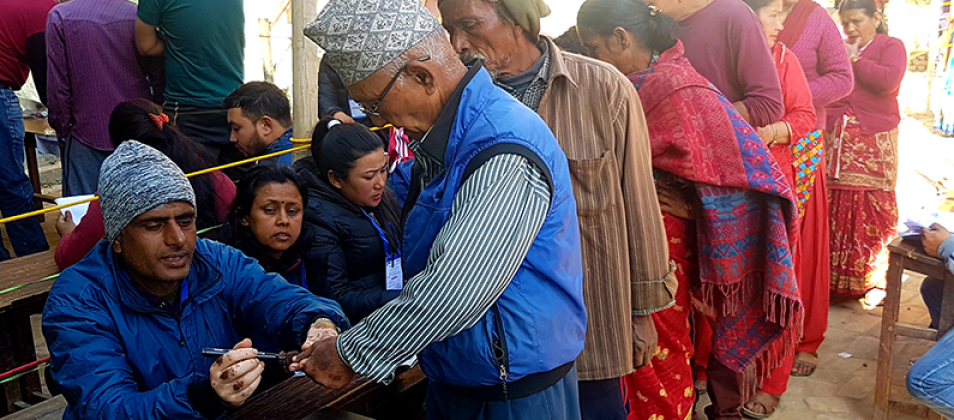
Landlocked Himalayan nation Nepal prepares for its ninth national election  on 5 March, which was necessitated with the collapse of its government in Kathmandu during September last year following an anti-corruption mass uprising, which was initiated by the young people and resulted in the killing of dozens of agitators and injuring hundreds other. The south Asian country of around 30.55 million people, sandwiched between two giants India and Tibet/China, has readied all necessary arrangements for the single day polling through ballot papers under the protection of  nearly 3,50,000 security personnel (with additional armed forces kept ready for an unwanted emergency situation).

According to the Election Commission of Nepal, the Hindu majority nation has 18,903,689 eligible voters comprising 9,240,131 women, who will elect their representatives to the  275-member  House of Representatives (HoR). The fate of 3,484 candidates representing 68 political parties and independent contestants will be sealed inside ballot boxes placed in 10,967 polling stations (comprising 23,112 polling booths) across the republic, currently ruled by an interim government led by  former Supreme Court’s chief justice Sushila Karki, who took  charge on 12 September 2025 (subsequently the Parliament/HoR was dissolved by  President Ram Chandra Poudel) and assured general election within six months.

Nepal follows a mixed electoral system guided by the 2015 Constitution, where the electorates give consent to a candidate of his/her choice with the first ballot (the process named First Past The Post of direct voting system) to elect  165  Parliamentarians. The second ballot records mandates a political party (known as Proportional Representation) to elect 110 members offering space to the  minorities and smaller parties in the Parliament. The system usually prevents any political party acquiring most of the seats leaving due space to the opposition.

At least three prime ministerial candidates are in the electoral fray where two contenders are fighting from the same constituency, turning the India bordering locality a place of happening in the last few days. The electorates of Jhapa-5 seat will have the opportunity to re-elect veteran communist leader Khadga Prasad Sharma Oli, who had to resign on 9 September 2025 as the premier following the youth-led massive agitation or make choice in Balendra Shah (popularly known Balen), who was one of the front line leaders in the anti-government agitation. For Oli, leader of the Communist Party of Nepal–Unified Marxist Leninist (CPN-UML), his electoral constituency in eastern Nepal remains a stronghold. After his resignation from the office on 9 September 2025, the four-time prime minister kept hiding for some days, but soon the septuagenarian leader appeared among the people organizing his party workers.

On the other hand, 35 years old structural engineer turned rapper turned politician Balen enjoys a huge popularity among the social media users Nepali citizens. Days back, he resigned as the  mayor of Kathmandu metropolitan city  and joined  Rashtriya Swatantra Party (National Independence Party)  led by television journalist turned politician Rabi Lamichhane.  Even though there are no opinion polls in Nepal as it’s restricted by the authority, the general opinion indicates him as the front runner for the post of 16th premier (to be installed at Singha Durbar/ PMO in Kathmandu). Balen, who received wide appreciations as Kathmandu mayor for initiatives to expand roads, maintain an efficient garbage management and overall cleanliness drives across the picturesque city, now promises for a corruption-free administration and good governance.

He also promises  to create 1.2 million jobs to Nepali youths to prevent their exodus to foreign lands. Needless to mention that over  3 million Nepali nationals study, work and live in more than100 countries across the world. In contrast to the Constitutional guarantees, those non-resident Nepalis even though remain active on social media pursuing electoral preferences but cannot exercise their franchise from their workplaces. Balen drew international media attention as he recently dropped a China-sponsored mea industrial project under the Belt and Road Initiative of Beijing from the election manifesto. Adjacent to the strategically sensitive Siliguri corridor (Chicken’s neck) of India, the Damak industrial park in Jhapa  district remained as the headache for New Delhi, since its foundation stone was laid five years back.
The third prime ministerial contender has been floated by Nepali Congress, the country's oldest political party, which was an ally to the Oli-led government that collapsed following the deadly anti-corruption protests, putting its new president Gagan Kumar Thapa to the front. Thapa, 50, replaced five-time prime minister Sher Bahadur Deuba, 79, who decided not to contest in the election. Another former prime minister and senior leader of Nepal Communist Party (UML) Jhala Nath Khanal also did not participate in the polls. Mentionable is that both  Deuba and Khanal were targeted by a section of unruly agitators during the violent youth protests.

Add new comment

Other Contents by Author

The Press Emblem Campaign (PEC) awarded its annual prize for the protection of journalists to Palestinian journalist Iyad Alasttal. This recognition comes amidst the unprecedented loss of over 150 Palestinian and Lebanese journalists since October 7, 2023, marking one of the highest tolls in such a short period in a conflict. The PEC dedicated the prize to the memory of these journalists who risk their lives daily. Iyad Alasttal, a journalist from Gaza, was forced to flee due to Israeli reprisals following the Hamas attack on October 7, 2023. Alasttal, who launched the Gaza Stories project in 2019, has been chronicling life in Gaza and reporting for French and Western media outlets....
On the midnight of August 31, 2019, an extraordinary bureaucrat unveiled the contentious National Register of Citizens (NRC) in Assam, amidst a large gathering of eager media personnel in Guwahati. Prateek Hajela, the then State NRC coordinator, not only explained various features of the NRC to the assembled reporters but also declared the supplementary list as the definitive one. Some television journalists, excited by the so-called "extraordinary work" of the technocrat-turned-IAS officer, went as far as to applaud Hajela as a superhero. However, the ground reality paints a different picture. The Assam NRC has never been endorsed—nor is it today—by the Registrar General of India (RGI...
It’s shocking to report that a number of Guwahati-based scribes and RTI (right to information) activists have been facing interrogation and even arrest by Assam chief minister’s special vigilance cell following the allegations of Sewali Devi Sharma, the prime accused in Rs 105 crore State council of educational research and training (SCERT) scam, as being blackmailers to her in different occasions. The arrestees include a female reporter (identified as Pujamoni Das alias Honey Kashyap, who reportedly took a large volume of money from Ms Sharma) along with a satellite news channel reporter named Bhaskarjoti Hazarika.  RTI activists namely Rabijit Gogoi (who pretended to be a...
Can we imagine a world of zero poverty, zero unemployment, and zero carbon emissions with a new approach in post-corona economics! Ask Nobel laureate Professor Muhammad Yunus and he will answer in the affirmative. The university professor turned revolutionary banker believes that the human race should not only dream about a safer world by reducing global warming, wealth concentration and unemployment, but also work in that direction with personal and collective capacities. In his latest book titled ‘A World of Three Zeros’, Prof Yunus proposes a new economic system focusing on every human being as an entrepreneur in the making. He believes that humans are not born to work only for...
Guwahati: Assam is all set to host first sustainable financial working group (SFWG) meeting and Youth 20 inception meeting as part of India's year-long G20 presidency, where it is meticulously chalked out various tour programs that would help in promoting the State’s rich biodiversity and socio-cultural heritage in international arena. The authorities have completed the preparation to welcome the foreign delegates to the State. Guwahati is adorned with digital wall painting, thematic gates, flags of G 20 countries, LED cut-outs, standees, hoarding, etc as part of branding and beautification. The government has also completed the arrangement for the visiting delegates to places of...
Guwahati: India observes National Press Day on 16 November with an aim to pay tributes to everyone who contributed to the growth of print media along with its mentor & watchdog the Press Council of India (PCI). Moreover, it’s also an occasion for the practicing media persons to introspect seriously over their noble profession where it has been heading in the post-Covid-19 pandemic era. Since its inception and functioning, the PCI continues to symbolize a free and responsible press in the largest democracy in the world. Among all press or media councils, functioning in various countries, the PCI is recognised as a unique entity that exercises authority over the media and also safeguards...
Participating in a debate on satellite television or digital channels needs some homeworks to make the deliberations short and clear. Unless you face an arrogant anchor and unruly participants, the experience in talk shows normally emerges as an intriguing one. It happened to me, as I had recently participated in a digital media discussion on the pertinent issue of National Register of Citizens  (NRC) in Assam, where the prime guest was none other than the immediate past State NRC coordinator Hitesh Dev Sarma. The talk show host Dikshit Sharma put the questions in a clever way so that the issue comes alive and my part was just to interpret Dev Sarma’s version for clarity to the valued...
Guwahati: It was an amazing experience to attend the foundation day of a 25 year old press club in central Assam on a lazy Sunday, where a number of senior citizens along with rural scribes and novice journalists were waiting to listen to my speech. It’s easier to address a journalist’s meet- where we can discuss many issues with liberties, but while the audience includes respected senior citizens and young people, it becomes a difficult task to speak to them together. First, the question that arises, how much should I highlight the eroding credibility of the mainstream media around India in general and Assam in particular and secondly what may be the role of social (alternate/digital)...
Guwahati: A year-long celebration of 100 years of sports journalism in Assam begins coinciding on the day while the first ever news related to a football competition is published in Asomiya (a weekly news magazine mentored by Chandra Kumar Agarwala) on 1  July 1923. Assam Sports Journalists Association (ASJA), which is affiliated with the Sports Journalists Federation of India (a national affiliate of the International Sports Press Association), has taken the lead in celebrating the occasion that will culminate on 1  July next year. On Saturday, flags for ASJA and the centenary celebration were hoisted by ASJA’s founder president Balendra Mohan Chakraborty and his successor...
Reactions from the public (sensitive readers) against a news item in any newspaper (also news channel) are usual in India, but outrages against the mainstream media outlets in digital platforms for not covering a particular issue is definitely an unusual phenomenon. The north-eastern state of Assam witnessed such public fury against some of the editor-journalists for avoiding press conferences by opposition political parties where they targeted the state chief minister for his family’s alleged land scam. The organized public uproar in the alternate media was so intense that the celebrity editor-journalists of Assam did not dare to clarify their positions. They preferred to avoid the...