
Skip to content Skip to navigation

Dreaming of a new world with three zeros
Can we imagine a world of zero poverty, zero unemployment, and zero carbon emissions with a new approach in post-corona economics! Ask Nobel laureate Professor Muhammad Yunus and he will answer in the affirmative. The university professor turned revolutionary banker believes that the human race should not only dream about a safer world by reducing global warming, wealth concentration and unemployment, but also work in that direction with personal and collective capacities.

In his latest book titled ‘A World of Three Zeros’, Prof Yunus proposes a new economic system focusing on every human being as an entrepreneur in the making. He believes that humans are not born to work only for someone else, but they possess unlimited creative energy to sustain themselves if proper patronages are accorded in a dignified manner. Once a human being is encouraged to get appointed under the conventional economic arrangement, his/her creativity is thoroughly destroyed.

Once a teacher at Chittagong University, Prof Yunus pioneered the concept of microcredit & microfinance and later founded a bank with all differences in 1983, where many usual policies were challenged. Dedicated to the poor, mostly women, Grameen Bank of Bangladesh offers loans with no collateral and even enjoys a nearly 100% recovery rate. The unique bank directs its employees to go to the people and unlike conventional banks, it encourages women borrowers to own shares.

Prof Yunus treated borrowers as the real owners of the bank and himself as an employee. The new-found bank, with all its successful parameters, drew the attention of world intellectuals and finally the creator and Grameen were jointly awarded the Nobel Peace Prize in 2006 for extraordinary efforts to alleviate poverty in Bangladesh. He is also honoured with several high-profile international awards like Gandhi Peace Prize, United States’ Presidential Medal of Freedom, Karl Kübel Prize, etc. His book titled ‘Banker to the Poor’ narrates his sour & sweet experiences and also elaborates his idea of banking with benefits to the society.

Prof Yunus recently graced the first Bodoland International Knowledge Festival held in Kokrajhar (administrative headquarters of Bodoland Autonomous Region), where he emphasized on empowering women by turning them into entrepreneurs. Citing the example of 10 million Grameen women borrowers, he commented that if they could become entrepreneurs, then anybody can emerge as an entrepreneur (if she/he is not compelled to be a job seeker). The focus of any government should be to create entrepreneurs, not job holders, he asserted.

Organised by Bodoland University with active support from the Bodoland Territorial Region government, the knowledge festival (27 February to 2 March 2023) focused on implementing sustainable development goals 2030 in BTR and the world at large. Various issues, deliberated and discussed in the festival, included science & technology, indigenous knowledge systems, women empowerment, child rights & protection, peacebuilding, good governance, communication & media, behavioural change & communication, human rights, sustainable agriculture, climate justice & action, quality education, health & wellbeing, art & culture, youth entrepreneurship, intellectual property rights, trade-commerce-investment in BTR, etc.

The festival was also addressed by BTC chief Pramod Boro, Bhutanese diplomat Jigme Thinlye Namgyl, philanthropist Padmashri SB Dholakia, creative engineer Sonam Wangchuk, popular film personalities Vivek Oberoi & Sonu Sood, Assam assembly speaker Biswajit Daimary, State minister UG Brahma with a number of vice-chancellors of universities. More than 300 invited delegates from across India and 35 international delegates from 14 countries are participating in the festival, where 10,000 students, academicians, researchers, development practitioners, government officials, politicians, entrepreneurs, farmers, SHG members were present as participants.

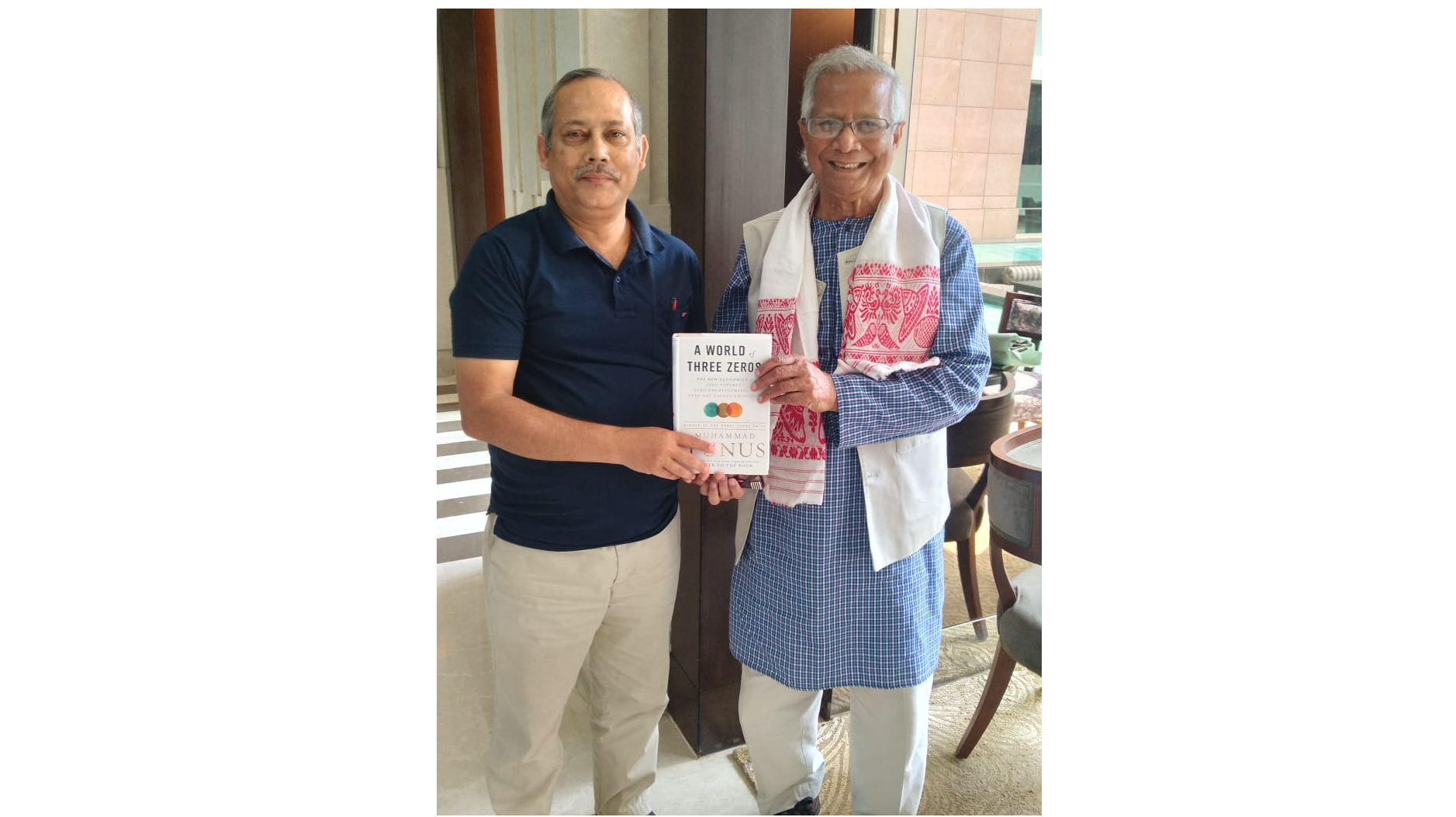
Besides addressing the knowledge festival, Prof Yunus also spoke at Bodoland College and Bodoland University. Later he addressed the students and teachers of  Rongia College and Gauhati University. Prof Yunus had an intensive exchange of thoughts on education with the vice chancellors from ten Assam-based universities in a special session. Prior to his departure to Dhaka, I had an opportunity to meet the soft-spoken, simple and smiling gentleman, who gave me a signed copy of ‘A World of Three Zeros’. As usual we had a long chat on a variety of issues including his invention of social business, a financial exercise where the goal is assumed not to maximize the monetary profit but to do something good for society.

Many may doubt the sustainability of such a business, but Prof Yunus argues that all people have two dimensions in them, selfishness and selflessness.  In each person both selfishness and selflessness exist in varying ratios. Selfless side is not recognized within framework of the business theory. It is left to charity.

Prof Yunus included this dimension of human beings in the business theory by adding the concept of social business, defined as a non-dividend business dedicated to solving social problems in a sustainable way. That becomes the big door for creativity of human beings to address all human problems in a sustainable business way. He agreed the mainstream media should (could) have been a social business where it is not run for maximizing personal profit. As a social business the net profit of a media house should be ploughed back into the business to achieve the goal of the media to keep the public informed without fear or favour or desire to enrich the owners.

Author info

Nava Thakuria's picture

Senior journalist based in Guwahati.

Add new comment

Other Contents by Author

An initial sadness and grief following the unforeseen death of Assam’s cultural icon in Singapore at only 53 have slowly turned into outrages with a sole demand for justice to  Zubeen Garg, as millions of his fans and admirers got convinced that something wrong had happened to their prince of melody during an unplanned sea-yacht outing in the southeast Asian nation. The heart-breaking news that brought the India’s north-eastern State with  3.3 million people to a standstill turning its capital city into a sea of humans weeping, sobbing, crying and exclaiming why Zubeen was put to die in the islands nation, thousands kilometer away from his motherland, on 19 September 2025. The...
The heartbroken news arrived from Singapore in multiple media outlets, which baffled the people of Assam, but immediately in outrages among the young generation, who were born in eastern India and brought up with the melodious voice of iconic singer Zubeen Garg. The sadness and melancholy soon turned into outrages with a vital question, why Zubeen was taken to Singapore as he  was not physically well for months. Millions of his fans were annoyed when they encountered some clippings of videos on social media, where the singing sensation was seen swimming in the seawater (without a life-jacket), whereas he was cautioned by the doctors in Guwahati to avoid the fire and water body. The...
Guwahati: Since 1  February  2005, Assam government has implemented the National Pension Scheme (NPS) for the government employees. All Assam Government NPS Employees’ Association terms it an anti-employee policy and a mockery in the name of pension. The Union government, instead of restoring the Old Pension Scheme (OPS), has taken initiatives  to replace the NPS with a new one named Universal Pension Scheme (UPS). The third biennial conference of the association, held on 24 August at Rupnagar in the city strongly opposed this move and demanded the reintroduction of the OPS. President Achyutananda Hazarika and general secretary Apurba Sharma announced that from next month...
The natural gas leakage from Bhatiapar  crude oil well continues for 15 days, even though  the Oil and Natural Gas Corporation (ONGC) along with an expert team from USA continue working for full dousing of the RDS-147A under  Rudrasagar oilfield in Sivasagar district of eastern Assam. The blowout began on 12 June 2025 and uncontrolled leakage compelled nearly 350 families to leave their places for safety reasons. Besides the local villagers living near the old well, the high pressure gas flow impacted the surrounding environment heavily. Lately, the ONGC issued a statement claiming that ‘a significant progress in controlling the well at RDS 147A’ was made. It also added the...
When hundreds of media workers died of  Covid-19 complications across India, a few people thought the corona disaster would also devastate the print media with sharply declined circulation figures resulting in shrinking advertisement revenues. Many established newspaper-publishing groups either closed many of their editions in the post-corona period or drastically reduced the number of employees to cope up with the hard situation. Some newspapers were shut down forever and many owners were compelled to sell their publications. The troubles are now brewing for the oldest media house in north-eastern region after a Dimapur-based English daily recently ceased its publications. The...
Guwahati: Amid stained bilateral relations between India and Bangladesh, Prime Minister Narendra Modi and the head of Dhaka-based interim government Dr Muhammad Yunus exchanged warm greetings on the occasion of Eid-ul-Azha. In an official letter (dated on 4 June 2025), PM Modi on behalf of the people and government of Bharat conveyed good wishes to Dr Yunus and the people of Bangladesh on the auspicious occasion of the Islamic festival. This holy festival is an integral part of the rich and diverse cultural heritage of India and is celebrated with immense joy and fervour by millions of people of Islamic faith across the country. It reminds us of the timeless values of sacrifice,...
In the decisive war against Pakistan in 1971, India won and a new nation was born, but a small State in eastern part of Bharat had to pay a heavy price with millions of East Pakistan refugees, for which Assam  still cries but nobody cares. With an absorbent border with Bangladesh and unconvincing political will from the government, augmented by continued callous attitude of majority Asomiya people, the situation remains grim even today. New Delhi supported the Mukti Bahini (the freedom aspiring Bengalis of East Pakistan) in their movement against West Pakistan and finally the atrocious Pakistan forces had to surrender on 16 December 1971. But the newly born sovereign country was not...
The current interim government of Bangladesh, led by Nobel laureate Professor Muhammad Yunus, remains busy pursuing the final reports by a number of reform commissions with their proposals and subsequent discussions with the political party representatives. Even after nine months of its formation in Dhaka, the situation across the south Asian nation continues to be murky. Needless to mention that a sense of joy and expectation surfaced among nearly 170 million Bangladeshi nationals, when the caretaker government was constituted following a massive student-led uprising compelled sitting Prime Minister Sheikh Hasina to resign and flee (to India) on 5 August last year. Enjoying the...
A recent controversy erupted following a social media post by a television journalist, associated with Gauhati Press Club (earlier Guwahati Press Club) in northeast India, brought many questions for the media body, which invited a minister in Assam chief minister Himanta Biswa Sarma’s cabinet for a cultural program, but shockingly ‘faced derogatory comments’. The particular post was generated by the journalist working for a satellite news channel owned by the CM’s family, and his outburst that the State health & family welfare minister Ashok Singhal disrespected a delegation from GPC, was taken seriously. According to the journalist, the GPC delegation went to invite Singhal for a...
The recently concluded by-polls for 48 legislative assembly constituencies in 14 States (along with two Parliamentary constituencies in Kerala and Maharashtra) divulged an important fact that no less than  41 assembly seats needed  the special elections as those were vacated by the respective legislators after they were elected to the lower house of Indian Parliament. The representatives of different political parties (irrespective of their ideologies or position in the governments) participated in the last general elections and succeeded to be  lawmakers in the 18th Lok Sabha. One may wonder how all these members of State legislative assemblies turned Parliamentarians...