Skip to content Skip to navigation

Dissecting Assam NRC for better understanding

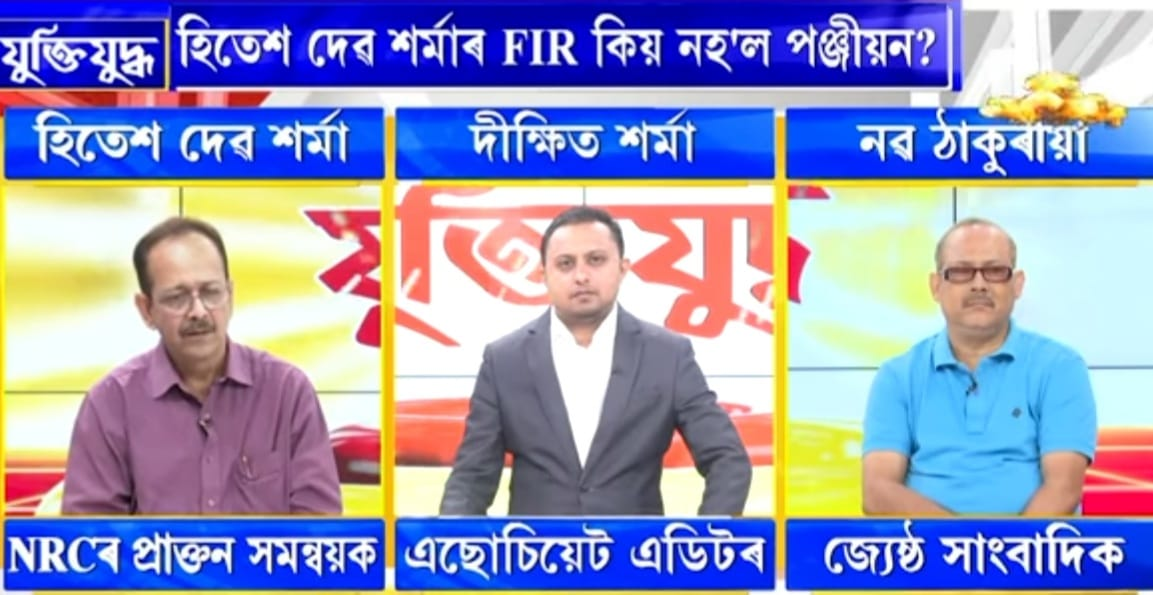
Participating in a debate on satellite television or digital channels needs some homeworks to make the deliberations short and clear. Unless you face an arrogant anchor and unruly participants, the experience in talk shows normally emerges as an intriguing one. It happened to me, as I had recently participated in a digital media discussion on the pertinent issue of National Register of Citizens  (NRC) in Assam, where the prime guest was none other than the immediate past State NRC coordinator Hitesh Dev Sarma. The talk show host Dikshit Sharma put the questions in a clever way so that the issue comes alive and my part was just to interpret Dev Sarma’s version for clarity to the valued audience of Time8.

Dev Sarma, recently retired as an Indian Administrative Services officer, lodged complaint against his predecessor Prateek Hajela, another IAS officer- presently in deputation to Madhya Pradesh, accusing him and the system integrator (Wipro Limited) of engaging in corruption and money laundering while updating the 1951 NRC in Assam. He clarified that the supplementary NRC list, which was released on 31 August 2019 excluding 19,06,657 applicants due to lack of papers, was asserted by Hajela as the final one (but the same is yet to be notified by Registrar General of India). As Hajela’s three-year deputation term is almost completed, he is scheduled to return back to Assam by this year.

The issue of base year for NRC updation in Assam also came to the discussion as the State had to obey 1971 as prescribed in the Assam Accord (unlike the national cut-off year of 1951). The people of Assam are expecting a final verdict on the cut-off year (to identify foreigners in the State) from the Supreme Court of India. Dev Sarma was asked about the implications of a verdict favouring 1951 as the base year for Assam too, where he stated that it would increase more work to the responsible officers and employees, but the common people (except a few) would face no troubles. With stored documents in the NRC directorate, the issue would be resolved amicably, added Dev Sarma.

Speaking about the inclusion of thousands of suspected families in the NRC draft, Dev Sarma claimed that Hajela used a faulty software technology in the process with no cross-checking facility. The provision  for checking family legacy datas (through family tree matching) was deliberately designed in such a way that no superior officers (except Hajela) could go for reverification. So it’s a criminal and anti-national activity, asserted Dev Sarma. On another occasion, Hajela adopted the policy of DMIT (district magistrate investigation team) verification, which was not recommended by the apex court, but surprisingly he did not face any brickbate from the then SC chief justice, reasons best known to Ranjan Gogoi only.

Assam Public Works (original petitioner in the apex court with the demand to update the NRC in Assam) filed a number of police complaints against Hajela and his close aides alleging gross misappropriation of government funds in the process. Lately, APW chief Aabhijeet Sharma lodged another complaint against information technology firm Wipro alleging the misappropriation of public money, where the influential civil rights group made the NRC directorate also a party. Quoting the Comptroller and Auditor General of India’s interim report, it narrated in the FIR that a massive corruption had taken place in the Rs 1,600 crore exercise with the active role of the concerned top officials.

Dev Sarma, who also submitted an affidavit in the apex court, said that the accountant general observed that undue benefit of Rs 155.83 crore was allowed to SI/labour contractor. It also identified an avoidable expenditure to the tune of Rs 10.73 crore in connection with the engagement of third-party monitoring consultants. As per the rules, for expenditure of above Rs five crore, Hajela had to obtain an approval from the empowered committee, headed by the State chief secretary or from the RGI, but he did not do so.

In his formal complaint, Dev Sarma described the anomalies where the Wipro engaged one sub-contractor for providing data entry operators (DEOs) without any prior approval from the authority. It was found that the then State coordinator was aware of the sub-contractor, but did not intervene. Wipro was paid Rupees 14,500 to 17,500 per month per DEO (by the NRC authority), but the DEOs got only Rs 5,500  to  9,100  per month during the years (2015 to 2019). Shockingly, more than 6000 DEOs were denied even the least amount as per the country’s  minimum wages act. Some DEOs even came to the streets demanding their due amounts. They also approached the State labour commissioner for their dues.

My final assertion was that the DEOs must get their legal dues irrespective of the fate of NRC, as they have nothing to do with it. A huge amount of money, meant for them, was grabbed by some individuals with corrupt practices. Unfortunately three Guwahati-based senior television journalists have also been named and shamed on social media as the beneficiaries of NRC scam. Thousands of social media users participated in the discourse and many urged those  media persons to clarify their stand, but they have not made any public statement about the allegation, which is surprising and unusual compared to their smart & energetic personalities reflected in the television screen.

Author info

Nava Thakuria's picture

Senior journalist based in Guwahati.

Add new comment

Other Contents by Author

After months of uncertainties, the Press Council of India (PCI) recently got its chairman, but the space of 13 working journalists remains vacant till date. Justice Ranjana Prakash Desai, who served as the PCI chairman from 17 June 2022 to 16 December 2025, assumed the charge on 24 April 2026 once again. The retired judge of the Supreme Court of India was nominated for another term of three years. But the quotas for working journalists remain vacant as seven members, to be represented by professional scribes (other than editors) and six members, to be represented by journalist-editors, are yet to be picked up to complete the 15th council (https://presscouncil.nic.in/CurrentMemberPCI.aspx...
After Assam, Keralam and Puducherry (union territory), the State legislative assembly elections are knocking at the doors of  Tamil Nadu and West Bengal in the second half of April 2026. Meanwhile, the millions of voters have shown an extraordinary commitment to electoral politics as they participated in the largely peaceful single-phase assembly polls on  9 April recording a high voters’ turnout. Assam recorded 85.96% voter participation  in 126 assembly seats, where Puducherry showcased over 90% voting in 30 constituencies followed by Keralam (140 seats) with nearly 80% turnout. Assam’s 2.50 crore electorates (including 1.25 crore female voters and 6.4 lakh first-timers...
As Assam goes to the single-phase polling  tomorrow (9 April 2026), nearly 2.49 crore registered voters (including 5.75 lakh young/first time voters) will exercise their franchise to elect 126 representatives for the State legislative assembly. Under the guidelines of  Election Commission of India, all types of campaigning had already came to a halt at 5 pm on Tuesday (48 hours prior to voting) where the authority urged all candidates, political parties, and media outlets to strictly follow the guidelines. The same timeline is made applicable for Kerala and Pondicherry as well, whereas Tamil Nadu will vote on 23 April, and West Bengal going for polling on 23 and 29 April next....
Landlocked Himalayan nation Nepal prepares for its ninth national election  on 5 March, which was necessitated with the collapse of its government in Kathmandu during September last year following an anti-corruption mass uprising, which was initiated by the young people and resulted in the killing of dozens of agitators and injuring hundreds other. The south Asian country of around 30.55 million people, sandwiched between two giants India and Tibet/China, has readied all necessary arrangements for the single day polling through ballot papers under the protection of  nearly 3,50,000 security personnel (with additional armed forces kept ready for an unwanted emergency situation...
Even all political parties, not to speak of millions of fans and well-wishers of Assam’s revered cultural icon  Zubeen Garg, continue preaching for sparing the maverick singer’s name in doing politics, his mysterious death last year in a foreign land may dominate the electoral politics in the forthcoming legislative polls. Indications surface that Assam assembly elections (scheduled for March-April 2026 along with West Bengal, Tamil Nadu, Kerala and Puducherry) will observe a high voltage campaigning on  Zubeen’s unexplained demise in Singapore on 19 September 2025 and subsequent investigation and judicial processes. Even after five months of his final departure, Zubeen continues...
As Bangladesh has constituted a new government under the leadership of  Bangladesh Nationalist Party (BNP) after a largely fair & peaceful national election on 12 February 2026, the people of eastern India (the region virtually embraces the poverty stricken country except a few kilometers in Myanmar and the Bay of Bengal)  hope for a progressive regime in Dhaka enjoying political stability and pursuing economic developments to over 170 million people in the south Asian nation. The Muslim majority country continues to grow as a headache for the north-eastern states, more precisely Assam, for at least two  reasons namely unabated influx of migrants and regional security...
Amid high security arrangements across the country, polling begins this morning at 7:30 am for the highly projected 13th Jatiya Sansad election in Bangladesh, where over 2000 candidates representing 50 political parties along with many independent contestants are in the fray. The Muslim majority nation has over  12.77 crore registered voters including 6.27 crore women and 1,232 third-genders, who are voting for electing   299 representatives (out of 300 seats in the national assembly). Over 42,000 polling centres will facilitate the electorates to exercise their franchise (through  ballots in person) till 4:30 pm (on 12 February 2026). The election will be conducted...
As Bangladesh heads for 13th Parliamentary election and  the referendum on  July National Charter simultaneously on Thursday (12 February 2026), the interim government chief Professor Muhammad Yunus urged all participating candidates to rise above personal and party interests to prioritize greater interest of the Muslim majority nation regardless of the poll-outcomes. Addressing the nation of over 170 million people ahead of the much watched electoral exercises, Nobel peace laureate  Dr Yunus commented that victory as well as defeat is an integral part of democracy and hence after the election, they should dedicate themselves to build a new, just, democratic, and inclusive...
Is it possible to have a quasi-judicial body like the Press Council of India to survive for weeks without its chairperson? Should the largest democracy on Earth put such an example where its government recognized autonomous media watchdog faces an existential crisis as the 15th council of PCI still devoid of a functioning head and 13 seats? How come a press council runs its business without filling these 13 seats, meant for millions of media professionals, for more than a year now, whereas the term of a council is limited to three years only? Many such pertinent questions  emerge among media professionals in the   south Asian nation, as the regular three-year term (as well as...
Amid an existential crisis in the Guwahati-based Assam Tribune group of newspapers, which worsened after the Covid-19 pandemic, a popular Assamese weekly newspaper lost its publication in the latter part of 2025. Asom Bani, once a mainstream weekly for Assamese readers for decades, stopped hitting the stands from September last year, as the management lost interest in continuing its printing every Friday. Even though the seven-decade-old Assamese-language weekly was lost from the media market, the management did not make any statement about Asom Bani’s fate. Prior to its departure, the weekly was merged with Dainik Asom, an acclaimed Assamese daily from the prestigious media house, as its...