
Skip to content Skip to navigation

When Bangladesh turmoil rubs northeast India
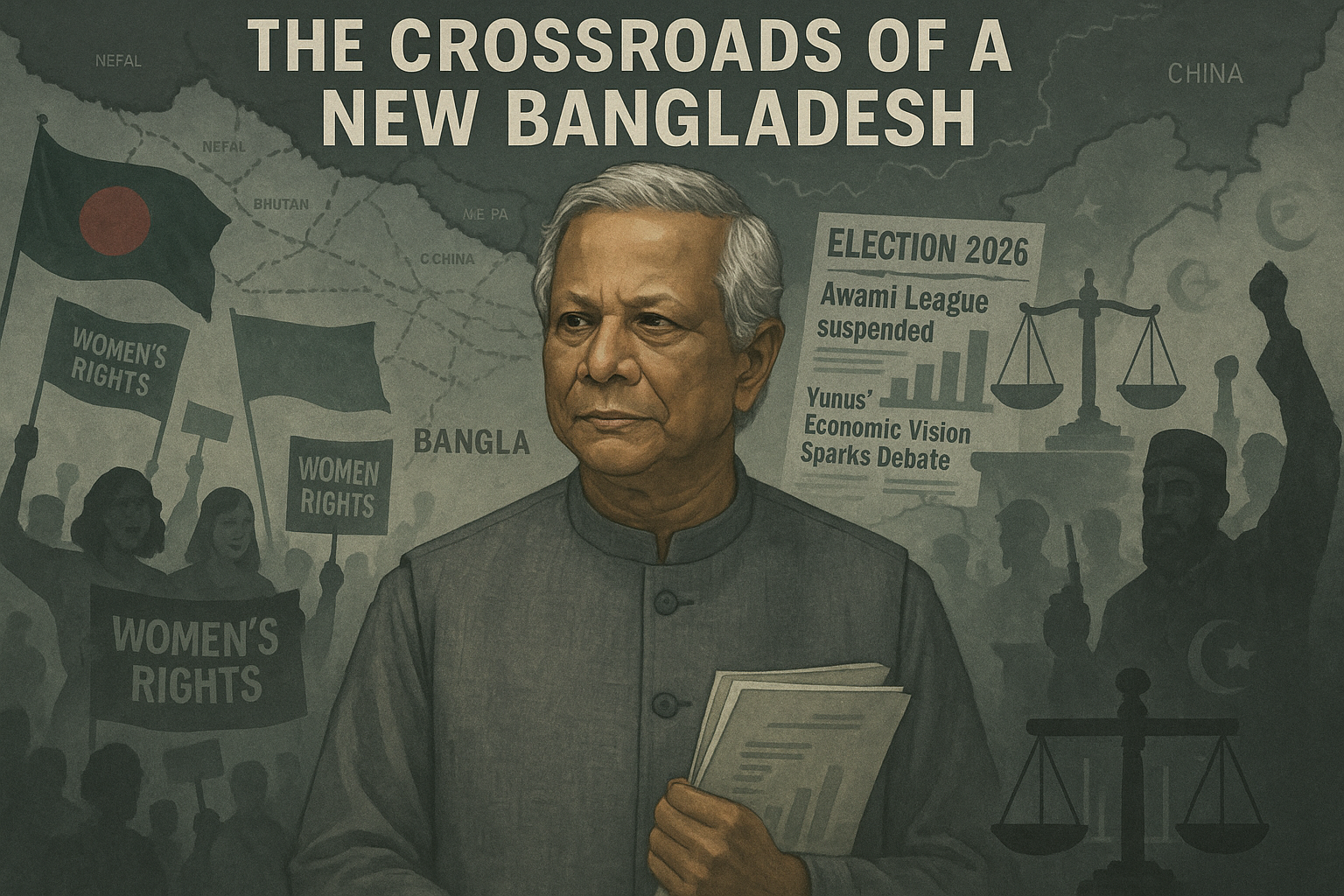
The current interim government of Bangladesh, led by Nobel laureate Professor Muhammad Yunus, remains busy pursuing the final reports by a number of reform commissions with their proposals and subsequent discussions with the political party representatives. Even after nine months of its formation in Dhaka, the situation across the south Asian nation continues to be murky. Needless to mention that a sense of joy and expectation surfaced among nearly 170 million Bangladeshi nationals, when the caretaker government was constituted following a massive student-led uprising compelled sitting Prime Minister Sheikh Hasina to resign and flee (to India) on 5 August last year. Enjoying the overwhelming popularity, Prof Yunus also termed the July-August 2024 rebellion (popularly called as Monsoon Revolution) as the second freedom movement and the octogenarian banker turned social business preacher opined how a new Bangladesh was possible with important reforms in various sectors.

The government maintains its optimism  about the exercises and lately declared  that the country will go for the next general elections latest by June 2026, even though some political leaders are demanding the polls by December this year. Amid political confusions and continued deterioration of the law & order situation across the Muslim majority nation, the country recently witnessed an uproarious situation after a commission (dedicated for the welfare of women) submitted its suggestions advocating more  freedom & benefits to the Bangladeshi better halves. A number of  Islamist parties, which are now gaining more ground across the densely populated country, surrounded by India, Myanmar and the Bay of Bengal, hit the streets with a massive participation of agitators.

Recently, the authorities banned all kinds of activities for Awami League (the party which was instrumental in the freedom movement giving birth to sovereign  Bangladesh out of Pakistan) under a revised anti-terrorism law. Later the Bangladesh Election Commission suspended the  registration of Awami League, which ruled the country since 2009 (till August 2024), making it almost clear that the deposed premier Hasina may not be able to participate in the up-coming polls. It was followed by a dramatic escape of  former Bangladesh President Mohammad Abdul Hamid to Thailand to avoid legal procedures in his home country. The  former lawmaker belonging to the suspended party has been co-accused in a murder case and he was under police investigation along with many Awami League top leaders.

Often controversies relating to the integrity of  northeast India also surfaced in Bangladesh. The recent one involved Prof Yunus as he recently commented that there should be an ‘integrated economic plan’ for Bangladesh, Nepal, Bhutan and North-east’. He also underlined the potential of cross-border collaboration in various sectors like hydropower, healthcare, tourism and road connectivity. But his comments on the integrated economic plan  invited strong reactions from various corners in India. Citing his earlier China visit, where Prof Yunus pursued Beijing for taking a position in making Bangladesh as a key regional partner for production, logistics and trades, the critics expressed annoyance that he unnecessarily brought India’s far-eastern parts under a probable economic roadmap for the advantage of Beijing.

Mentioning northeast India as ‘Seven sisters’, Prof Yunus argued that the landlocked region has ‘no way to reach out’ to the ocean  bypassing Bangladesh, even though he avoided mentioning about the under-construction Kaladan multi-modal riverine project, designed to connect Sittwe port in western Myanmar with northeast India for trade related activities. Assam chief minister Himanta Biswa Sarma denounced the statement of Prof Yunus as offensive and condemnable as it endorses the  vulnerability narrative for Siliguri corridor (popularly known as Chicken's Neck) to connect North-east through the land route. Tipra Motha chief Pradyut  Debbarma also criticized Prof Yunus for the provocative statement, saying that North-east is not dependent on anyone for its growth. Deputy leader of the Opposition in Lok Sabha, Gaurav Gogoi and former Manipur chief minister N Biren Singh also termed the Yunus statement as irresponsible.

Responding to the controversy, a close aide of Prof Yunus in Dhaka, clarified that he made this observation through the lens of a cross border economic perspective and it has nothing to do with politics or integrity of any nation. Prof Yunus was simply trying to make his point for creating economic opportunities for dwellers of the entire region. He emphasized that the region needs to ‘build things, produce things and market things’. If Nepal (currently supplying 40 megawatt power, whereas over  2,500 Nepali students pursuing higher education in Bangladesh) and Bhutan share adequate electricity, the country would enhance the production quality for the products meant for global markets, stated the Bangladeshi individual, adding that China can also be a useful market for those products, which are usually cheaper even after maintaining the international quality.

Author info

Nava Thakuria's picture

Senior journalist based in Guwahati.

Add new comment

Other Contents by Author

After months of uncertainties, the Press Council of India (PCI) recently got its chairman, but the space of 13 working journalists remains vacant till date. Justice Ranjana Prakash Desai, who served as the PCI chairman from 17 June 2022 to 16 December 2025, assumed the charge on 24 April 2026 once again. The retired judge of the Supreme Court of India was nominated for another term of three years. But the quotas for working journalists remain vacant as seven members, to be represented by professional scribes (other than editors) and six members, to be represented by journalist-editors, are yet to be picked up to complete the 15th council (https://presscouncil.nic.in/CurrentMemberPCI.aspx...
After Assam, Keralam and Puducherry (union territory), the State legislative assembly elections are knocking at the doors of  Tamil Nadu and West Bengal in the second half of April 2026. Meanwhile, the millions of voters have shown an extraordinary commitment to electoral politics as they participated in the largely peaceful single-phase assembly polls on  9 April recording a high voters’ turnout. Assam recorded 85.96% voter participation  in 126 assembly seats, where Puducherry showcased over 90% voting in 30 constituencies followed by Keralam (140 seats) with nearly 80% turnout. Assam’s 2.50 crore electorates (including 1.25 crore female voters and 6.4 lakh first-timers...
As Assam goes to the single-phase polling  tomorrow (9 April 2026), nearly 2.49 crore registered voters (including 5.75 lakh young/first time voters) will exercise their franchise to elect 126 representatives for the State legislative assembly. Under the guidelines of  Election Commission of India, all types of campaigning had already came to a halt at 5 pm on Tuesday (48 hours prior to voting) where the authority urged all candidates, political parties, and media outlets to strictly follow the guidelines. The same timeline is made applicable for Kerala and Pondicherry as well, whereas Tamil Nadu will vote on 23 April, and West Bengal going for polling on 23 and 29 April next....
Landlocked Himalayan nation Nepal prepares for its ninth national election  on 5 March, which was necessitated with the collapse of its government in Kathmandu during September last year following an anti-corruption mass uprising, which was initiated by the young people and resulted in the killing of dozens of agitators and injuring hundreds other. The south Asian country of around 30.55 million people, sandwiched between two giants India and Tibet/China, has readied all necessary arrangements for the single day polling through ballot papers under the protection of  nearly 3,50,000 security personnel (with additional armed forces kept ready for an unwanted emergency situation...
Even all political parties, not to speak of millions of fans and well-wishers of Assam’s revered cultural icon  Zubeen Garg, continue preaching for sparing the maverick singer’s name in doing politics, his mysterious death last year in a foreign land may dominate the electoral politics in the forthcoming legislative polls. Indications surface that Assam assembly elections (scheduled for March-April 2026 along with West Bengal, Tamil Nadu, Kerala and Puducherry) will observe a high voltage campaigning on  Zubeen’s unexplained demise in Singapore on 19 September 2025 and subsequent investigation and judicial processes. Even after five months of his final departure, Zubeen continues...
As Bangladesh has constituted a new government under the leadership of  Bangladesh Nationalist Party (BNP) after a largely fair & peaceful national election on 12 February 2026, the people of eastern India (the region virtually embraces the poverty stricken country except a few kilometers in Myanmar and the Bay of Bengal)  hope for a progressive regime in Dhaka enjoying political stability and pursuing economic developments to over 170 million people in the south Asian nation. The Muslim majority country continues to grow as a headache for the north-eastern states, more precisely Assam, for at least two  reasons namely unabated influx of migrants and regional security...
Amid high security arrangements across the country, polling begins this morning at 7:30 am for the highly projected 13th Jatiya Sansad election in Bangladesh, where over 2000 candidates representing 50 political parties along with many independent contestants are in the fray. The Muslim majority nation has over  12.77 crore registered voters including 6.27 crore women and 1,232 third-genders, who are voting for electing   299 representatives (out of 300 seats in the national assembly). Over 42,000 polling centres will facilitate the electorates to exercise their franchise (through  ballots in person) till 4:30 pm (on 12 February 2026). The election will be conducted...
As Bangladesh heads for 13th Parliamentary election and  the referendum on  July National Charter simultaneously on Thursday (12 February 2026), the interim government chief Professor Muhammad Yunus urged all participating candidates to rise above personal and party interests to prioritize greater interest of the Muslim majority nation regardless of the poll-outcomes. Addressing the nation of over 170 million people ahead of the much watched electoral exercises, Nobel peace laureate  Dr Yunus commented that victory as well as defeat is an integral part of democracy and hence after the election, they should dedicate themselves to build a new, just, democratic, and inclusive...
Is it possible to have a quasi-judicial body like the Press Council of India to survive for weeks without its chairperson? Should the largest democracy on Earth put such an example where its government recognized autonomous media watchdog faces an existential crisis as the 15th council of PCI still devoid of a functioning head and 13 seats? How come a press council runs its business without filling these 13 seats, meant for millions of media professionals, for more than a year now, whereas the term of a council is limited to three years only? Many such pertinent questions  emerge among media professionals in the   south Asian nation, as the regular three-year term (as well as...
Amid an existential crisis in the Guwahati-based Assam Tribune group of newspapers, which worsened after the Covid-19 pandemic, a popular Assamese weekly newspaper lost its publication in the latter part of 2025. Asom Bani, once a mainstream weekly for Assamese readers for decades, stopped hitting the stands from September last year, as the management lost interest in continuing its printing every Friday. Even though the seven-decade-old Assamese-language weekly was lost from the media market, the management did not make any statement about Asom Bani’s fate. Prior to its departure, the weekly was merged with Dainik Asom, an acclaimed Assamese daily from the prestigious media house, as its...