
Skip to content Skip to navigation

When Bangladesh turmoil rubs northeast India
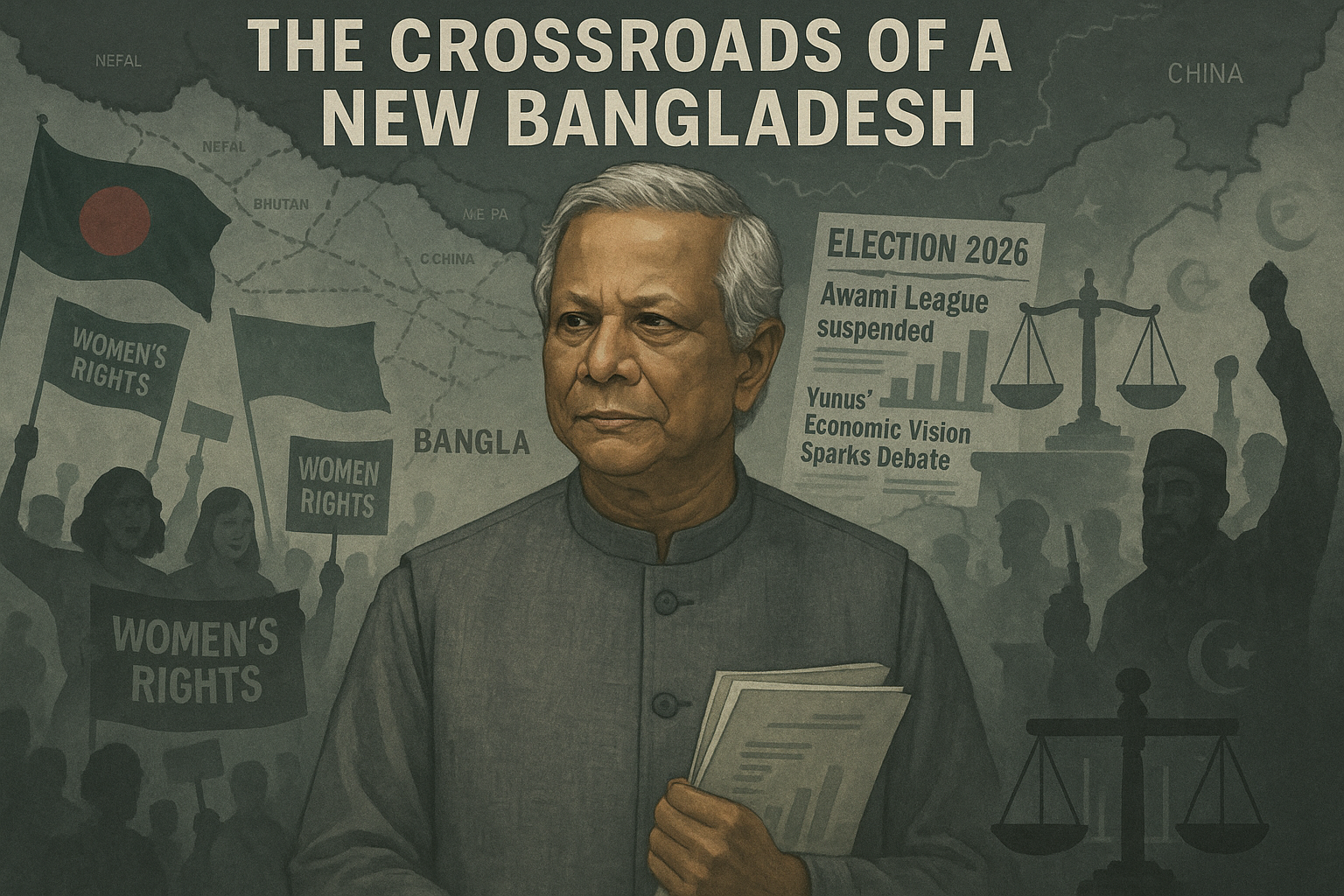
The current interim government of Bangladesh, led by Nobel laureate Professor Muhammad Yunus, remains busy pursuing the final reports by a number of reform commissions with their proposals and subsequent discussions with the political party representatives. Even after nine months of its formation in Dhaka, the situation across the south Asian nation continues to be murky. Needless to mention that a sense of joy and expectation surfaced among nearly 170 million Bangladeshi nationals, when the caretaker government was constituted following a massive student-led uprising compelled sitting Prime Minister Sheikh Hasina to resign and flee (to India) on 5 August last year. Enjoying the overwhelming popularity, Prof Yunus also termed the July-August 2024 rebellion (popularly called as Monsoon Revolution) as the second freedom movement and the octogenarian banker turned social business preacher opined how a new Bangladesh was possible with important reforms in various sectors.

The government maintains its optimism  about the exercises and lately declared  that the country will go for the next general elections latest by June 2026, even though some political leaders are demanding the polls by December this year. Amid political confusions and continued deterioration of the law & order situation across the Muslim majority nation, the country recently witnessed an uproarious situation after a commission (dedicated for the welfare of women) submitted its suggestions advocating more  freedom & benefits to the Bangladeshi better halves. A number of  Islamist parties, which are now gaining more ground across the densely populated country, surrounded by India, Myanmar and the Bay of Bengal, hit the streets with a massive participation of agitators.

Recently, the authorities banned all kinds of activities for Awami League (the party which was instrumental in the freedom movement giving birth to sovereign  Bangladesh out of Pakistan) under a revised anti-terrorism law. Later the Bangladesh Election Commission suspended the  registration of Awami League, which ruled the country since 2009 (till August 2024), making it almost clear that the deposed premier Hasina may not be able to participate in the up-coming polls. It was followed by a dramatic escape of  former Bangladesh President Mohammad Abdul Hamid to Thailand to avoid legal procedures in his home country. The  former lawmaker belonging to the suspended party has been co-accused in a murder case and he was under police investigation along with many Awami League top leaders.

Often controversies relating to the integrity of  northeast India also surfaced in Bangladesh. The recent one involved Prof Yunus as he recently commented that there should be an ‘integrated economic plan’ for Bangladesh, Nepal, Bhutan and North-east’. He also underlined the potential of cross-border collaboration in various sectors like hydropower, healthcare, tourism and road connectivity. But his comments on the integrated economic plan  invited strong reactions from various corners in India. Citing his earlier China visit, where Prof Yunus pursued Beijing for taking a position in making Bangladesh as a key regional partner for production, logistics and trades, the critics expressed annoyance that he unnecessarily brought India’s far-eastern parts under a probable economic roadmap for the advantage of Beijing.

Mentioning northeast India as ‘Seven sisters’, Prof Yunus argued that the landlocked region has ‘no way to reach out’ to the ocean  bypassing Bangladesh, even though he avoided mentioning about the under-construction Kaladan multi-modal riverine project, designed to connect Sittwe port in western Myanmar with northeast India for trade related activities. Assam chief minister Himanta Biswa Sarma denounced the statement of Prof Yunus as offensive and condemnable as it endorses the  vulnerability narrative for Siliguri corridor (popularly known as Chicken's Neck) to connect North-east through the land route. Tipra Motha chief Pradyut  Debbarma also criticized Prof Yunus for the provocative statement, saying that North-east is not dependent on anyone for its growth. Deputy leader of the Opposition in Lok Sabha, Gaurav Gogoi and former Manipur chief minister N Biren Singh also termed the Yunus statement as irresponsible.

Responding to the controversy, a close aide of Prof Yunus in Dhaka, clarified that he made this observation through the lens of a cross border economic perspective and it has nothing to do with politics or integrity of any nation. Prof Yunus was simply trying to make his point for creating economic opportunities for dwellers of the entire region. He emphasized that the region needs to ‘build things, produce things and market things’. If Nepal (currently supplying 40 megawatt power, whereas over  2,500 Nepali students pursuing higher education in Bangladesh) and Bhutan share adequate electricity, the country would enhance the production quality for the products meant for global markets, stated the Bangladeshi individual, adding that China can also be a useful market for those products, which are usually cheaper even after maintaining the international quality.

Add new comment

Other Contents by Author

The Press Emblem Campaign (PEC) awarded its annual prize for the protection of journalists to Palestinian journalist Iyad Alasttal. This recognition comes amidst the unprecedented loss of over 150 Palestinian and Lebanese journalists since October 7, 2023, marking one of the highest tolls in such a short period in a conflict. The PEC dedicated the prize to the memory of these journalists who risk their lives daily. Iyad Alasttal, a journalist from Gaza, was forced to flee due to Israeli reprisals following the Hamas attack on October 7, 2023. Alasttal, who launched the Gaza Stories project in 2019, has been chronicling life in Gaza and reporting for French and Western media outlets....
On the midnight of August 31, 2019, an extraordinary bureaucrat unveiled the contentious National Register of Citizens (NRC) in Assam, amidst a large gathering of eager media personnel in Guwahati. Prateek Hajela, the then State NRC coordinator, not only explained various features of the NRC to the assembled reporters but also declared the supplementary list as the definitive one. Some television journalists, excited by the so-called "extraordinary work" of the technocrat-turned-IAS officer, went as far as to applaud Hajela as a superhero. However, the ground reality paints a different picture. The Assam NRC has never been endorsed—nor is it today—by the Registrar General of India (RGI...
It’s shocking to report that a number of Guwahati-based scribes and RTI (right to information) activists have been facing interrogation and even arrest by Assam chief minister’s special vigilance cell following the allegations of Sewali Devi Sharma, the prime accused in Rs 105 crore State council of educational research and training (SCERT) scam, as being blackmailers to her in different occasions. The arrestees include a female reporter (identified as Pujamoni Das alias Honey Kashyap, who reportedly took a large volume of money from Ms Sharma) along with a satellite news channel reporter named Bhaskarjoti Hazarika.  RTI activists namely Rabijit Gogoi (who pretended to be a...
Can we imagine a world of zero poverty, zero unemployment, and zero carbon emissions with a new approach in post-corona economics! Ask Nobel laureate Professor Muhammad Yunus and he will answer in the affirmative. The university professor turned revolutionary banker believes that the human race should not only dream about a safer world by reducing global warming, wealth concentration and unemployment, but also work in that direction with personal and collective capacities. In his latest book titled ‘A World of Three Zeros’, Prof Yunus proposes a new economic system focusing on every human being as an entrepreneur in the making. He believes that humans are not born to work only for...
Guwahati: Assam is all set to host first sustainable financial working group (SFWG) meeting and Youth 20 inception meeting as part of India's year-long G20 presidency, where it is meticulously chalked out various tour programs that would help in promoting the State’s rich biodiversity and socio-cultural heritage in international arena. The authorities have completed the preparation to welcome the foreign delegates to the State. Guwahati is adorned with digital wall painting, thematic gates, flags of G 20 countries, LED cut-outs, standees, hoarding, etc as part of branding and beautification. The government has also completed the arrangement for the visiting delegates to places of...
Guwahati: India observes National Press Day on 16 November with an aim to pay tributes to everyone who contributed to the growth of print media along with its mentor & watchdog the Press Council of India (PCI). Moreover, it’s also an occasion for the practicing media persons to introspect seriously over their noble profession where it has been heading in the post-Covid-19 pandemic era. Since its inception and functioning, the PCI continues to symbolize a free and responsible press in the largest democracy in the world. Among all press or media councils, functioning in various countries, the PCI is recognised as a unique entity that exercises authority over the media and also safeguards...
Participating in a debate on satellite television or digital channels needs some homeworks to make the deliberations short and clear. Unless you face an arrogant anchor and unruly participants, the experience in talk shows normally emerges as an intriguing one. It happened to me, as I had recently participated in a digital media discussion on the pertinent issue of National Register of Citizens  (NRC) in Assam, where the prime guest was none other than the immediate past State NRC coordinator Hitesh Dev Sarma. The talk show host Dikshit Sharma put the questions in a clever way so that the issue comes alive and my part was just to interpret Dev Sarma’s version for clarity to the valued...
Guwahati: It was an amazing experience to attend the foundation day of a 25 year old press club in central Assam on a lazy Sunday, where a number of senior citizens along with rural scribes and novice journalists were waiting to listen to my speech. It’s easier to address a journalist’s meet- where we can discuss many issues with liberties, but while the audience includes respected senior citizens and young people, it becomes a difficult task to speak to them together. First, the question that arises, how much should I highlight the eroding credibility of the mainstream media around India in general and Assam in particular and secondly what may be the role of social (alternate/digital)...
Guwahati: A year-long celebration of 100 years of sports journalism in Assam begins coinciding on the day while the first ever news related to a football competition is published in Asomiya (a weekly news magazine mentored by Chandra Kumar Agarwala) on 1  July 1923. Assam Sports Journalists Association (ASJA), which is affiliated with the Sports Journalists Federation of India (a national affiliate of the International Sports Press Association), has taken the lead in celebrating the occasion that will culminate on 1  July next year. On Saturday, flags for ASJA and the centenary celebration were hoisted by ASJA’s founder president Balendra Mohan Chakraborty and his successor...
Reactions from the public (sensitive readers) against a news item in any newspaper (also news channel) are usual in India, but outrages against the mainstream media outlets in digital platforms for not covering a particular issue is definitely an unusual phenomenon. The north-eastern state of Assam witnessed such public fury against some of the editor-journalists for avoiding press conferences by opposition political parties where they targeted the state chief minister for his family’s alleged land scam. The organized public uproar in the alternate media was so intense that the celebrity editor-journalists of Assam did not dare to clarify their positions. They preferred to avoid the...