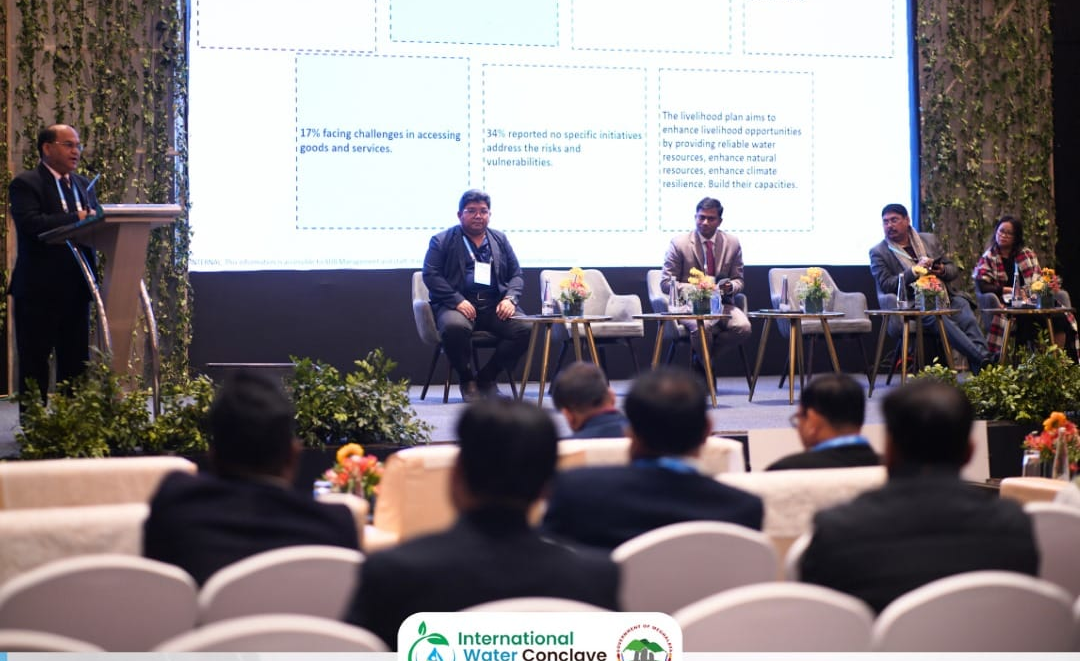
In a landmark move, participants of the International Conclave on Water, Hill Lives, and Future, convened in Shillong on February 9th and 10th, 2024, have jointly adopted the "Shillong Declaration." This declaration underscores the critical interlinkages between water resources and hill ecosystems, emphasizing a holistic approach towards achieving sustainable development in these regions.
The vital role of water as a critical resource and the need for enhanced resilience around water in hilly terrains, as underscored by the declining water table and spring water levels, waning traditional water systems, retreating, and polluting rivers, changing rainfall patterns, increase in the natural disasters and the recent pandemic, among others.
The fact that hill regions will be vulnerable, in absence of improved, safe, and sustainable water management and any uncontrolled anthropogenic action can add to this risk.
The importance of protecting springs, rivers, and all other traditional water management systems as well as the complex nature of the hill ecosystems, and of ensuring sustainable and safe preservation of the aquifers and other water resources.
The necessity for adopting state-of-the-art technology for sanitation, waste, and wastewater treatment as well as for water recycling, to augment water availability.
The critical need to aligning agriculture, horticulture, forestry, poultry, animal husbandry, and all related livelihood initiatives in an appropriate manner, addressing water productivity of the hill ecosystems.
The unavoidable act of ensuring safety and quality of water for all kinds of human and cattle consumption, by minimizing contaminations and instituting context-appropriate measures for purifications and verifications.
The Importance of not hampering the synergy with nature, and reassuring the commitment to the water and ecosystems, while bringing advanced amenities to enhance the quality of lives in hill systems.
The vitality of reconciling with any challenges to water systems, its sustainability and related measures and any adverse impact on the environment, while planning new infrastructure, industry, commerce, and business, in and for the region.
The significance of realising the critical challenges posed to the nature and ecosystems, while commoditising water and profiteering on it.
The need of participatory planning, implementation, and oversight of safe, sustainable, and resilient water management and governance systems to meet the drinking, domestic, irrigation, commercial, industrial, infrastructural, developmental, and emergency water needs of populations in all hill regions, in a reasonable manner.
The essentiality of safeguarding gender, equity and inclusiveness in the entire processes around 11. water and climate.
Realising the human right to safe drinking water and sanitation with an acknowledgement that water, sanitation and hygiene are fundamental for sustainable development.
The declaration also acknowledges the human right to safe drinking water and sanitation, underscoring their fundamental importance for sustainable development.
Participants commit to generating necessary data, conducting mindful reviews, and taking actions to realize a better future for hill communities amidst water and climate challenges. The declaration calls upon citizens, community groups, governments, and global authorities to reciprocate the spirit of the declaration and prioritize the safety and well-being of hill communities and the environment.
The "Shillong Declaration" represents a significant step towards addressing the complex challenges faced by hill regions worldwide and charting a path towards sustainable development and environmental stewardship.
Heavy pre-monsoon rainfall has caused multiple breaches, locally known as “rain cuts”, in the Ulfa dyke at Panigaon in Assam’s Lakhimpur district, raising fresh concerns of flooding in the region.
The 3.7-km-long agri-bund embankment—stretching from Jorkhat-Boniyagaon to Pub-Aamtola Nepaligaon under Pachim Telahi Gaon Panchayat—is popularly known as the Ulfa dyke. It was originally constructed in 1989 by members of the United Liberation Front of Asom (ULFA) with community participation.
According to reports, continuous rainfall over recent weeks has led to the formation of more than 20 rain cuts along the embankment, significantly weakening its structure ahead of the...
A district-level convening of humanitarian organisations and civil society groups was held in Jorhat at the premises of the North-East Affected Area Development Society (NEADS), Dhekiakhowa, focusing on Community Feedback Mechanism (CFM) and flood preparedness.
Organised by NEADS in collaboration with the State Inter Agency Group and Roots to Branches Foundation, with support from UNICEF Assam, the meeting brought together civil society representatives, district authorities, and local humanitarian actors to strengthen coordination ahead of the flood season.
The session opened with a welcome address by Tirtha Prasad Saikia, who underscored the importance of community-centred approaches...
In a grim reminder of the city’s crumbling urban infrastructure, four lives were lost within 48 hours after heavy rains triggered widespread artificial flooding across Guwahati. What should have been a seasonal downpour instead exposed a deadly mix of neglected drains, poor planning, and administrative failure.
The first victim, Payel Nath Das (around 30), a Dharapur resident working at a jewellery shop on GS Road, met a tragic end on the night of April 19. At around 9:30 pm, while wading through knee-deep water at Maligaon Chariali, she slipped into an uncovered roadside drain concealed beneath floodwaters. Her body was recovered 150–250 metres away the next morning by SDRF personnel...
Voting for the Assam Assembly elections gathered steady momentum through the morning hours on April 9, with scenes from across the state reflecting a strong and participatory democratic exercise. By mid-morning, polling booths were already witnessing long queues, as men and women, young voters and the elderly alike, stepped out early to cast their votes. The initial hours after 9 AM saw a smooth and peaceful polling process, backed by visible security presence and efficient booth management.
In Guwahati, the day unfolded with a calm yet purposeful energy. Polling stations across the city saw a steady stream of voters, many arriving with family members, some even accompanied by children,...
Susovan Sonu Roy has steadily carved a place for himself across multiple creative fields—Bengali television, modelling, and films—building his career through persistence, training, and adaptability.
Born in Howrah, Susovan spent his formative years between Kolkata and Guwahati. His early life was marked by hardship after losing his father in an accident at a young age. Raised by his mother under challenging circumstances, he went on to complete his graduation in Commerce from Dum Dum Motijheel Rabindra Mahavidyalaya in 2016.
His entry into the performing arts began with dance. Driven by interest, he joined a dance institute where he trained in Western dance for nearly two years....
A major political controversy has erupted around Himanta Biswa Sarma after the Congress party levelled serious allegations regarding the alleged accumulation of vast wealth abroad by his family, particularly involving his wife Riniki Bhuyan Sarma.
According to a report by The Wire, Congress leader Pawan Khera claimed that assets worth nearly ₹52,000 crore have been stashed overseas, particularly in the United States, through a company allegedly linked to the Chief Minister’s family.
At a press conference in New Delhi, Khera alleged that Riniki Bhuyan Sarma holds multiple foreign passports and questioned the source of such large-scale wealth. He further demanded a probe and even called...
Guwahati, April 3, 2026: The Moung-Dun-Chun-Kham State Demand Committee and the Moung-Dun-Chun-Kham People’s Party on Friday held a press conference at the Dispur Press Club, reiterating their demand for permanent political rights and autonomy for the Tai-Ahom community in Assam.
Addressing the media, representatives of the organisations stated that despite the Tai-Ahom community’s historical and demographic significance, successive governments have failed to provide meaningful constitutional safeguards.
“At present, almost all indigenous communities of Assam… have been raising demands for autonomy or self-determination under the Indian Constitution,” the press release noted,...
A three-day workshop titled “Youth Leaders for Rivers: Learning Workshop” concluded today at the Cachar Club Conference Hall, bringing together young leaders from across the region to collaborate on river governance, water rights and community resilience.
Organized by the North-East Affected Area Development Society (NEADS) with support from the International Union for Conservation of Nature, the event was held from March 24 to 26 under the Youth Basin Ambassadors (YBA) initiative. It aimed to connect youth working across the Ganges–Brahmaputra–Meghna Basin and deepen their understanding of river systems, governance challenges and community-driven solutions.
Participants included...
Tinsukia, March 22: Suspected militants of the banned outfit United Liberation Front of Asom (Independent) (ULFA-I) launched a pre-dawn attack on an Assam Police commando camp in the Jagun area of Tinsukia district, leaving at least four security personnel injured.
According to reports, the militants attacked the camp around 2 a.m., allegedly lobbing several grenades and opening fire with automatic weapons. Security forces retaliated, leading to an exchange of fire that lasted for several minutes before the attackers fled the scene. The injured personnel were later shifted to a hospital in Dibrugarh for treatment.
Following the attack, Army and police units launched a joint...
WWF-India, in collaboration with Samagra Shiksha Assam, felicitated five top-performing schools under the ‘Mission Prakriti’ programme for 2025–26 at a ceremony in Guwahati.
The initiative promotes environmental awareness among students through themes like biodiversity, water, waste, food, and energy. In Assam, the programme covers over 4,700 schools across all districts.
The award-winning schools include Natun Fatasil Town HS (Kamrup Metro), Sakai Khangia High School (Jorhat), Bishnu Jyoti MES (Sonitpur), PM Shri Jamira HS School (Hailakandi), and PM Shri Gossaigaon Girls HS School (Kokrajhar). Tinsukia district was also recognised as the best-performing district.
Officials...






Add new comment