

During our school days, when the historic Assam agitation broke out, we used to go to Tihu town in western Assam for joining various protest demonstrations against the outsiders (read non-Assamese Indians) and the movement was initially known as ‘Bohiragata Kheda Andolan’ (literary meaning agitation to deport outsiders) to create a prosperous Assam for the indigenous population. Later it was redefined as the agitation against illegal migrants (read Bangladeshi/East Pakistani nationals) by the intellectuals and media barons in Guwahati, the virtual capital of northeast India. Simultaneously an armed movement also surfaced with an initial trigger from the economic domination of Hindi speaking people in eastern Assam.
After decades, as the mighty river Brahmaputra keeps on rolling, the issue came alive with an incident in Sibsagar, where a community was compelled to apologize for a crime committed by some individuals (belonging to that group). The accused individuals, who physically assaulted a minor female arm wrestler at Babupatty on 13 August 2024, were already brought to the legal process. But still the entire community (read Marwari) was made responsible for the crime. Shockingly a responsible State minister was present on the occasion, where some aged male & females were forced to kneel down to convey the public apology.
The Sibsagar incident was enjoyed by a number of parochial Assamese individuals terming it as an example of Asomiyagiri (domination of Assamese community). They made it clear that anyone living in Assam must respect the Asomiya language and culture. Otherwise they have to leave the State, the exact narrative that inspired the people of Brahmaputra valley to join the students led agitation. Amazingly, some people in Assam still nurture a day-dream of crafting the State as a land of Assamese speaking people only. They bluntly defy the argument that hundreds of thousands of Assamese families (precisely students) today live outside the State as proud Indians.
However, the Sibsagar resolution annoyed a large number of logical Assamese personalities who outrighly denounced the attitude of the agitators to construct a strong divide between Asomiya and non-Asomiya nationals. Many social media users pointed out them as senseless and trouble makers in the society. Some advised them to come out of Assam and visit the country with a vivid sense of nationalism with pride. A few urged them to raise voices against the illegal Bangladeshi Muslims, who have emerged as a threat to the locals of Assam. They strongly argued that Asomiyagiri will not survive if those illegitimate foreigners start dominating the politics of the country in future.
Meanwhile, a forum of nationalist citizens in northeast Bharat came out with a media statement questioning those Sibsagar revolutionaries if they would stand against the illegal Bangladeshis, who have slowly challenged the entire Assamese culture with a changing demography in the last few decades. Expressing dismay over the attitude, Patriotic Peoples’ Front Assam (PPFA) urged them to support a corrected National Register of Citizens (NRC) in the State with the base year of 1951, so that all illegal immigrants can be (at least) identified, if not they can be deported.
“Since the days of historic Assam movement (1979 to 1985), it’s observed that a large number of local community leaders remain apprehensive about the Hindi speaking residents in the State, but they are too soft against illegal migrants. The classic example was the Assam Accord (singed in presence of the then Prime Minister Rajiv Gandhi to culminate the six years old agitation), which agreed to recognize hundreds of thousands of East Pakistani nationals (who entered Assam till 24 March 1971) as Indians and to allow to live in Assam,” said the PPFA statement.
Most of the mainland Indians overlook the fact that the cut-off year to identify an illegal migrant in Assam (not even in other north-eastern States) remains 1971 as it was endorsed by the particular bureaucratic accord. The argument was put cleverly as why a new nation (Bangladesh) will accept the East Pakistani nationals. Hence New Delhi cannot deport those migrants who entered Assam since the post-independence days. But the question that arises is, what prevented the student agitators (led by PK Mahanta) to demand New Delhi to shift the population to other places. After all, the agitation sntached away the lives of over 850 Assamese nationals and an academic year of ours as the educational institutions remained closed for the whole year (1971-80). How come the then Congress government also thought of making Assam a dumping ground for millions of illegal migrants !
The ecstasy of success in Sibsagar was however short lived, as a rape incident shook the conscience of the entire Assamese population. A minor at Dhing area in central Assam faced gang rape on 22 August as she was returning home from tutorial classes in the evening hours. At least three youths belonging to the Muslim community on a two-wheeler chased the class x girl and finally overpowered her. Locals found her in an unconscious condition on a roadside and sent her to a nearby health centre. Later she was shifted to Nagaon town for better treatment.
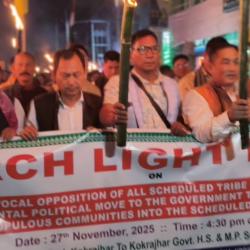
Hundreds of Assamese women supported by students hit the street and condemned the police forces for its repeated failure to protect the women in their locality. A large number of angry protesters sat on the road with a bright Sunlight on their heads alleged that months back an aged lady was raped in their locality, where the police did only cover ups. They accused the habituated rapists as being suspected migrants and demanded justice for the victim girl. A few of them even chanted slogans demanding an encounter (meaning extra judicial killing) for the monsters.
Meanwhile, following a call by the Dhing unit of All Assam Students’ Union (AASU), all commercial establishments and educational institutions were closed in the locality. AASU president Utpal Sarma demanded stringent actions against the culprits. He expressed serious concern that the criminals start daring the law enforcement agencies and hence the authority must take serious note over the alarming rise of rape-murder incidents in the State. Criticizing the State home department for its failure to protect the women in their own places, the AASU chief insisted that the indigenous girls must be safeguarded at any cost. The protest demonstrations in Dhing continued for days demanding the arrest of all involved criminals.
Realising the charged situation, Assam chief minister Himanta Biswa Sarma, who was full of praise for the Sibsagar resolution, made a stern comment through his social media handling over the Dhing incident. Expressing serious concern over it, Sarma (also in charge of State home portfolio) directed the State police chief GP Singh to rush to the location and ensure swift actions against the monsters. He asserted that the horrific incident at Dhing, involving a minor, was a crime against humanity and the government will not spare the perpetrators.
And the news broke in next day morning hours that one of the prime accuseds in the gang-rape died by drowning as he tried to escape police custody by jumping into a pond. Tafajjul Islam, who was arrested after the horrible incident, was taken to the place where it took place for recreating the crime scene. According to the police personnel on duty, Tafazzul attacked them and tried to escape. After two hours of search by State Disaster Response Force personnel, his body, still handcuffed, was recovered from the pond. The local villagers did not join in his cremation, as it was conducted by the close family members only.
Meanwhile, a number of protest rallies were organized in different parts of Assam supporting the demand of Dhing-lady agitators. A group of indigenous people’s organisations even issued a deadline to Miyas (indicating Muslims of Bangladesh origin) to leave upper Assam within a week. They were loud & clear that the Dhing rape was committed by the Miyas and urged the government to do the needful. Representatives of All Tai Ahom Students Union, Bir Lachit Sena, Asomiya Yuva Manch, Asomiya Mahila Manch, All Assam Adivasi Students’ Union, All Assam Chutia Students’ Union, All Assam Sonowal Kachari Students’ Union, etc termed the Miyas as cancerous to the Assamese society and insisting on its quick eradication.
- 491790 reads

Add new comment