
Skip to content Skip to navigation

Ganga-Brahmaputra (Tsan-Po)-Meghna basin

The Brahmaputra (Tsan-Po in Chinese) river originates on the northern slope of the Himalayas in Tibet, China. It flows eastwards for a length of about 1,130 km and then takes a sharp bend towards south and enters Arunachal Pradesh of India. It travels through Arunachal Pradesh, Assam and Meghalaya and then enters Bangladesh at Bahadurabad Ghat. The segment of the river between Bahadurabad and Aricha, where the river joins the river Padma (as the Ganga is known in Bangladesh), is popularly known as Jamuna in Bangladesh. The total length of the river from the source to the sea is about 2840 km. Within Bangladesh, the channel varies considerably in width ranging from less than 2.0 km to more than 12.0 km.


The discharge of the Brahmaputra is mostly contributed by the melting snow in Tibet before it reaches the Arunachal Pradesh in India. In north eastern states of India and in Bangladesh rainfall is quite heavy. This contributes to a substantial amount of flow in the river.


The Ganga is a combination of the Alakananda and the Bhagirathi, which meet at Deva Prayag in Uttaranchal Pradesh of India, also within the mountain range of the Himalayas. From the original southward course it flows through easterly direction and finally in its last lap, the Ganga flows again southward until it meets the Bay of Bengal.


The Yamuna, a tributary, joins the Ganga at Allahabad in India. The Ganga then enters Bangladesh near Farakka and joins the Brahmaputra near Goalanda Ghat assuming the name of the Padma and further down the combined discharge joins the Meghna at Chandpur. The mighty combined flow then runs for another 100 km or so and falls into the Bay of Bengal. The total length of the river Ganga/Padma from Deba Prayag to the sea is about 2,515 km. The Surma-Kushiara-Meghna river system flows on the east of the Brahmaputra river through Bangladesh. The Surma rises as the Barak in Assam in India and is divided into two branches namely Surma and Kushiara. Both flow through Indian territories and then enter Bangladesh, where they join the Meghna at different points in Sylhet. The lower Meghna is one of the largest rivers in the world, as it is the confluence of the three great river systems - the Ganga-Padma, the Brahmaputra and the Meghna. The total length of the river is about 930 km.


Both India and Bangladesh are regularly affected by floods due to widespread heavy rainfall in the catchment areas and inadequate capacity of the river channel to contain the flood flow within the banks of the river.


Resolving conflicts over water management issues for international rivers present huge challenges for the nations of the world. However since changing national boundaries is not an option, we have to develop understanding and mutual respect in order to resolve water resources management issues for the benefit of all riparian countries. As there are compelling economic reasons for the mutual benefits that will accrue to cooperative management and development of transnational river basins, we hope governments of Bangladesh, India, Nepal, Bhutan and China will work together and establish such a cooperative management structure for the Ganga-Brahmaputra(Tsan-Po)-Meghna basin.


Nuruddin Azam, Australia

Comments

bishwajeet sinha's picture

As Indian Remote Sensing had clear proof that China is constructing a dam to control the water flow into Brahamputra at their Tibet end, both India and Bangladesh will be at Chine mersy for continuous water when need arises and the danger will always be there for flood as China-ill motive may release the water when we not require it ! So, it is Wake-Up call 4 India to avoid diplomacy and ensure its national security first.
Pallavi Barua's picture

But what about the proposed mega dams in Arunachal Pradesh? Sometimes its good to have China nearby. Till yesterday dams in Arunachal were Assam's concern. Today a dam in Tibet (now a part of southern China), and the Union govt and Arunachal shivers. Had there been no Chinese Aggression, Assam would not have had the Koliabhumura bridge over the Brahmaputra so soon. India lost to China because troops didn't have a base in Tezpur.
rajatverma's picture

please tell me what is the length of brahmaputra only till it joins the padma river
tenzin choeying's picture

The Brahmaputra in Tibet is called Yarlung Tsangpo. Tsangpo is a Tibetan word which means river and Yarlung is the valley in central Tibet through which Tsangpo flows.authors mention of word Tsangpo as Chinese is in-correct.
Nuruddin Azam's picture

My thanks to Tenzin Choeying (Comment,11 november)for correcting my mistake re Chinese name (Yarlung Tsangpu) of the Brahmaputra. My apology to the readers, Nuruddin Azam
Gahori's picture

Dear Nuruddin Azam, I hope you have taken notice of what Tenzin is pointing out here. Tsangpo is a Tibetan word, not Chinese.
milk talukdar's picture

Tsan po is a pure chinese word. actually it should be shan po. shan means mountain in standard chinese and po means splashing. so the ultimate meaning of shan po is water splashing from mountain. maybe there have some similarities in tibetan and chinese words as some assamese words have with indian.
Nuruddin Azam's picture

Dear Gahori, Thanks, I now understand and express my gratitude and thanks to Tenzin and you for enlightening me. Nuruddin Azam

Pages

Add new comment

Other Contents by Author

A citizens meeting at Guwahati Press Club yesterday expressed serious concern at the increasing rate of killing of tigers in various parts of Assam and urges the State government to activate the forest department and its public relation wings to fight against the superstition involving the wildlife parts. Attended by a number wildlife and environment activists, the meeting also appealed to the government to enlighten the police personnel on wildlife issues as well. Initiated by activist-journalist Mubina Akhter, the meeting was attended and addressed by Soumyadeep Datta of Nature’s Beckon, Bibhab Talukder of Aranyak, Purnima Sarma of Early Birds, Satyaranjan Bora of Seuji...
The Tea Board is in a process to shift its regional office from Guwahati to Jorhat. If everything goes hunky dory, the country's tea apex body will ensure it within a short spell of six months. The Tea Board has already finlized the decision. Disclosing this, sources told Assamtimes that the Jorhat office would be of great help to boost the tea sector in the state. The decision as pending before the Tea Board since the Assam Government moved the proposal few couple of years. Meanwhile, in yet another bid to help the small tea growers, the Assam government would soon set up a tea dirctorate in Dibrugarh within a period of two years. Notbly, the small tea growers have been crying a...
The anti dam protest received yet another boost when hundreds of AASU activists started a three day long blockade at Gerukamukh to disrupt the supplies of machinaries to the NHPC-owned big dams construction site. Talking to Assamtimes,local AASU leaders said that they started the blockade from Friday to end on Sunday. They further said that the would force Assam and Arunachal Pradesh governments to stop the construction of mega dams till it is ensured that the downstream areas would have no adverse impact. AASU began the road blockade immediately after KMSS suspended protest in Lakhimpur and Dhemaji for three days.
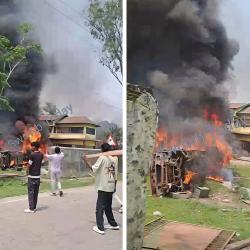
Properties worth several lakh have been reduced to ashes when a devastating fire broke out in Sivasagar on Saturday. The incident took place in the evening at Station Chariali in the heart of the town where at least 30 houses were razed to ground. The fire broke out immediately after the burst of a LPG cylinder at around 7-30 in the evening which later was quickly spreading to the adjacent houses. Fire tenders were arrived in the spot but by then the fire engulfed more than 30 houses including some shops. The extent of damage is yet to be ascertained.
Arunachal Pradesh Chief Minister Nabam Tuki has sought Centre’s intervention to resolve the big dam agitation simmering in Lakhimpur and Dhemaji. The Chief minister on Friday called on Union Power Minister Sushil Kumar Shinde in Delhi and sought his intervention in the on-going agitation against NHPC project at Gerukamukh. He called on Sindhe after protesters served a two-day ultimatum to Dispur to break the stalemate and threatened to go for a massive blockade. Accompanied by MP Takam Sanjoy, Tuki requested him to convene a meeting of the chief ministers of Assam and Arunachal besides MPs of both the states to end the on-going stalemate. Tuki, further, urged the...
Lakhim and Dhemaji districts are set to heave a sigh of relief. KMSS, AJYCP, TMPK have called off the big dam blockade from Saturday. Addressing a press conference in Lakhimpur on Friday, KMSS leader Akhil Kumar Gogoi said that they would suspend the blockade on Saturday and Sunday. He said they have decided to call off the stir in view of the government’s appeal to create a congenial atmosphere for talks. “ We hope that the government will show its willingness for talks within the next two days,” said Gogoi. He further criticized Arunachal Pradesh Chief Minister Nabam Tuki who very recently refused to halt the NHPC constriction work despite a hail of protest in...
Assam Chief Minister Tarun Gogoi on Friday accused KMSS and other anti big dam organizations of trying to foment trouble in the state. Addressing a function in Jorhat, Gogoi said those agitating against the mega dam donot want any process of development to take place and that they want unrest to prevail in the state. Gogoi’s statement assumes significance a day after he alleged presence of ULFA and Maoist elements in the anti big dam protest.
The Assam government is on the hunt for getting a new DGP appointed to replace Shankar Baruah who retires on Saturday. According to information, Chief Minister Tarun Gogoi is actively considering two names----SC Goswami and Jayanta Narayan Chaudhury. Goswami, is senior most additional DGP who is working as chairman cum Managing director with Assam Police Housing Corporation. Another name is Jayanta Narayan Choudhury. He is 1978 batch IPS officer and is in the stint as Next in seniority is additional director, IB. The name is expected to finalise within the next 12 hours. Notably, Shankar Baruah retires on Saturday.
Assam Chief Minister Tarun Gogoi on Wednesday alleged presence of ULFA and Maoist elements in the simmering anti big dam agitation in Lakhimpur and Dhemaji. Talking to reporters in the sidelights of a function in Guwahati, Gogoi said that such a big demonstration in the form of road blockade was not possible for KMSS to organize without the active help and support from Maoists and ULFA. He said that the government keeps its door open to discuss anything with protestors. But in the same breath he said he wont allow anybody to take law on their own hands. “My position is clear. If one takes law on one’s hand we not remain silent.”