
Skip to content Skip to navigation

Ekal Vidyalayas empowering tribals economically and socially

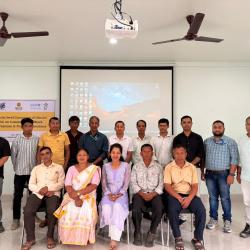
Mission of Friends of Tribal Society (FTS) is to eradicate illiteracy from rural areas, particularly tribals, so that a literate population simultaneously gets access to primary health, child care and gainful self-employment to empower them economically and socially. The Society established in 1989 along with likeminded organizations, has now spread to nearly 38,120 villages as on June,30,2012, in 23 states of India, where 10,76,691 students and lakhs of adults in villages are getting benefit of the Ekal’s education programmes. In the North East Ekal has its presence in 3,060 villages with about one lakh children being given support education. The society has evolved a cost effective support education system where the one teacher school functions in a village under a tree or in open space provided by the inhabitants of the village.


A local tribal youth from the same village or a neighboring village is associated to function as the Acharya of the school following induction training and recurring training support for effectively transacting the curriculum. He is also provided with necessary teaching aids to run the school for three hours a day at a time convenient to the students. Syllabus of three years--- comprising seven subjects would enable a child to get admission in class 3 or 4 of a formal primary school. Teachers are also motivated during their training to guide the students to develop consciousness about personal hygiene, healthcare, village sanitation and to free themselves from the age-old habit of alcohol consumption which is a bane of the tribal society. To make the tribals healthy, strong and gainfully employed, Ekal Vidyalaya runs a four pronged programme of education as primary education, healthcare education, development education and the empowerment education.


Besides motivating them to go to school daily, Ekal Vidyalaya imparts support education for three hours daily to children of the village who do not go to any school or even those who go to other schools.
Through health care education programme the vidyalaya disseminates information about health hazards and preventive measures through community participation. The emphasis is on hygiene, sanitation, nutrition, first aid, maternal and child care and information on common diseases prevailing in the local area.
Under development education providing information on various income generating programmes, the objective of the Ekal Vidyalaya is to make the village self-reliant by utilizing local resources. For sustaining development, small projects like vermin-culture, tree plantation, vegetable plantation, water management, animal husbandry etc, are pursued.


Ekal Vidyalayas educate villagers about various government schemes meant for their benefit. Modalities of using ‘Right to Information Act’ are also in the curriculum under empowerment education. Through four -pronged functional education program, the Ekal Vidyalaya wants to realise integrated village development to help marginalized population become literate, healthy and economically well-off to lead a dignified life.
Ekal Vidyalayas work is being recognized globally. Besides having support in Indian cities it has a strong support base in eleven countries like Australia, Canada, Dubai, Hongkong, Newzeeland, United Kingdom (UK) and United States of America (USA), where it has 40 chapters. Besides many other recognisations and service awards, Ekal Vidyalaya had the privilege of being selected by the organizers of Petrotech Society and ONGC as their Corporate Social Responsibility (CSR) partner for Petrotech 2010.


Recently Ekal has been selected to receive the National Award for 2011 for its contribution in spreading literacy among tribals inhabiting interior areas of India by Lala Dewan Chand Trust, Delhi. Over the years programmes run by Ekal Vidyalayas have shown positive impact on the villagers. These are registering of Indian Sansakar on young minds, eradication of drinking habits, mutual co-operation, greater interest in education, greater awareness about hygiene and cleanliness and striving for self sufficiency.


The Guwahati chapter of the Friends of Tribals Society was formed in the year 2005 and since then it has been responsible for expanding and the smooth running of the Ekal Vidyalayas in the entire north east region. The whole northeast has been divided into 16 districts for the convenience of effective administration and each district has a full-fledged district committee with its own office to look after the functioning of the Ekal Vidyalaya in its respective area. The committees are supported by a team of about 600 full time workers, who have voluntarily come forward to spare their lives for the National cause.

Add new comment

Other Contents by Author

Citizens’ First , an NGO has demanded the land vacated by shifting of Guwahati Central Jail from Fancy Bazaar area of the city to be converted into a freedom fighters’ park with green coverage and installation of Martyrs’ column. In a memorandum submitted to the Assam Chief Minister, Tarun Gogoi recently, the NGO President Jagannath Chakraborty, Working President Ajoy Dutta, Ex-MLA and General Secretary Jagannath Das have urged an important issue relating to utilization and preservation of 64 Bighas of land vacated by shifting of Central jail from the city to outside. The memorandum pointed out that the Fancy Bazaar and surrounding areas in the midst of the city...
One out of every 1000 children born, is born deaf. An undiagnosed deaf child at 3 years of age will know about 25 words, compared to over 1000 words for a hearing child of the same age. Eighty one percent of the parents of a deaf child never learn to communicate with their child. About 530 schools in India educate around 50.000 children with hearing impairment in the age group of 5 to 18 years. The other children do not receive any formal education. Ninety percent of the deaf children grow up in hearing families with little or no experience of deafness. Deaf children face a complete disconnect from the world around them. A feeling of isolation and desperate loneliness develops within the...
Established in 1901 Digboi oil refinery is not only India’s, but Asia’s first oil refinery, which is now losing its glory due to present marketing policy and mismanagement. According to the workers of the refinery the journey of oil industry in India began from Digboi in Assam. After long sixty years, Indian Oil Corporation Ltd (IOCL) came into existence in 1962, with its first refinery at Guwahati. Under the IOCL and even prior to that there was no effort by the management to increase the production capacity of this refinery. Whereas, for the survival of refinery its capacity should have been increased to 9 million MT, it came down to 0.65 million tons. In the meantime, the...
India has a long stretch of international borders with Bangladesh surrounding throughout north, east and west. On the north eastern part, Indo-Bangla borders in Assam, barbed wire fencing work is continue for a longtime. Despite all efforts infiltration of foreign nationals from that country is continue. In between the two countries a vast area, called ‘No man’s land’ is lying where a large number of Indian families are living and there is nobody to look after their convenience and welfare. They are Indians, but they are not independent like other Indians. According to official reports, beyond the wire fencing on the borders 448 families are land locked. Out of them...
Industrial development in India has been dependent on political influence and leadership, ever since Independence. As a matter of fact no fair policy could be framed for equal development of all the regions of the country simultaneously. That is why some of the regions remained completely neglected, while others developed beyond limitations, resulting in heavy congestions. Besides, the metropolis and a few big industrial centers of the country, where opportunities are ample for growth, there is vast disparity in establishment of industries in various regions. The industrialization of a particular area depends on the degree of political influence in its favor. Unfortunately, the...
Mismanagement, fund crunch and irregular supply of raw materials has put the Cachar paper mill on brink of closure. The employees and casual laborers of the mill are put under tight corner and the management has maintained complete silence over the whole affairs. Production of the paper mill has been confined to the tune of daily material collection from various sources. The supply of disproportionate raw materials could not ease the tension of high officials. Supply of bamboo, coal, lime etc, are urgently required to run the factory. The problems in supply of bamboo from North Cachar Hills to this mill began about three years back due to legal complexities, unwillingness of...
In spite of tall talks of Assam Chief Minister, Tarun Gogoi and the minister of health and family welfare, Dr Himanta Biswa Sarma, about record progress in health sector in respect of establishment of health sub centers, appointment of doctors etc; the picture in this sector is far behind the truth. Construction of hospital buildings, payment of salaries and wages, organizing public meetings about awareness and precautions against diseases, can in no case be treated as the progress in health sector. It may be mentioned here that one health sub centre is required for every five thousand population in both rural and urban areas. Against every five thousand population, doctors, nurses and...
Ubati Riang, a sixty year old lady, who played a major role in bringing Barak valley militants to negotiation table with the government, is disappointed on the role of the state government for its dillydally tactics in solution of the major issues relating to the rehabilitation of those, who came forward for the peace talks. According to her recent violent incidents in the Hailakandi district of southern Assam, were the outcome of state’s inaction as regards the solution of the issues. The Riang youths are losing heart and peace is vanishing, she was reported to have said. She said that the Riangs did not ask any thing that was not possible for the government to agree. Their...
With growing intolerance and unrest minds among the youths of the country, demand for creating smaller states is growing day by day. Recently Uttar Pradesh Assembly has adopted a resolution to divide the state into four parts namely, Purvanchal, Avadh Pradesh, Paschim Pradesh and Bundelkhand. It is realized that this situation has attained importance because of the regional disparity in growth, discrimination in all rights and privileges and sense of insecurity at the individual and community level. Most of the Indian states are politically insurmountable state of affairs to all fronts especially in respect of political and economic fields. There are imbalances and unmanageable equal...
Assam Government has given a work order for construction of a ropeway project over Urvashi river Island to M/s Samir Damodar Ropeway Pvt Ltd; who have constructed four big size RCC pillars in the Umananda Island to install high structure for ropeway project. Getting this information a team of a NGO, namely, Citizens’ First, consisting of Ajay Dutta, Ex- MLA, Krishna Kanto Borooah, Jagannath Das, General Secretary of the Forum and renowned archaeologist, Dr Pradip Sarma, visited the site of construction on the Umananda Island and found that the said company has already occupied a portion of the island and piled deep inside its rock bed to raise RCC pillars. By its such act, the...