
Skip to content Skip to navigation

Ekal Vidyalayas empowering tribals economically and socially

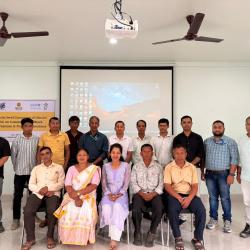
Mission of Friends of Tribal Society (FTS) is to eradicate illiteracy from rural areas, particularly tribals, so that a literate population simultaneously gets access to primary health, child care and gainful self-employment to empower them economically and socially. The Society established in 1989 along with likeminded organizations, has now spread to nearly 38,120 villages as on June,30,2012, in 23 states of India, where 10,76,691 students and lakhs of adults in villages are getting benefit of the Ekal’s education programmes. In the North East Ekal has its presence in 3,060 villages with about one lakh children being given support education. The society has evolved a cost effective support education system where the one teacher school functions in a village under a tree or in open space provided by the inhabitants of the village.


A local tribal youth from the same village or a neighboring village is associated to function as the Acharya of the school following induction training and recurring training support for effectively transacting the curriculum. He is also provided with necessary teaching aids to run the school for three hours a day at a time convenient to the students. Syllabus of three years--- comprising seven subjects would enable a child to get admission in class 3 or 4 of a formal primary school. Teachers are also motivated during their training to guide the students to develop consciousness about personal hygiene, healthcare, village sanitation and to free themselves from the age-old habit of alcohol consumption which is a bane of the tribal society. To make the tribals healthy, strong and gainfully employed, Ekal Vidyalaya runs a four pronged programme of education as primary education, healthcare education, development education and the empowerment education.


Besides motivating them to go to school daily, Ekal Vidyalaya imparts support education for three hours daily to children of the village who do not go to any school or even those who go to other schools.
Through health care education programme the vidyalaya disseminates information about health hazards and preventive measures through community participation. The emphasis is on hygiene, sanitation, nutrition, first aid, maternal and child care and information on common diseases prevailing in the local area.
Under development education providing information on various income generating programmes, the objective of the Ekal Vidyalaya is to make the village self-reliant by utilizing local resources. For sustaining development, small projects like vermin-culture, tree plantation, vegetable plantation, water management, animal husbandry etc, are pursued.


Ekal Vidyalayas educate villagers about various government schemes meant for their benefit. Modalities of using ‘Right to Information Act’ are also in the curriculum under empowerment education. Through four -pronged functional education program, the Ekal Vidyalaya wants to realise integrated village development to help marginalized population become literate, healthy and economically well-off to lead a dignified life.
Ekal Vidyalayas work is being recognized globally. Besides having support in Indian cities it has a strong support base in eleven countries like Australia, Canada, Dubai, Hongkong, Newzeeland, United Kingdom (UK) and United States of America (USA), where it has 40 chapters. Besides many other recognisations and service awards, Ekal Vidyalaya had the privilege of being selected by the organizers of Petrotech Society and ONGC as their Corporate Social Responsibility (CSR) partner for Petrotech 2010.


Recently Ekal has been selected to receive the National Award for 2011 for its contribution in spreading literacy among tribals inhabiting interior areas of India by Lala Dewan Chand Trust, Delhi. Over the years programmes run by Ekal Vidyalayas have shown positive impact on the villagers. These are registering of Indian Sansakar on young minds, eradication of drinking habits, mutual co-operation, greater interest in education, greater awareness about hygiene and cleanliness and striving for self sufficiency.


The Guwahati chapter of the Friends of Tribals Society was formed in the year 2005 and since then it has been responsible for expanding and the smooth running of the Ekal Vidyalayas in the entire north east region. The whole northeast has been divided into 16 districts for the convenience of effective administration and each district has a full-fledged district committee with its own office to look after the functioning of the Ekal Vidyalaya in its respective area. The committees are supported by a team of about 600 full time workers, who have voluntarily come forward to spare their lives for the National cause.

Add new comment

Other Contents by Author

The people of Assam are likely to face serious flood and erosion during the new-year 2012 due to reluctance of state governments to take necessary steps to tackle the situation, despite the demand of All Assam Water Resource Contractors’ Association (AAWRCA). Speaking to the media people recently, Muhi Bargohain, President of AAWRCA, alleged that the state’s water resource department has not taken any step to get last year’s damaged embankments repaired till now. It is learnt that Assam’s Revenue and Finance departments have not approved the schemes related to it. It is well known fact that the northern districts of Lakhimpur, Dhemaji, Dibrugarh and Shivsagar etc...
Protest against use of Armed Forces (Special Powers) Act 1958, has shifted from extreme northeastern part of the country to the remote northern part. Now, demands are high by the Chief Minister of Jammu and Kashmir, Omar Abdullah, to withdraw at least partially, the aforesaid Act, from his state in order to bring peace in the troubled region of the country. It is alleged that in guise of the search for militants, the security personnel are misusing the Act and ‘harassing and torturing’ the innocent people of the state. The Union government is now facing an embarrassing situation due the state’s demand. Similar demand for withdrawal of the AFSP Act1958 is long...
History repeats itself and it seems that our Union government is trying to get it repeated as early as possible by allowing foreign investments in every sector of industries and agriculture as well. The Union Cabinet by justifying 51 percent foreign direct investment (FDI) in retail trade has proved that it has no regards either for the poor people of the country or the Father of the Nation, Mahatma Gandhi, who cherished a dream to bring ‘Ram Rajya’ in the country by his followers. Now, the country is moving head very fast to ‘Ravan Rajya’. It has to be mentioned that Mahatma’s name is being utilized by our leaders to save the ‘corrupt politicians...
The anti-corruption movement launched by the Gandhian leader, Anna Hazare, has threatened a number of politicians, bureaucrats and big businessmen involved in various financial crimes against the country and the society. The issue of black money in Swiss banks and calling back the same to the country for investment and prosperity of the nation, has also threatened them of losing their unfair incomes. The United Progressive Alliance (UPA) government led by the Congress party, has been found involved in the practices leading to great sufferings of the countrymen. The Civil Society’s proposal in respect of the Lokpal Bill, has been ‘turned down’ by the Union cabinet...
Reacting to the recent ‘blatant lies’ of the Assam Power Minister, Pradyut Bardoloi, Krishak Mukti Sangram Samiti (KMSS) leader Akhil Gogoi made it clear that he is not opposed to the demand and need of power for the state, but he wanted to know the ‘secrets of the deal’ which made the state government to ignore all the facts related to the geographical and environmental needs of Assam. Addressing the media persons in Guwahati recently, the RTI activist, Akhil Gogoi said that the power minister had given the history of Lower Subansiri Project. He said an unknown fact of this history was that the Central Electricity Authority (CEA) report of October 2001 gave rank...
Yoga Guru Ramdeva fighting to get back the Indian’s black money in the foreign banks to the country continued his fast from June 4, had to give up on 9th on demand of millions of countrymen, who wanted his precious life to be utilized in the welfare of mankind. His tirade against the ‘unholy’ politicians and bureaucrats, who are involved in top-level corruption continued during his fast and none of high- level officials approached to solve the issues raised by him. This was interpreted by a section of the society as the government was not interested in bringing back the black money in the country. Even the government was not interested to reveal the names of such persons,...
The Gauhati High Court directed petitioners Asian Centre for Human Rights and others in PIL No.6/2011 to provide practical and workable solutions to the issue of displacement of the Rabhas and Garos as submitted before the Court pursuant to the respondents States of Assam and Meghalaya and the Union Home Ministry within a week to act upon. It had earlier directed the petitioners on January 22 last to submit practical and workable solutions. Addressing the media persons the petitioner, Suhas Chakma, Director of Asian Centre for Human Rights said that he appeared in person before the Chief Justice, Madan B Lokur. The matter is listed for May 2011 after the state governments take necessary...
National Election Watch (NEW), a nationwide campaign comprising of more than 1200 NGOs and other citizen-led organizations working on electoral reforms, improving democracy and governance in India, has stepped up the pressure on political parties to demand accountability from them in the state of Assam as well. It announced several initiatives with the purpose of bringing transparency and accountability in the political system on February 17 last through a press conference organized in Guwahati Press Club. Addressing the media persons the coordinator of the Assam Election Watch, Tasaduk Ariful Hussain, said that different civil society organizations, eminent citizens, media, senior...
Trade is the ‘spinal cord’ of a country’s economy and the traders are its protectors. It was said at a time, when our traders were among the most trusted nationals, who scarified all their earnings of life and belongings, when the country needed it. Now, the time has changed and the national feelings in the trading community have gradually diminished. ’Honesty’ the essence of the trade has lost its value and it is no more the ‘best policy’ in the trade. Majority of the traders feel difficulty in surviving, if they try to be honest in the present political situation of the country. They have to oblige political leaders and parties, some of whom...
The Asian Centre for Human Rights in a briefing to media persons at Guwahati Press Club on Friday, alleged that about fifty thousand Garos and Rabhas displaced by conflict since January 1, 2011, are being discriminated in terms of relief and rehabilitation in comparison to assistance being provided to the Kashmiri Pandits and Sri Lankan Tamil refugees, by the Government of India. Director of Asian Centre for Human Rights, Suhas Chakma said, in terms of rations at the relief camps at Jammu and in Delhi, Kashmiri internally displaced persons are given Rs.1,000 per head per month subject to maximum of Rs.4,000 per family per month plus dry ration. The Sri Lankan Tamil refugees in India...