Skip to content Skip to navigation

Training to Bhutan’s forest rangers for tiger protection

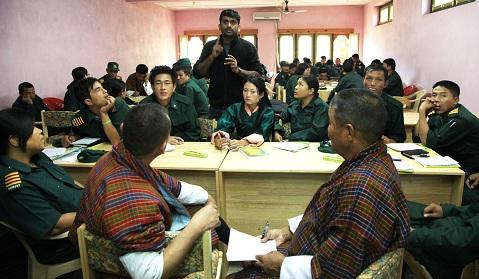
The Wildlife Conservation Division of Bhutan along with the International Fund for Animal Welfare – Wildlife Trust of India (IFAW-WTI) have launched a month-long training for around 450 forest rangers for effective wildlife crime prevention in the landlocked country.

The skills learned will help the rangers deal with a wide range of issues to protect the country’s natural heritage including the tiger. Each staff will also be equipped with field kit sets (rucksack, winter jacket, rainsuit, water bottle, cap, sleeping bag) to help them in their daily duties, including specially-made kits for frontline staff working 5000 masl protecting the rare snow leopards.

Sonam Wangchuk, Chief of the Wildlife Conservation Division (WCD) of the Royal Government of Bhutan, said, “The training programme could not have been timed better than this. Our people in the field need better incentives, training and better equipment to do their job of saving our natural heritage. People become effective when their needs are fully met and I must take this privilege to thank our counterparts at the WTI-IFAW for starting this in some way.”

The session (each lasting three days) began on Sunday for over 50 participants including 13 ladies, of Wangdue Forest Division.

Subsequently, the IFAW-WTI team will travel and conduct these trainings for staff of Jigme Singye Wangchuk Naitonal Park (NP), Toorsa Strict Nature Reserve, Wangchuk Centennial Park, Thrumsingla NP, Bumdeling Wildlife Sanctuary (WLS), Sakteng WLS, Samdrup Jongkhar FD, Samtse FD, ending on November 17 at Jigme Dorji NP, in coordination with the local authorities in each of these areas.

“It really does take the entire global community to protect our remaining wildlife. The government of Bhutan is doing their part to help protect wildlife by preserving habitat, setting sound policies and committing staff to the field. IFAW is proud to fund ranger training and equipment so we can help them. The animals will be safer from poachers and so will the rangers and communities,” said Azzedine Downes, IFAW, President & CEO. 

The trainers include authorities of Bhutan as well as IFAW-WTI members from India.

The Bhutanese trainers include Sangay Dorji, Head of Carnivore programme of the WCD, Forest Officers – Kinley Rabgay, Ugyen Tenzin, Tshering Zam, and Officer-in-charge of Toorsa Strict Nature Reserve, Namgay Wangchuk.

IFAW-WTI trainers include Aniruddha Mookerjee, who has been in the field of wildlife conservation for over four decades, Jose Louies, who assists authorities in India in wildlife trade control activities, and Krishnendu Mondal, Officer-in-charge of the IFAW-WTI Van Rakshak Project (Guardians of the Wild) in India. 

“Bhutan is one of the tiger-range countries’ that have overall good records of wildlife conservation and protection. Yet, wildlife conservation in a globalised and interconnected world can be quite a complicated task. Effects of actions in one country or region have repercussions on another,” said Vivek Menon, Regional Director – South Asia, IFAW and Executive Director, WTI. “We are sure that this training will help the rangers continue their efforts better, even as we thank them for their efforts on saving the tiger among other wildlife.”

In June last year, the team had covered Royal Manas NP and Phibsoo WLS adjoining India’s Greater Manas region. A total of 107 rangers were trained then.

As with earlier sessions, the rangers will not only be updated on Bhutanese laws but also international laws on wildlife conservation. The experienced trainers will also apprise the rangers on effective patrolling and ambushing techniques, collection and preservation of evidences/samples, preparation of offense reports, identification of original and fake wildlife articles, etc.

Field exercises will be conducted on wildlife crime investigation, use of global positioning systems (GPS), camera traps, and other field crafts. The participants were also oriented on first aid for snake bites, and basic wildlife rescue and rehabilitation.


Add new comment

Other Contents by Author

Marking a significant milestone for conservation of Amur falcons in the northeast Indian state of Nagaland, three villages in Wokha district have pledged to save the migratory raptor in Doyang Reservoir - its largest roosting site in the country. With mass annual hunt potentially threatening the species, a resolution has been cleared by the villages to penalise offenders, this year onwards.Village Council Members (VCM) of Pangti, Asshaa and Sungro signed a tri-party Memorandum of Understanding with the Wildlife Trust of India (WTI) and the Wokha-based NGO Natural Nagas, to assist the Nagaland Forest Department to stop the wide-scale hunt which was brought to light last year.Tens of...
A sub-adult wild tusker stranded in human-dominated area in Nagaon district of Assam was successfully translocated to the wild. The exhaustive two-day rescue operation was carried out by the Forest Department assisted by IFAW-WTI team, local elephant experts, mahouts and phandies, with local police and paramilitary forces fencing the crowd of thousands.The tusker was separated from its herd, was disoriented and had been taking shelter for over 70 days in and around Kaki Reserve Forest. It had been caught in conflict with people, resulting in damage to property and crops and even casualty of a farmer; it was also treated for gunshot injuries by the authorities assisted by...
A seven-year old male leopard is being shifted today to the Nagaland Zoological Park from the Centre of Wildlife Rehabilitation and Conservation (CWRC), near Kaziranga National Park. The Assam Forest Department and International Fund for Animal Welfare -Wildlife Trust of India (IFAW-WTI) run CWRC had been taking care of the leopard since 2006, after he was found alone in a tea garden by locals and handed over to the authorities. "When we get any animal at CWRC, our first choice is to look into rehabilitation back in the wild. However, rehabilitation is not an easy option for large carnivores, considering the need for extensive space as they are territorial animals, and...
The International Fund for Animal Welfare - Wildlife Trust of India (IFAW-WTI) has provided 35 boats to the Kaziranga National Park authorities to assist in anti-poaching patrolling in the flood-prone UNESCO World Heritage that houses more than 70% of the world's greater one horned rhinoceros.The boats are largely aimed at providing assistance to the local field staff in their patrolling (anti poaching) activities during the floods in Kaziranga National Park.  Every year the park faces flooding of the Brahmaputra river, causing many animals to wander out in search of higher grounds. Many that are caught in the floods are rescued and rehabilitated by the Forest...
As preparations to tackle potential flood emergencies are on at the Centre for Wildlife Rehabilitation and Conservation (CWRC), good news poured in for the rehabilitators, as yet another rhino hand-reared here gave birth to a healthy calf in the wild in Manas National Park.The female rhino, named Jamuna, was rescued as a three-month-old calf during the annual floods in the famed Kaziranga National Park in June 2004, by the Assam Forest Department. She was admitted to the Assam Forest Department and IFAW-WTI run CWRC near Kaziranga for hand-raising and rehabilitation. In 2007, she along with another female calf, Ganga, was moved to Manas NP.With this, all three female rhinos...
A rescued rhino calf, Purabi, under care at Centre for Wildlife Rehabilitation and Conservation (CWRC) was moved to Manas National Park today, to join an orphaned rhino calf being hand-reared there. This is being done to increase the rehabilitation prospects of the latter calf which has been deprived of company of its kind since its mother was poached early this year.“We have been rescuing rhino calves at Kaziranga in various circumstances and most of them are now successfully hand raised at CWRC. At due course of time all these calves go back to the wilderness again,” said NK Vasu, Chief Conservator of Forest and Director, Kaziranga National Park.Purabi was separated from her mother...