

Assam's Floods: We Need to Think Beyond Embankments
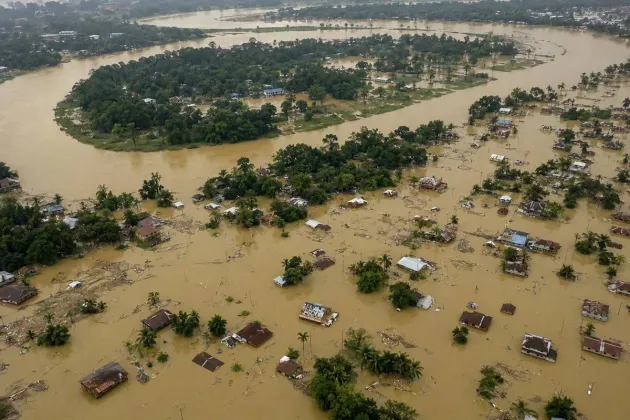

Like clockwork, the arrival of the monsoon brings a familiar disaster to Assam. Year after year, thousands of families watch their homes go under water, crops are destroyed, roads become impassable, and daily life comes to a halt. As the floodwaters recede, the same question returns: will Assam ever find a lasting solution?
The honest answer is that there is no single solution.
Whenever floods strike, the immediate demand is almost always the same: build more embankments and strengthen the existing ones. Embankments undoubtedly protect many communities and remain an essential part of flood management. But treating them as the answer to Assam's flood problem overlooks the complexity of the Brahmaputra basin.
No embankment can completely eliminate flood risk. During exceptionally high floods, a breach can release enormous volumes of water within minutes, causing widespread damage downstream. Rivers such as the Brahmaputra constantly change course, erode banks, deposit sediment and reshape their channels. Managing such a river requires more than building higher walls.
Assam's floods cannot be understood by looking only within the state's boundaries.
The Brahmaputra begins in Tibet before flowing through Arunachal Pradesh into Assam. Major tributaries descend from Arunachal Pradesh, Meghalaya, Nagaland, Bhutan and other upstream catchments. Heavy rainfall across these regions eventually reaches the Assam valley. By the time the water arrives, there is little the state can do except respond to the consequences.
Climate change has made this system even more unpredictable. Warmer temperatures are affecting Himalayan hydrology, while extreme rainfall events have become more frequent in many parts of the region. Short periods of exceptionally intense rainfall can generate flash floods with very little warning.
Land use also plays a significant role. Forests slow the movement of rainwater, stabilise slopes and reduce soil erosion. When forests are cleared, runoff increases and more sediment enters rivers. Over time, sediment deposition alters river channels, reducing their carrying capacity in some stretches while increasing erosion in others. In the hills, landslides can temporarily block rivers before collapsing suddenly and sending large volumes of water downstream.
Assam also faces challenges of its own making.
Wetlands have been encroached upon, natural drainage channels have been blocked and floodplains have seen unplanned development. Guwahati provides a familiar example. Many parts of the city experience severe urban flooding after heavy rainfall because stormwater drainage has failed to keep pace with rapid urban expansion.
Large dams and hydropower projects are often presented as another solution. Reservoirs can help moderate flood peaks under certain operating conditions, but they cannot prevent all floods, particularly during exceptionally heavy rainfall. Moreover, many major projects affecting the Brahmaputra basin lie outside Assam's jurisdiction, limiting the state's influence over their management.
The conclusion is difficult to avoid: Assam cannot solve its flood problem alone.
Reducing flood risk requires cooperation across the entire river basin. That means better coordination between the Central Government, northeastern states and neighbouring countries, together with timely sharing of rainfall and river-flow data from upstream regions. Reliable forecasting and early warning systems become far more effective when information moves quickly across political boundaries.
Engineering will always remain part of flood management, but it should be complemented by scientific river basin planning, wetland conservation, catchment restoration, improved drainage, climate-resilient urban planning and stronger disaster preparedness at the community level.
Floods themselves are not the enemy. Seasonal flooding has long sustained the Brahmaputra valley by replenishing wetlands, supporting biodiversity and depositing fertile silt on agricultural land. The challenge is not to eliminate floods—an impossible objective—but to reduce the loss of lives, livelihoods and property when they occur.
Assam's floods are not simply a state issue. They reflect the condition of an entire river basin shaped by geography, climate and human activity across multiple regions. A safer future will depend not only on stronger infrastructure but also on sound science, environmental responsibility and genuine regional cooperation.
Only by thinking beyond embankments can Assam begin to reduce the human cost of its annual floods.
Comments (0)
No comments yet. Be the first to share your thoughts.
Leave a Comment