

Postpartum depression: The silent illness new mothers in Assam don't talk about
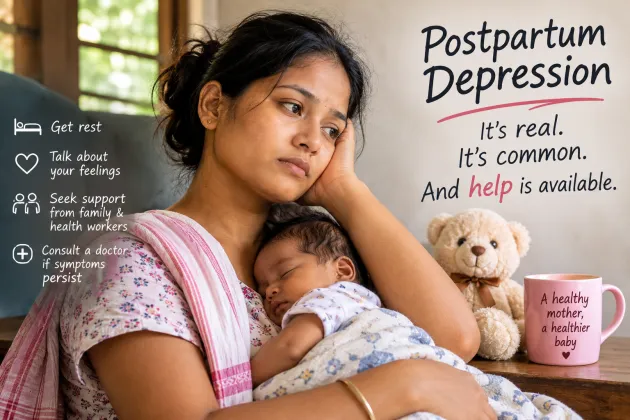

When a baby is born, the whole family's attention turns to the newborn. Is the baby feeding well? Is the baby gaining weight? Why is the baby crying? These are important questions. But there is another question that is asked far less often, and it matters just as much: How is the mother doing?
The first few weeks after childbirth can be among the most challenging periods in a woman's life. Her body is recovering from labour or a caesarean section, her hormones are changing rapidly, and she is learning to care for a newborn, often with very little sleep.
In many households across Assam, whether it is a joint family in a town, a village home or the labour lines of a tea garden, the mother's own health can quietly drop out of the conversation once the delivery is over.
Sleep loss is not just tiredness
In the first few weeks, a mother may wake every one to two hours, day and night, to feed her baby. Some tiredness is normal and expected. But when interrupted sleep continues week after week, it can affect much more than her energy. It can influence her mood, patience, appetite and memory, as well as her recovery after childbirth.
Poor sleep and low mood can also reinforce each other. A mother who cannot rest may become increasingly anxious or low. Anxiety, in turn, can make it harder to sleep, even when the baby is finally asleep.
Baby blues or something more?
Many women experience what is commonly called the "baby blues" in the days following childbirth. They may feel tearful, anxious or overwhelmed. These feelings generally settle within about two weeks.
Many families in Assam take good care of a new mother's food and physical rest during this period, and that support is valuable. But caring for her body is not the same as paying attention to her emotional well-being.
When sadness, hopelessness or anxiety persist, become severe or interfere with daily life, it may be a sign of postpartum depression. This is a recognised medical condition. It is not a weakness, a personal failure or an indication that a woman is not a good mother. With appropriate support and treatment, recovery is possible.
The condition is more common than many people realise. The World Health Organization (WHO) estimates that around 16 in every 100 women in developing countries experience a mental health condition, mainly depression, during pregnancy. After childbirth, the figure is approximately 20 in every 100.
A 2017 systematic review and meta-analysis published in the Bulletin of the World Health Organization examined 38 Indian studies involving more than 20,000 women. It estimated the pooled prevalence of postpartum depression at 22 per cent. These findings highlight the importance of recognising and addressing maternal mental health.
Many women, however, remain undiagnosed because their emotional distress is not recognised or discussed.
Why mothers stay quiet
There are several reasons a new mother may hesitate to speak about what she is experiencing.
She may feel that she is expected to be happy all the time because she has a baby and the support of her family. She may worry that admitting to feeling low will make others question her ability to be a good mother.
In many families, exhaustion after childbirth is considered normal, simply part of a mother's duty and something she should endure without complaint. In a joint household, she may also hesitate to trouble elders or ask for additional support.
As a result, she stays silent, smiles for visitors and struggles alone.
What families can do
Small acts of support can make a significant difference.
A husband, mother or mother-in-law can take care of the baby for a few hours, allowing the mother to get uninterrupted sleep. Other family members can take over cooking, cleaning and receiving visitors during the first few weeks. Ensuring that she eats regular meals and drinks enough water also supports her physical recovery.
Sometimes, however, the most helpful thing is the simplest. Sit with her in a quiet place and ask: "How are you feeling today?"
Then listen without judging, dismissing her concerns or rushing to offer advice.
Support should also come through the local healthcare system. When an ASHA worker visits after delivery, families should discuss the mother's mood and sleep, not just the baby's health. The same concerns can be raised with nurses and doctors at health centres, antenatal and postnatal check-ups, tea garden hospitals and even during the baby's vaccination visits.
For women in remote villages and tea garden communities, these routine interactions can provide an important opportunity to identify problems early and seek appropriate care.
As a gynaecologist, I believe every mother should be asked about her emotional well-being during pregnancy and at every postnatal check-up.
When to seek medical help
Families should encourage a new mother to consult a doctor if she:
- Experiences persistent sadness, frequent crying or anxiety.
- Cannot sleep even when the baby is sleeping.
- Loses interest in food, social interaction or activities she previously enjoyed.
- Feels hopeless, excessively guilty or unable to cope with everyday responsibilities.
These symptoms should not be dismissed or left unaddressed. A healthcare professional can assess the mother's condition and recommend appropriate treatment and support.
If a mother has thoughts of harming herself or her baby, this requires immediate medical attention. Take her to the nearest hospital or emergency department and do not leave her alone.
In India, the government's free Tele-MANAS mental health helpline, 14416, provides round-the-clock support.
A healthy baby needs a healthy mother
We rightly celebrate every new baby, and we should. But a baby is cared for best when the mother is also healthy, rested, supported and listened to.
The next time you visit a family with a newborn, ask about the baby. Then turn to the mother and ask about her.
Sometimes, that simple question can be the beginning of the support she needs.
Comments (0)
No comments yet. Be the first to share your thoughts.
Leave a Comment