

UN recognises campaign against child marriage with global day declaration
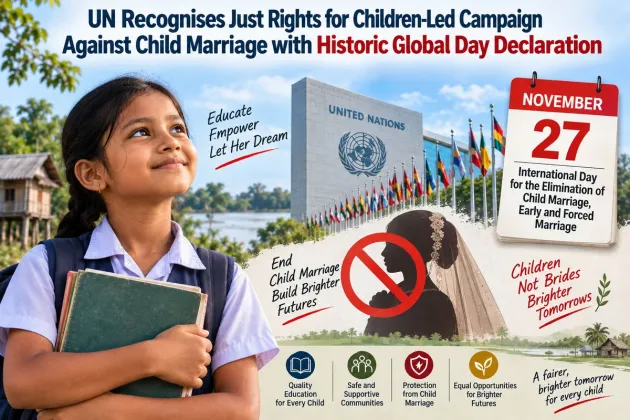

GUWAHATI, September 5, 2026 — The North-East Affected Area Development Society (NEADS) has welcomed the United Nations’ decision to designate November 27 as the International Day for the Elimination of Child Marriage, Early and Forced Marriage, calling it a significant global recognition of the sustained campaign led by Just Rights for Children (JRC) to end child marriage.
NEADS, which has been spearheading grassroots efforts against child marriage in Majuli and Charaideo districts of Upper Assam, said the UN declaration marks an important milestone in the global movement against the practice. The organisation is a partner of JRC, which has campaigned for years for a dedicated international day to strengthen action against child marriage.
Addressing an event organised on Teachers’ Day, NEADS Director Tirtha Prasad Saikia said the UN recognition was a matter of pride for India as well as a renewed call for stronger action.
“The voice that emerged from India has today become a global resolve. It is a moment of immense pride that our efforts have received global recognition. It is also a matter of great pride for India that the United Nations has chosen November 27 for a global day dedicated to ending child marriage,” Saikia said.
He noted that November 27 also marks the date on which the Government of India, in partnership with JRC partners, launched the Bal Vivah Mukt Bharat campaign in 2024.
“But this is not a moment to celebrate and stop,” he said, stressing that global commitment must now translate into sustained action at the grassroots.
“Until even one child in a village in our district continues to live under the threat of child marriage, our fight remains incomplete,” Saikia said.
He said legislation alone would not be sufficient to eliminate child marriage and underlined the need for sustained community mobilisation, education and economic support for vulnerable families.
NEADS has conducted awareness campaigns in schools, panchayats and villages, encouraged communities to take anti-child-marriage pledges, linked vulnerable families with government welfare schemes and facilitated the re-enrolment of children who had dropped out of school.
The organisation has also undertaken legal interventions and community-level preventive measures in cases of child marriage across Majuli and Charaideo. It claims that sustained awareness drives, community mobilisation, pledges and written undertakings from families have helped prevent more than 1,200 potential child marriages across the two districts.
The campaign for a dedicated international day against child marriage was initiated by Bhuwan Ribhu, founder of Just Rights for Children. In March 2026, Ribhu reiterated the call for a dedicated UN resolution while addressing the United Nations. The initiative received support from international figures, including Sierra Leone’s First Lady, Dr Fatima Maada Bio.
Sierra Leone subsequently led the effort, backed by 67 countries, including India, by introducing a resolution before the UN General Assembly seeking the designation of November 27 as a global day dedicated to ending child marriage.
The UN General Assembly adopted the resolution on September 4, marking a significant step towards strengthening international efforts to eliminate child, early and forced marriage.
The date has particular significance for India, as the Bal Vivah Mukt Bharat campaign was launched on November 27, 2024.
JRC, through its ‘Child Marriage Free World’ campaign, describes itself as one of the world’s largest child protection networks working to build a global movement against child marriage.
In India, JRC partner organisations work with governments and administrations across 782 districts, engaging schools, panchayats, tribal and marginalised communities, women, police personnel, faith leaders and political representatives, in collaboration with government and law-enforcement agencies.
According to JRC, these collective efforts have contributed to preventing more than 5.5 lakh child marriages in India, while millions of people have taken pledges against the practice.
National data also indicate a decline in child marriage in India. According to the National Family Health Survey, the proportion of women aged 20–24 who were married before the age of 18 fell from 23.3% in NFHS-5 (2019–21) to 20.1% in NFHS-6 (2023–24).
The Government of India has set a target of reducing the prevalence of child marriage by 10% by 2026. The global commitment to eliminate child marriage by 2030 is also aligned with Target 5.3 of the Sustainable Development Goals, which calls for the elimination of harmful practices, including child, early and forced marriage.
For grassroots organisations such as NEADS, however, the UN declaration is not an endpoint.
“The global declaration gives greater strength to the movement, but the real measure of our success will be what happens in our villages, schools and communities,” Saikia said.
Comments (0)
No comments yet. Be the first to share your thoughts.
Leave a Comment