
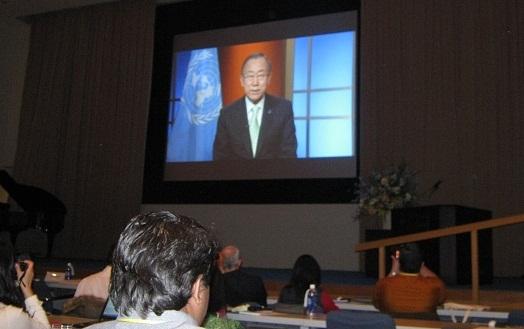
It is not boundaries, but water, that has emerged as the most critical issue for the people of Assam or rather Northeast India. While the contentious issue of Brahmaputra water sharing continue to dominate bilateral agendas, the 2014 United Nations World Water Development Report (WWDR) concludes that the world's fresh water resources will suffer from efforts to meet the growing global demand for energy. Launched in Tokyo last week at UN World Water Day conference, the report critically reviews the lack of coordination and planning at all levels to avoid shortage in energy and water supplies, and further deterioration of natural resources.
Demand for energy and freshwater will increase significantly in the coming decades. This increase will present big challenges and strain resources in nearly all regions, especially in developing and emerging economies. According to the Report, worldwide demand is projected to grow by more than one-third over the period to 2035. Demand for electricity is expected to grow by 70% over the same period. About 90% of global power generation is water-intensive.
According to an editorial of The Assam Tribune, a leading daily of Northeast India,-- "We have seen how contentious an issue water-sharing can become-- something that stands to worsen in the days ahead with the demand for a precious asset like fresh water mounting manifold. It is precisely with an eye on the vast water resources of Tibet and the Eastern Himalayas that has been pursuing an aggressive water management policy in violation of international norms of water sharing. In sharp contrast stands the role of the government of India which seems little perturbed by the uncalled-for interventions made by China on the Yarlung Tsangpo (Brahmaputra in India)."
The WWD Report expresses concern over Brahmaputra dams under construction. The report says- "...... In the Ganges-Brahmaputra river basin (Bangladesh, Bhutan, China India and Nepal), the Zangmu Dam in Tibet, a run-of the-river facility slated for completion in 2015, as well as the recent approval of the three more Brahmaputra dams as part of China's Twelfth Five Year Plan, are raising concerns over downstream effects in India and Bangladesh."
Emphasizing hydro power the UN says that countries with short, swift rivers can benefit from small hydro-power installation (100 kilowatt (KW) to 30 megawatt (MW) capacity), particularly if these are integrated with land use plans and overall economic development. Such countries include Democratic People's Republic) of Korea, Indonesia, Malaysia and the Republic of Korea,as well as some of the small island developing states (SIDS) in the Indian ocean, Pacific ocean and South China sea. Installations may also be advantageous on certain tributaries of big rivers, particularly if these projects extend benefits to rural communities and the alteration of flow patterns does not have significant downstream effects." the report says.
But concern over the potential adverse effects of hydro-power raises other issues, for example in the lower Mekong delta, where 45 million people are reliant on the river system for their livelihoods and sustenance. Twelve dams are set for construction in 2011-15, and altered river ecology and disrupted fisheries are critical issues. The report further warns that the existing and potential hotspots in Asian trans-boundary river basins develop where issues and challenges for both energy and water have political and socioeconomic implications at local and basin levels. Area of conflict include the Aral sea, Ganges- Brahmaputra River, Indus river and Mekong river basins.
"Now the UN has also voiced concern over China's water policy in view of its deliberating impacts on South-east Asian nations. It is a matter of grave concern that China's plans to maximise hydro power are bound to impact the riparian Indian regions such as the Northeast in a manner that would be calamitous and irreversible. Being a downstream state, and given that the Brahmaputra is the lifeline of the state, Assam will bear the brunt of adverse effects. This is something that the Government of India needs to take up with China at the earliest"-warned the Assam Tribune editorial.
Global water demand in terms of water withdrawals is projected to increase by some 55% by 2050 and due to growing demands from manufacturing, thermal power generation (mainly from the expansion of coal and gas powered plants) and domestic use. Agriculture water consumption alone, which already accounts for 70% of groundwater withdrawals, is expected to increase by about 20% globally by 2050 unless efficiency improved."Water and energy are among the world's pre-eminent development challenges and must feature prominently in the post-2015 agenda", said Michel Jarraud, Chair of UN- Water. He is also the Secretary- General of the World Meteorological Organization. The challenges will be greater in developing and emerging economies, where agriculture, industry and urban areas are often growing at an unprecedented pace.
The Report stresses the imperative of coordinating political governance and enduring that water and energy prices reflect real costs and environmental impacts. Li Young, the Director-General of United Nations Industrial Development Organisation (UNIDO), emphasized the importance of water and energy for inclusive and sustainable industrial development. "I am convinced that inclusive and sustainable industrial development will be a key driver for the successful integration of the economic, social and environmental dimentions." Li Yong said.
The UN predicts that by 2030, the global population will need 35% more food, 40% more water and 50% more energy. Already today 768 million people lack access to improved water sources, 2.5 billion people have no improved sanitation and 1.3 billion people cannot access electricity. Releasing these facts, through the 2014 World Water Development Report , the UN says that roughly 75% of all industrial water withdraws are used energy production. Tariffs also illustrate this interdependence: if water is subsidised to tell below cost (as is often the case), energy producers - major water consumers- are less likely to conserve it. Energy subsidies, in turn, drive up water usage. These issues need urgent attention - both now and in the post-2015 development discussions.
"But right now the attention is so much on energy, that our planners and policymakers are throwing all the cautions to the wind. Like the Chinese, the Indian government's thrust has been on generating hydro-power. There are plans to generate a whopping 55,000 MW hydro-power by constructing mega dams in the upper reaches of the Brahmaputra in India (Arunachal Pradesh) ignoring the concerns of the impact that these large scale interventions would create on the delicate Himalayan ecology," says Mubina Akhtar, activist and coordinator of Assam Environment NGOs Forum.
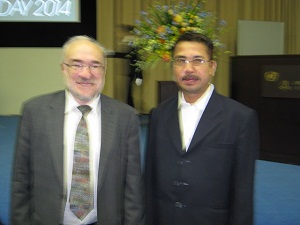
The writer with Michel Jarraud
- 8842 reads





Add new comment