Skip to content Skip to navigation

‘Islamist fundamentalists in Bangladesh a threat to northeast India’

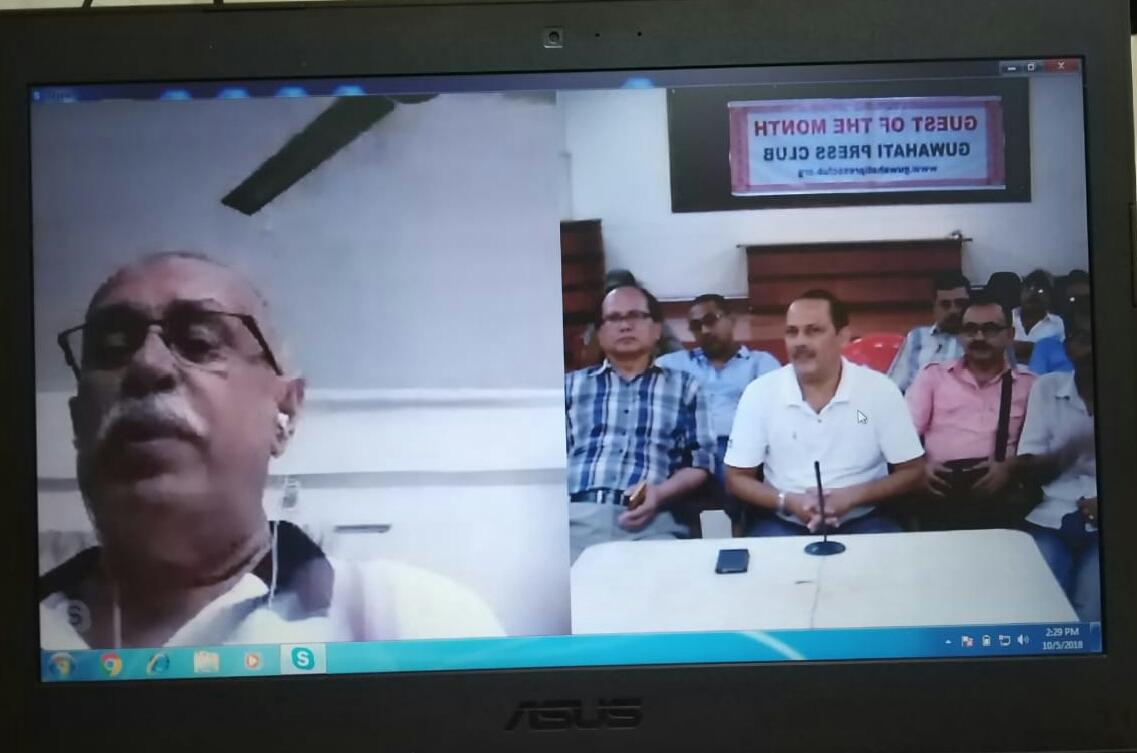
Guwahati: Rise of Islamist extremism in Bangladesh is not only posing a serious threat to the Muslim dominated country, but also to its neighbouring north-eastern States of India along with West Bengal. Speaking to a group of scribes at Guwahati Press Club from Dhaka through internet on Friday, prominent Bangladeshi journalist Saleem Samad made this comment.

An Ashoka Fellow and Hellman-Hammett Award recipient journalist also added that an upsurge of fundamentalist forces in Bangladesh poses serious threats not only to the religious minority communities there, but also to the secularists, intellectuals and other sects within the Muslim community.

Samad narrated how atheist & secularist bloggers are increasingly becoming the target of the Islamist forces in Bangladesh, which has otherwise slowly (but steadily) marched on the path of becoming a country of one nationality (Bangladeshi), one language (Bengali) and one religion (Islam, more precisely Sunni Muslim).

The outspoken journalist made an observation that due to overwhelming majority of Sunni Muslims in the country, among whom considerable rise of extremism is observed, other minority sects within the Muslim community like Shia, Ahmadiya etc also face serious threat of survival.

Citing how a network of Jamaat-ul-Mujahideen Bangladesh was busted in West Bengal few years back, Samad urged the north-eastern States to remain alert about jihadi elements. He revealed that thousands of Bangladeshi youths had already joined various militia groups in Syria, Iraq, Palestine, Afghanistan, Pakistan etc to fight alongside the jihadis there.

Answering queries from Guwahati scribes, the senior journalist reiterated that currently there is no northeastern militants in Bangladesh as the Sheikh Hasina government in Dhaka continues rigorous crackdowns against the outfits. Samad made it clear that Prime Minister Hasina would leave no stone unturned to weep out militancy in the country.

A front runner for media rights, Samad painted a dismal picture of press freedom in Bangladesh, as journalists are frequently targeted by both State and non-State actors. He regretted that though 26 Bangladeshi journalists lost their lives to assailants since 1991, not a single accused has been convicted till date.

In another significant remark, Samad, who works as special correspondent at The Bangladesh Monitor and contributes news-features to India Today, has divulged that none of the Indian leaders visiting Dhaka had taken up the issue of illegal Bangladeshi infiltrators in Assam (India) with their host counterparts.

Speaking about the process of National Register of Citizens updation in Assam, Samad asserted that for the Bangladesh government it is an internal affair of India only and hence it has not made any official statement over the development. He agreed that there were little media coverage in Bangla media over the NRC updation process and its outcome.

Strongly advocating people-to-people contact between Assam (India) and Bangladesh, Samad lamented how the State had missed the bus despite being so closely located, while other States like West Bengal and Tripura were taking several steps to improve connectivity with Bangladesh via railway and roadways.

Advocating a regular bus and air services between Guwahati and Dhaka, Samad opined that trade & commerce along with cultural ties would help in erasing many misconceptions prevailing on both sides. He also claimed that more students and patients are expected to move from here to there & vice versa for better options and would enhance the tourism in both parts of the international divide.

Author info

Nava Thakuria's picture

Senior journalist based in Guwahati.

Add new comment

Other Contents by Author

After months of uncertainties, the Press Council of India (PCI) recently got its chairman, but the space of 13 working journalists remains vacant till date. Justice Ranjana Prakash Desai, who served as the PCI chairman from 17 June 2022 to 16 December 2025, assumed the charge on 24 April 2026 once again. The retired judge of the Supreme Court of India was nominated for another term of three years. But the quotas for working journalists remain vacant as seven members, to be represented by professional scribes (other than editors) and six members, to be represented by journalist-editors, are yet to be picked up to complete the 15th council (https://presscouncil.nic.in/CurrentMemberPCI.aspx...
After Assam, Keralam and Puducherry (union territory), the State legislative assembly elections are knocking at the doors of  Tamil Nadu and West Bengal in the second half of April 2026. Meanwhile, the millions of voters have shown an extraordinary commitment to electoral politics as they participated in the largely peaceful single-phase assembly polls on  9 April recording a high voters’ turnout. Assam recorded 85.96% voter participation  in 126 assembly seats, where Puducherry showcased over 90% voting in 30 constituencies followed by Keralam (140 seats) with nearly 80% turnout. Assam’s 2.50 crore electorates (including 1.25 crore female voters and 6.4 lakh first-timers...
As Assam goes to the single-phase polling  tomorrow (9 April 2026), nearly 2.49 crore registered voters (including 5.75 lakh young/first time voters) will exercise their franchise to elect 126 representatives for the State legislative assembly. Under the guidelines of  Election Commission of India, all types of campaigning had already came to a halt at 5 pm on Tuesday (48 hours prior to voting) where the authority urged all candidates, political parties, and media outlets to strictly follow the guidelines. The same timeline is made applicable for Kerala and Pondicherry as well, whereas Tamil Nadu will vote on 23 April, and West Bengal going for polling on 23 and 29 April next....
Landlocked Himalayan nation Nepal prepares for its ninth national election  on 5 March, which was necessitated with the collapse of its government in Kathmandu during September last year following an anti-corruption mass uprising, which was initiated by the young people and resulted in the killing of dozens of agitators and injuring hundreds other. The south Asian country of around 30.55 million people, sandwiched between two giants India and Tibet/China, has readied all necessary arrangements for the single day polling through ballot papers under the protection of  nearly 3,50,000 security personnel (with additional armed forces kept ready for an unwanted emergency situation...
Even all political parties, not to speak of millions of fans and well-wishers of Assam’s revered cultural icon  Zubeen Garg, continue preaching for sparing the maverick singer’s name in doing politics, his mysterious death last year in a foreign land may dominate the electoral politics in the forthcoming legislative polls. Indications surface that Assam assembly elections (scheduled for March-April 2026 along with West Bengal, Tamil Nadu, Kerala and Puducherry) will observe a high voltage campaigning on  Zubeen’s unexplained demise in Singapore on 19 September 2025 and subsequent investigation and judicial processes. Even after five months of his final departure, Zubeen continues...
As Bangladesh has constituted a new government under the leadership of  Bangladesh Nationalist Party (BNP) after a largely fair & peaceful national election on 12 February 2026, the people of eastern India (the region virtually embraces the poverty stricken country except a few kilometers in Myanmar and the Bay of Bengal)  hope for a progressive regime in Dhaka enjoying political stability and pursuing economic developments to over 170 million people in the south Asian nation. The Muslim majority country continues to grow as a headache for the north-eastern states, more precisely Assam, for at least two  reasons namely unabated influx of migrants and regional security...
Amid high security arrangements across the country, polling begins this morning at 7:30 am for the highly projected 13th Jatiya Sansad election in Bangladesh, where over 2000 candidates representing 50 political parties along with many independent contestants are in the fray. The Muslim majority nation has over  12.77 crore registered voters including 6.27 crore women and 1,232 third-genders, who are voting for electing   299 representatives (out of 300 seats in the national assembly). Over 42,000 polling centres will facilitate the electorates to exercise their franchise (through  ballots in person) till 4:30 pm (on 12 February 2026). The election will be conducted...
As Bangladesh heads for 13th Parliamentary election and  the referendum on  July National Charter simultaneously on Thursday (12 February 2026), the interim government chief Professor Muhammad Yunus urged all participating candidates to rise above personal and party interests to prioritize greater interest of the Muslim majority nation regardless of the poll-outcomes. Addressing the nation of over 170 million people ahead of the much watched electoral exercises, Nobel peace laureate  Dr Yunus commented that victory as well as defeat is an integral part of democracy and hence after the election, they should dedicate themselves to build a new, just, democratic, and inclusive...
Is it possible to have a quasi-judicial body like the Press Council of India to survive for weeks without its chairperson? Should the largest democracy on Earth put such an example where its government recognized autonomous media watchdog faces an existential crisis as the 15th council of PCI still devoid of a functioning head and 13 seats? How come a press council runs its business without filling these 13 seats, meant for millions of media professionals, for more than a year now, whereas the term of a council is limited to three years only? Many such pertinent questions  emerge among media professionals in the   south Asian nation, as the regular three-year term (as well as...
Amid an existential crisis in the Guwahati-based Assam Tribune group of newspapers, which worsened after the Covid-19 pandemic, a popular Assamese weekly newspaper lost its publication in the latter part of 2025. Asom Bani, once a mainstream weekly for Assamese readers for decades, stopped hitting the stands from September last year, as the management lost interest in continuing its printing every Friday. Even though the seven-decade-old Assamese-language weekly was lost from the media market, the management did not make any statement about Asom Bani’s fate. Prior to its departure, the weekly was merged with Dainik Asom, an acclaimed Assamese daily from the prestigious media house, as its...