
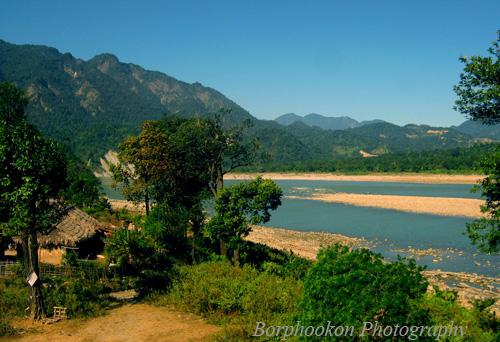
Recent Earthquakes in Tibet are most probale cause of muddy water flowing through the Brahmaputra for last two weeks. Chand Kumar Duarah, a science journalist based in Guwahati said that most of geologist and experts believe earthquake and aftermaths are responsible for the phenomenon. Yang Yong, a geologist and Yarlung Zangbo (known as in China) expert said muddy water might highly be caused by the recent earthquake in Linzhi, Tibet. Linzhi region of Southern Tibet is popularly known as Ningchi. The Yanglung Zangbu river scenerary spot as well as the Yarlung Zangbo Grand Canyon was closed by the Chinese Authority due to the quake. No one is allowed to enter the region for last two weeks.
China has escalated military control over Tibetan borders, expanded mining based on the rich resources of the Tibetan plateau in order to fuel China’s economic development and has dramatically expanded infrastructure with a strategic road and rail network. It seeks to raise the productivity of the industrial cities of Xi’an, Chongqing and Chengdu at the foot of the Tibetan plateau and to address the progressive scarcity of water resources in the North and North-East of China with water sourced in Tibet.
Moreover rampant mining threats both indigenous Tibetan and their motherland. A large lithium mine not only desecrates the sacred grasslands, villagers say, but spawns deadly pollution. The river used to be full of fish. Today, there are hardly any. Hundreds of yaks, the villagers say, have died in the past few years after drinking river water. So mining and construction of tunnel on the river or its tributaries are also prime suspects, Duarah says. But according to Yang Young, Yong, a scientist from Hengduan Mountain Research Institute and Deputy Director of Expert Committee of China Foundation for Desertification Control believe it is prematured to claim the cause without verification of the phenomenon.
China’s thirst for mineral resources — and its desire to exploit the rich deposits under the Tibetan plateau — have spread environmental pollution and anguish for many of the herders whose ancestors lived here for thousands of years. The land they worship is under assault, and their way of life is threatened without their consent, Duarah said. He suspects materials or minerals might mixed with the water of Yarlung Zangbo during or after recent earthquakes.
A strong 6.9 magnitude earthquake has shaken China's Tibet region. There was no immediate detail given on the damage caused or number of casualties. No casualties have been reported following a 6.9-magnitude earthquake that hit Nyingchi in southwest China's Tibet Autonomous Region at 6:34 a.m. Saturday. However, the quake caused power failure and building damages in a number of villages in the epicenter in Nyingchi City.
The epicenter was detected at 29.75 degrees north latitude and 95.02 degrees east longitude, according to the China Earthquake Networks Center. The US Geological Survey said the quake hit at a depth of about 6 miles about 36 miles northeast of Nyingchi. China's official Xinhua News Agency put the magnitude at 6.9 and said it struck at 6.34am local time.
The quake struck at a depth of about 10 km. Four minor aftershocks measuring between 5 magnitude and 3.1 magnitude were felt in the city's rural areas. Sources with the regional power grid said the power grids of both Tibet and Nyingchi are operating normally, though it had launched an emergency response mechanism. The China Seismological Bureau has launched a third-degree emergency response mechanism, holding a teleconference to monitor an investigation into the situation and sending experts to the quake-hit region.
The bureau observed that the highest seismic intensity of the quake affected an area of 500 square meters, which is sparsely populated. The tremors triggered falling rocks, blocking a highway linking Nyingchi's city proper with Tangmai, one of the quake-hit townships. Armed police transport troops are clearing the road.
The Ministry of Transport dispatched staff to investigate the safety condition of bridges in the quake-hit area. The Tibet subsidiaries of Chinese telecom providers China Mobile and China Tower said that their networks are now operating normally. But the Tibet branch of China Telecom reported the disruption of an optical cable for broadband service in Pome and Zayul counties.
The Nyingchi government said in a statement on its microblog that the quake's epicentre was in an uninhabited region and that it had yet to receive any casualty reports.The epicentre was within 150 miles of the Indian towns of Along, Pasighat and Tezu, the USGS added. Southwestern parts of China are frequently hit by earthquakes. A huge quake in Sichuan province in 2008 killed almost 70,000 people.
After few days of earthquake, the change in the colour of the water, which was first noticed near Geling in the northeastern state’s Upper Siang district, has triggered many local channel and Indian political leaders to suspect a ‘Chinese hand’ in it.
Siang flows about 1,600 kilometres as Tsangpo river through the Tibet plateau before entering India in Arunachal Pradesh. The river becomes Brahmaputra after it flows into Assam near Sadiya. As per media reports from Guwahati, the waters of Brahmaputra in some places are also beginning to turn muddy, firming up the suspicion that China may have begun construction upstream.
Responding to Indian media reports, on December 2, China denied any role in muddying the waters of Siang. “South Tibet is the territory of China, which has the duty to preserve local environment… India should not point its finger at China on hydrological issues to incite anti-China sentiment, which cannot help repair the ties of the two countries,” the state-owned The Global Times said in a report quoting Chinese analysts. China criticised the role of Indian media on account of its negative reporting about China.
Media reports quoting laboratory test results of samples taken from the Siang by the state water quality testing laboratory in Itanagar mentioned high turbidity in it. The report said, “A high turbidity level of more than 425 NTU, if exposed for a long period, may affect fish survivability as it leads to choking of gills resulting in death.”
Importantly, the Daying Ering memorial wildlife sanctuary, situated between Siang and its tributary Sibia, witnesses many migratory birds at this time of the year. Divisional forest officer (wildlife) of the sanctuary R. Riba told local media that the number of sightings of migratory birds has been lower this year. It is believed that the birds have avoided the sanctuary as they are unable to spot fish in the muddy waters.
Some domestic animal and aquatic wildlife have allegedly died after drinking the river water in the downstream areas. Responding to the developments, Arjun Ram Meghwal, Union minister of state for water resources, river development and Ganga rejuvenation, said on December 3 that it could be due to an earthquake that shook Tibet on November 18. “There is a strong possibility that the colour of the water has changed due to natural reasons,” the minister reportedly said. In a letter to the minister, Ering has termed the reason “completely absurd”.
On the other hand , the Bogang Students' Union has threatened to launch a mass agitation if the central and state governments do not take steps to check the contamination of the Siang river in Arunachal Pradesh owing to alleged upstream construction carried out by China.
The Yarlung Tsangpo after flowing through southern Tibet enters India near Tuting in Arunachal Pradesh's Upper Siang district to become the Siang, which is called the Brahmaputra after entering Assam. A delegation of the union met Siang deputy commissioner Tamiyo Tatak on Monday following which he ordered the public health engineering and water resources departments to test the quality of the river water.
Water unfit for Consumption
The water of the Siang river in Arunachal Pradesh, which has turned dark and muddy, has become unfit for human consumption, the State Water Quality Testing Laboratory (SWQTL) has said in a report. The river enters India after flowing through the Tibetan plateau as Yarlung Tsangpo. It flows through Arunachal Pradesh for about 230 km to reach Pasighat and then joins the Lohit and the Dibang to form the Brahmaputra river in Assam.
The laboratory under the Arunachal Pradesh Public Health Engineering and Water Supply (Sanitation) department, in its report, has said the water of the Siang is unfit for human consumption.The report stated that the Nephelometric Turbidity Unit (NTU) content of the water sample was 482, while the iron content was recorded at 1.65 mg/litre, which was beyond the permissible limits.
The water sample of the river was sent to the laboratory by the Water Resources Department’s Executive Engineer, Tamo Jamoh, on November 29, an official report informed. According to experts, at normal level, iron is not deadly for the aquatic animals, but unusually high amounts of iron in water may lead to adverse changes in its colour, odour and taste and also have negative effects on the aquatic animals’ behaviour and health.
The Siang river, Arunachal Pradesh’s primary water source, has turned black in the past two months, baffling residents. The Siang is the main tributary of the Brahmaputra river that connects to the Yarlung Tsangpo, as the Brahmaputra is called in Tibet, where it originates.
According to a report prepared by the state’s public health engineering department, the turbidity level of the Siang’s waters is several times higher than the permissible limit. Bimal Welly, an executive engineer in the department, said a sample he tested on November 27 showed a Nephelometric Turbidity Unit – a measure of the concentration of suspended particulates in a liquid – of 425. In the meantime, speculation of possible reasons for the river turning black is mounting. Officials and residents believe China may have something to do with it. This suspicion stems from a widely cited news report about the Chinese government’s purported plan to build a tunnel to divert water from the Yarlung Tsangpo in southern Tibet to the parched Taklamakan desert area in the province of Xinjiang. Arunachal Pradesh Chief Minister Pema Khandu askes the Central government to take the matter up with Beijing.
- 15383 reads







Add new comment