Skip to content Skip to navigation

Statement on National Register of Citizens in Assam

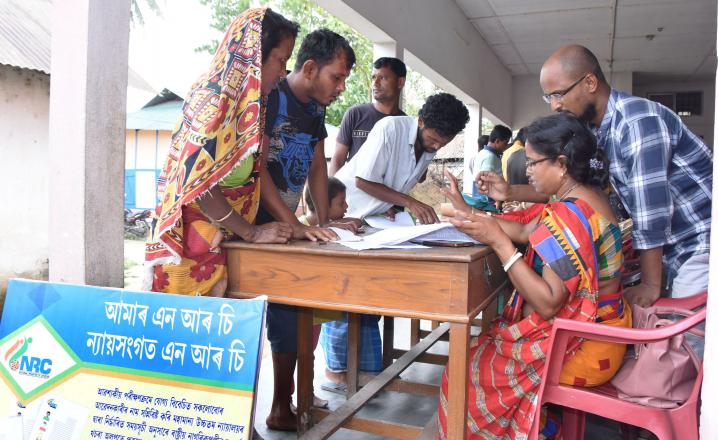
People checking their names in final NRC list at NRC Centre of Panchmaile Gao Panchayat in Tezpur on 01-09-19. Photo by UB Photos

THIS is for your kind information and necessary action

1. Yesterday, the office of the State Coordinator, NRC Assam released a press statement on the publication of the final NRC as on 31st August 2019.  

2.  Since then, there have been commentaries in sections of the foreign media about aspects of the final NRC which are incorrect.  

3.  Let me begin with the background.  Government of India signed the Assam Accord in 1985 with the promise to take care of the interests of the citizens of Assam.  NRC aims to give effect to the Assam Accord signed in 1985 between the Government of India, State Government of Assam, the All Assam Students Union (AASU) and All Assam Gan Sangram Parishad (AAGSP). Supreme Court of India mandated the government to deliver on the commitment in 2013. This led to the process of updating the National Register of Citizens in Assam in 2015.

4.  Updating of NRC is a statutory, transparent, legal process mandated by the Hon’ble Supreme Court of India. This is not an executive-driven process. The process is being monitored by the  Supreme Court directly and the government is acting in accordance with the directives issued by the court. The apex court of the land has itself set the deadlines for all steps that have been taken so far.

5. NRC is a fair process based on scientific methods. Inclusion in the NRC is a unique process, as it is based on “application” rather than “house to house enumeration”. It means that any person in Assam could have sought to be included in the list on the basis of having documentation to prove lineage from an entitled person, i.e. a person who was a resident of Assam as on March 24, 1971.

6. It is a non-discriminatory process, which leaves no room for bias and injustice. As can be seen from the application form for data entry in NRC, there was no column in the application asking for the religion of the applicant.

7. Anyone excluded from the list at this stage has a right to file an appeal within 120 days of receiving a notification of exclusion to the designated Tribunal.  All appeals and excluded cases will be examined by this Tribunal i.e. a judicial process. This judicial process will commence only after the appellate period is over. Thereafter, anyone still aggrieved by any decision of being excluded will have the right to approach the High Court of Assam and then the Supreme Court.

8. Exclusion from the NRC has no implication on the rights of an individual resident in Assam. For those who are not in the final list will not be detained and will continue to enjoy all the rights as before till they have exhausted all the remedies available under the law. It does not make the excluded person “Stateless”. It also does not make him or her a “Foreigner”, within the legal meaning of the term. They will not be deprived of any rights or entitlements which they have enjoyed before.

9. The government of India will even assist in providing directions on how to deal with such appeals. Through the District Legal Service Authorities, the government has provisioned to extend legal aid to the needy. The State of Assam has assured provision of free legal assistance to any person excluded from the list and who is unable to afford such legal assistance. This is to enable people, especially the disadvantaged sections, to have access to the best possible legal assistance.

10. To expedite the process of receiving applications for inclusion, the State Government is further adding 200 tribunals to the existing 100 tribunals. A further 200 more tribunals will be set up by the State of Assam by December 2019. These Tribunals will be set up at Block level for the convenience of appellants.

11.   India, as the world’s largest democracy, has firmly enshrined ‘equal rights for all’ and ‘respect for the rule of law’ in its Constitution.  An independent judiciary and fully autonomous state institutions, working for the defence of human rights, are an integral part of our political fabric and traditions. Any decision that is taken during the process of implementation of the NRC, will be within the four corners of the Indian law and consistent with India’s democratic traditions.

Add new comment

Other Contents by Author

Guwahati, August 23: The Rotary Club of Guwahati, in collaboration with the North Eastern Regional Agricultural Marketing Corporation Ltd. (NERAMAC), organized a major plantation and sapling distribution initiative this week. On Tuesday, August 21, a total of 3,000 medicinal and fruit-bearing saplings were distributed among local villagers of Bijoynagar and adjoining areas at the premises of 28 Nahira Primary School and Kongdang Primary School. The program witnessed enthusiastic participation from villagers, teachers, Rotarians, and NERAMAC officials. Continuing the green initiative, a tree plantation drive was also conducted on Friday, August 22, at the NERAMAC office premises...
The Press Emblem Campaign (PEC), a global media safety and rights organization, has strongly condemned the misuse of the “PRESS” symbol by armed combatants in conflict zones such as Syria and Gaza. The PEC expressed deep concern over incidents where individuals posing as journalists have used the emblem as a shield for violent activities. In southern Syria, Islamist fighters were seen wearing jackets marked “PRESS” while vandalizing a Druze household in Suwayda, as shown in a widely circulated video on social media. While PEC cannot independently verify the authenticity of the video, it emphasizes that under no circumstances should the press emblem be used as cover for armed combatants...
The number of journalists killed worldwide has surged dramatically in the first half of 2025, according to the Press Emblem Campaign (PEC). Since January, 86 media workers have been killed across 26 countries, marking a 16% increase compared to the same period last year. Gaza: Epicenter of the Crisis The ongoing conflict in Gaza is the primary driver behind this spike. At least 31 Palestinian journalists were killed in six months by the Israeli army, accounting for more than a third of the global toll. “The Israeli government is directly responsible for this tragedy, which targets civilians reporting on the situation in Gaza. The Israeli soldiers involved in these war crimes must...
Guwahati: – A transformative capacity-building workshop, “Learning from the Land: Participatory Knowledge Harvest from Assam and Meghalaya,” was held at Tata Institute of Social Sciences (TISS), Guwahati Off-Campus, on Friday, June 27, 2025. Organized by TISS in collaboration with UNDP-SGP, the event brought together over 50 NGOs from Assam and Meghalaya to exchange grassroots knowledge and strategies for sustainable land use, agroecological practices, and environmental conservation. The workshop aimed to empower local communities by enhancing skills in biodiversity conservation, land restoration, rural development, sustainability, and climate change adaptation. Prof. Jagannath Ambagudia...
Guwahati: The Assam Pradesh Congress Committee (APCC) has accused the BJP-led state government under Chief Minister Himanta Biswa Sarma of driving tea garden workers into a severe health crisis, with the average worker’s body weight dropping below 50 kg due to malnutrition and anemia. In a press conference on Wednesday at Rajiv Bhawan, APCC Working President Roselina Tirkey, joined by tea tribe leaders Raju Sahu, Etowa Munda, and Pranjal Ghatowar, condemned the government for neglecting workers’ welfare and plotting to dismantle Assam’s tea industry. Raju Sahu emphasized the alarming health decline, stating that malnutrition and anemia have rendered many tea workers unfit to donate blood...
In Assam, the land of the Brahmaputra, tea gardens, and vibrant indigenous cultures, a troubling pattern has emerged. The state’s push for development—solar plants, thermal power stations, cement factories, and urban restoration—has come at a devastating cost to its original inhabitants, the Khilonjiya. These indigenous communities, including Karbi, Bodo, Dimasa, and Adivasi, are being displaced from their ancestral lands to make way for wealthy industrialists and corporate giants like Adani. While rich outsiders are welcomed with open arms, the Khilonjiya bear the burden of uprooted lives, lost livelihoods, and erased heritage. This blog chronicles few recent land disputes, exposing the...
Guwahati: Expressing concern over the Sivasagar crude-oil well gas leakage in the last few days, a northeast India based forum of graduate engineers have urged both Oil and Natural Gas Corporation (ONGC) and Oil India Limited (OIL) to come clear about the so-called ‘abandoned’ wells, which have the potential to harm human life, property and environment, as the concerned private parties operating such wells often do not come forward to take responsibility.  All Assam Engineers Association (AAEA), in a statement, also appealed to the Union government in New Delhi to hold the concerned ONGC/OIL  officials accountable for any disaster at an oil or gas well after having declared it '...
On May 26, 2025, Gaurav Gogoi, a three-time MP and son of former Chief Minister Tarun Gogoi, was appointed President of the Assam Pradesh Congress Committee (APCC). His appointment marked a generational shift in Assam’s Congress leadership and was seen as a strategic move to reinvigorate the party ahead of the 2026 Assembly elections. Gogoi’s clean image, recent Lok Sabha victory from Jorhat by a margin of 1.44 lakh votes, and appeal among youth positioned him as a serious contender against Chief Minister Himanta Biswa Sarma. Gogoi's appointment replaces Bhupen Kumar Borah and is backed by a team of working presidents including Jakir Hussain Sikdar, Roselina Tirkey, and Pradip Sarkar....
Assam, a state rich in natural resources, has faced recurring nightmares from its oil and gas industry, with devastating impacts on its people and environment. The Baghjan gas leak of 2020, operated by Oil India Limited (OIL), and the ongoing ONGC gas leak in Sivasagar (June 2025), operated by Oil and Natural Gas Corporation (ONGC), are stark reminders of the human cost of industrial mishaps. This blog post delves into the profound effects on common people in both incidents, compares their timelines for containment, and highlights the urgency of addressing systemic issues to prevent future tragedies. The Baghjan Gas Leak (2020): A 173-Day Ordeal On May 27, 2020, a catastrophic blowout...
The Tai Ahom Indigenous Rights Forum convened its Executive Committee Meeting today at the Tai Educational and Cultural Centre in Boiragimoth, Dibrugarh. The meeting was presided over by Chow Sanjib Rajkonwar, President of the Forum, and saw the active participation of executive members, advisors, and regional representatives from across Assam. The gathering served as a vital platform to deliberate on the strategic direction of the Forum, with a special focus on aligning the movement for Tai Ahom rights with the principles enshrined in the United Nations Declaration on the Rights of Indigenous Peoples (UNDRIP) 2007. The Forum reaffirmed its unwavering commitment to advocating for the...