
Skip to content Skip to navigation

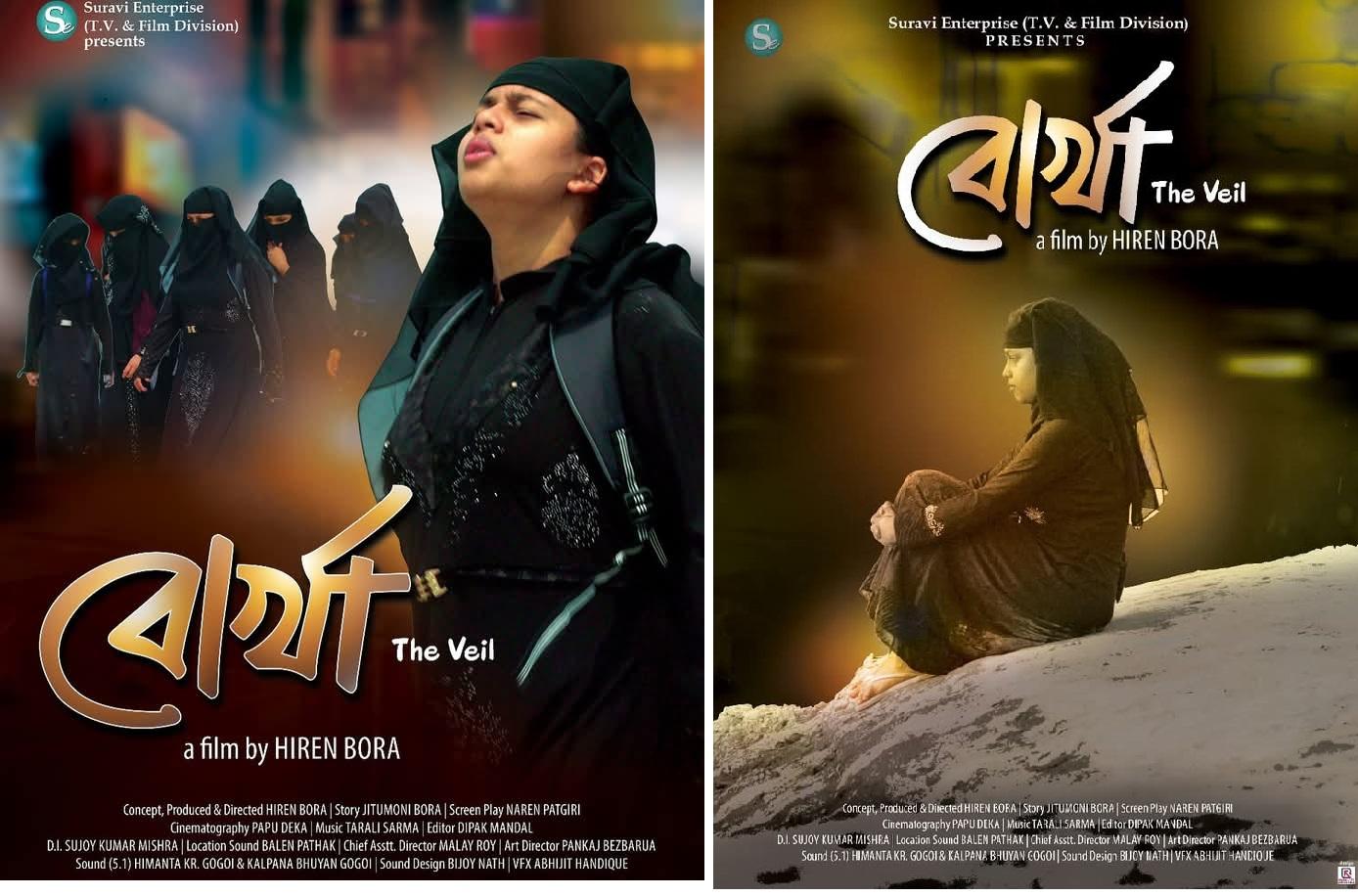
‘Burkha – The Veil’ creates waves at Kolkata International Film Festival

The Assamese film ‘Burkha – The Veil’ provided an unique cinematic experience for both audiences and critics at the ongoing Kolkata International Film Festival (KIFF), which runs from December 4 to 11, 2024. The film has been selected for the National Competition on Indian Languages Section at the 30th edition of the festival. ‘Burkha – The Veil’s director, Hiren Bora, is thrilled by the audiences’ response to his film.

The Kolkata International Film Festival has been a major cultural event for Kolkata’s residents, shaping generations of moviegoing audiences’ experience of cinema. It’s a festival for those who appreciate films, filmmaking, and artistic expression. The Assamese film 'Burkha – The Veil' was screened in the 'Competition on Indian Language Films' category at the Kolkata International Film Festival on Thursday, December 5.  Director Hiren Bora also attended the press conference, which took place at Nandan's press corner the next day.

The filmmaker has previously made films that convey thought-provoking stories, covering topics that everyone in the audience can relate to and sympathise with.

One thing is apparent about Hiren Bora's films: he remembers social responsibility and depicts society on film. Bora’s debut film, the critically acclaimed ‘Basundhara – The Earth’ bagged the Rajat Kamal award for Best Feature Film in Assamese in 2009. It was screened as an official entry at the festival circuits in London, Nottingham, Canada and in Mumbai, Pune, New Delhi and Goa. His next film  ‘Khobh – The Anguish’, made in 2014, became only the second Assamese film after Dr. Bhabendra Nath Saikia’s ‘Sandhyaraag’ in 1977 to be selected to participate at the prestigious Karlovy Vary International Film Festival in 2015. His 2019’s ‘Seema – the untold story’ was selected to various prestigious film festivals.

His most recent offering – ‘Burkha – The Veil’ is another socially conscious film. “I wanted to bring a true story to life on screen,” he said.

“The shooting experience was fantastic. We worked in Muslim-majority areas without encountering any difficulties at all. I am grateful to everyone.”

Hiren Bora was highly encouraged by the local residents of the region, who were predominantly Muslims. His sole motive behind its making was to question the poor medical and educational facilities of the interior villages of the northeastern part of India. He hopes to change and improve the existing system through this film.

For Bora, ‘Burkha – The Veil’ is “a journey from darkness to light.” The film revolves around Reshma, an eighth-grade student, who hails from a small village located on the banks of the river Brahmaputra. Her father Aminul is adamant that she marry young and have children rather than pursue her education. Additionally, a lecherous village elder wants to make Reshma his fourth wife. Reshma’s wishes get fulfilled when Hafeez, an honest teacher, admits her to his school. However, Hafeez becomes the target of the unscrupulous old man’s conspiracy. Reshma finally emerges from the shadows of darkness to the light of knowledge after receiving encouragement from a few young people in the village.

The film portrays various hurdles encountered by Reshma in her journey and how she navigates pre-established societal stereotypes and pressures. Hiren Bora’s films address socio-economic development issues, and this film is consistent with his vision. He emphasises the social element of the story more than the religious markings. Bora reckons Burkha to be a symbol of discrimination and oppression.

The various roles in the film are played by Rodali Bora, Jatin Khanikar, Durgashri Borah, Adrita Parasha Mahanta, Dipankar Bora, etc. Based on a story by Jitumoni Bora, the film is produced and directed by Hiren Bora under the banner of ‘Suravi Enterprise’. The screenplay is written by Naren Patgiri, music is scored by Tarali Sarma, cinematography is handled by Papu Deka, editing is executed by Dipak Mandal, while the film’s chief assistant director is Malay Roy, VFX works are by Abhijit Handique, costumes are provided by Rosy Bora, makeup by Nyumme Kamse and art direction is by Pankaj Bezbaruah.

A noted writer, director, stage actor, and screenwriter, Hiren Bora has written a number of short stories. Bora began his independent career by producing and directing television dramas in Hindi, English, and Assamese. He has also produced radio plays for All India Radio and documentaries for Doordarshan and other television channels.

Hiren Bora’s other films waiting for theatrical release includes the Rabha language feature ‘Nasimay’ (Darling), which was officially selected for screening at the 28th Kolkata International Film Festival in the ‘Unheard India: Rare Language Indian Film’ category, as well as the film ‘Baahi – the flute’, based on popular writer Monikuntala Bhattacharya’s much appreciated novel.


Author info

Prantik Deka's picture

Prantik Deka. Email: prantikdeka@gmail.com

Add new comment

Other Contents by Author

Seagull Theatre Brings Arun Sarma's Classic Sri Nibaran Bhattacharya to Hindi Stage for the First Time Guwahati, May 2025: Seagull Theatre, one of Guwahati's most respected theatre groups, drew packed houses on 28 and 29 May with its landmark production of acclaimed Assamese playwright Arun Sarma's Sri Nibaran Bhattacharya — staged in Hindi for the very first time. Founded in 1990, Seagull Theatre has long been committed to the art of performance. With this production, the group takes a significant step towards bringing Assamese theatrical heritage to a pan-Indian audience. The play was directed by Baharul Islam, who also envisioned its Hindi adaptation. Arun Sarma, celebrated as...
Throughout history, humans have aimed to eliminate darkness, both in a literal and metaphorical sense, as it is crucial for the advancement of our civilization. We are naturally drawn to light and strive to move in its direction. Is it then possible for us to embrace or find value in darkness? However, human life is incredibly intriguing and remarkably varied. In the short span of life, people discover various behaviors and many thoughts and ideas. The variety found within human nature often leaves people in a state of astonishment and wonder. This may explain why human existence is so intriguing, endearing, and compelling to experience. In the vibrant theatrical landscape of Assam,...
Guwahati: Renowned Assamese dramatist Dr. Arun Sarma, recipient of both the Sahitya Akademi and Sangeet Natak Akademi awards, is widely regarded as a pioneer of Assamese Absurd Theatre. He played a major role in shaping modern Assamese dramatic literature by introducing avant-garde European theatrical forms, including expressionism, to regional audiences. One of his most discussed plays, Anupam Andhar (Dark is Beautiful), first published in 2013, is considered among the final major full-length dramatic works of his illustrious literary career. The play continues to hold significance in contemporary Assamese theatre for its exploration of existential themes, human relationships, and...
A documentary spotlighting Assam’s traditional Tokari Geet has earned national recognition at two prominent film festivals, underlining renewed efforts to preserve an oral folk heritage. Strings of Tradition: A Tokari Geet Story, a 28-minute feature, received an Honorable Jury Mention at the 16th Dada Saheb Phalke Film Festival 2026 held in New Delhi on April 30. The film also secured a Special Jury Mention at the Indian World Film Festival in Hyderabad. Directed and produced by Dr. Aparna Buzarbaruah—an author, musician, and botanist—the documentary follows a scholar’s journey to explore the philosophical and cultural depth of Tokari Geet, a devotional folk tradition rooted in Assam...
Guwahati: Cultural practitioner and artist Sajan Nayak has been drawing attention for his sustained contributions to the promotion and preservation of traditional Assamese performing arts, particularly music and dance associated with Adivasi, tea tribe (Baganiya), Sadri, and broader Assamese traditions. An active lyricist, composer, music director, actor, and dancer, Nayak has worked across multiple artistic disciplines. He has written several songs that have gained popularity within and beyond Assam, including “Chal Gori,” “Ekadashi Ratiya,” and “Assam Desh.” A number of his compositions rooted in tea-tribe culture have been performed by noted Assamese singer Zubeen Garg, contributing...
The New Year brings encouraging news for Assamese cinema lovers with the announcement that Prastabana — The Preamble will release in theatres on January 16. Produced under the banner of JD and KP Productions, the film marks a directorial collaboration between Dilip Borah and Manik Roy. Based on Dilip Borah’s acclaimed novel Yatra, the film offers a sharp critique of political apathy and interference, particularly its corrosive impact on education and the lives of young people. Through a compelling narrative, Prastabana — The Preamble examines how political manipulation can undermine academic institutions and weaken the foundational values of democracy. Making their directorial debut...
Guwahati Sishu Natya Vidyalaya (GSNV) is set to present Phoshong, a contemporary children’s puppet play adapted from Madhurima Gharphalia’s Sahitya Akademi Award-winning short story collection Phosong. The production will be staged on November 18 and 19 at the Sri Sri Madhavadeva International Auditorium in Srimanta Sankardev Kalakshetra. The adaptation and direction are led by theatre practitioner and GSNV founder Manik Roy, who has undertaken the project to revive interest in puppetry—an art form that has seen a decline in recent years. Roy hopes that Phoshong will introduce children and young adults to the visual richness of puppetry while helping them understand its embedded moral...
The first song along with the promotional poster of the highly anticipated Assamese film ‘Jaubane Amoni Kore-2’ was unveiled during a lively event held at the Rudra Barua Auditorium of Jyoti Chitrabon Studio in Guwahati recently. The musical composition titled ‘Rohedoi Rosoki’ has been both written and composed by Palash Surya Gogoi, who also serves as one of the music directors for the film. Performers Dikshu Sarma and Chayanika Bhuyan’s rendition of this catchy tune left the eager audience, who had gathered with high expectations, feeling incredibly happy and content. It must be noted that ‘Jaubane Amoni Kore-2’, produced by Ashok Kumar Bishaya and Happy Moni Bishaya under the banner...
Guwahati, August 22: Assam’s noted screenplay writer Ranjit Sarma has released his much-anticipated novel The Tents, adding another significant work to his creative repertoire. The book was launched at the Guwahati Press Club in the presence of eminent personalities from Assam’s literary and social circles. Sarma, celebrated for his collaborations with filmmakers such as Bidyut Chakraborty (Rag-Birag, Nisiddha Nadi), Manju Bora (Baibhav, Anya Ek Jatra), Sanjeev Hazorika (Mimangsa), and Hemanta Kumar Das (Othello), has long established himself as one of the leading voices in Assamese cinema. Beyond screenwriting, he has penned the Assamese novelette Amithabhar Janma Mritu and a range of...
Emerging filmmaker Harsyajit Kumar Goyary, hailing from a small town in Assam, has been selected as one of the 24 Asian Fellows at the prestigious Asian Film Academy (AFA), held during the Busan International Film Festival (BIFF). The AFA is a rigorous 20-day program that provides hands-on filmmaking experience, mentorship from acclaimed directors, and opportunities to engage with global industry professionals. Representing India along with two other participants, Harsyajit will head the sound department in the production of four short films at the academy. A postgraduate in Sound Recording and Design from the Film and Television Institute of India (FTII), Pune, Harsyajit earlier...