

Restoration Work Begins at Historic British-Era Cemetery Inside ONGC Nazira Campus

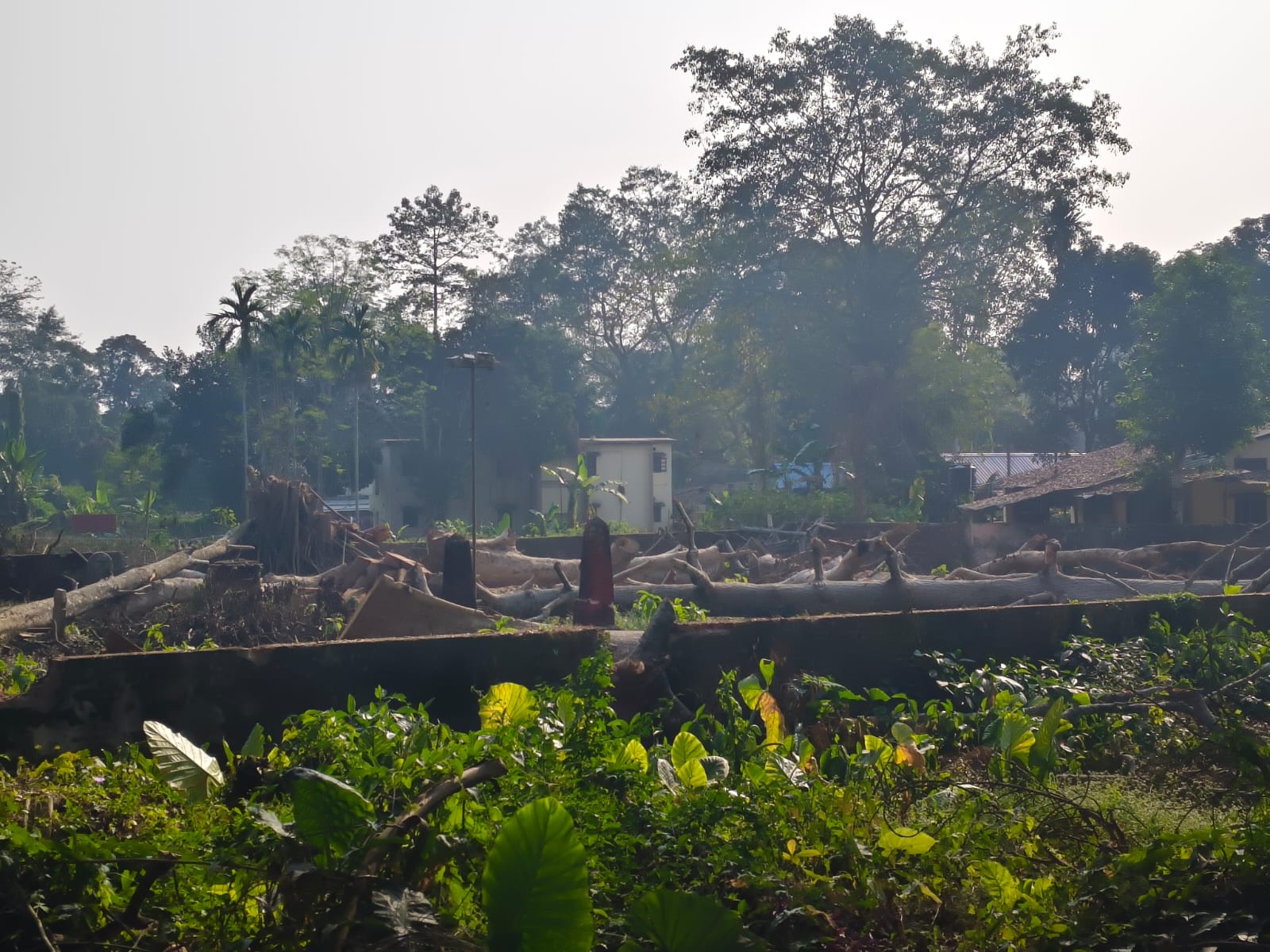
After years of discussion and a long wait, restoration and beautification work has finally begun at the historic British-era cemetery located within the ONGC campus at Nazira. Though regarded as an important heritage site of the region, the colonial-era cemetery had remained neglected for decades.
Towards the end of 2024, a concrete initiative was taken to renovate and preserve the cemetery with financial support from the Nazira MLA’s Local Area Development Fund. As part of the process, officials from the Nazira Co-District administration and the State Archaeology Department conducted site inspections and carried out a detailed assessment.
During the inspection, officials observed that the roots of several large trees growing inside the cemetery had caused damage to multiple graves. It was also noted that some graves lying outside the existing boundary wall need to be brought within the cemetery premises to ensure their proper protection.
Local residents and heritage-conscious citizens have cautioned that during the ongoing tree-cutting and cleaning operations, utmost care must be taken to prevent damage or loss of historical remains. They warned that any negligence at this stage could lead to irreversible damage to valuable heritage assets.
The initiative gained momentum after Nazira MLA Debabrata Saikia wrote to the Sivasagar regional office of the Directorate of Archaeology on 26 November 2024, seeking details about the condition of the cemetery. Subsequently, on 4 December 2024, a team from the Directorate visited the site and submitted a detailed report to the MLA, stating that the cemetery contains around 60 graves. The senior conservation officer highlighted the urgent need for regular maintenance, noting that many tombstones have already suffered weather-related damage, making inscriptions difficult to read.
The Archaeology Department’s Sivasagar office also recommended several conservation measures. Following the MLA’s proposal, a six-member committee was constituted under the chairmanship of the Co-District Commissioner of Nazira to oversee the development work. An amount of ₹5 lakh from the MLA’s Local Area Development Fund has been allocated for the project.
The cemetery holds immense historical significance and is closely linked to world tea history. In 1839, following the formation of the Assam Tea Company Limited—the world’s first tea company—commercial tea cultivation expanded in areas including Chabua, Nazira and Dumdum in present-day Dibrugarh, Sivasagar and Tinsukia districts. Nazira became the headquarters of the company under the supervision of J.W. Masters, whose grave is located in this cemetery.
Notably, Queen Victoria granted a Royal Charter to the Assam Tea Company in 1845. Its first board of directors included Dwarkanath Tagore, the grandfather of Kobiguru Rabindranath Tagore. The company remained active until 1966–67, after which its Nazira land came under ONGC, though several tea gardens in Assam still continue to operate under the company’s name.
Established during the Assam Tea Company era, the cemetery contains over 60 graves, including that of renowned educationist William Robinson, the pioneer of the first Assamese grammar. Robinson played a key role in the Normal School movement in Assam and was instrumental in establishing the Normal School in Guwahati, later shifted to Jorhat in 1906 as a teacher training institute. The cemetery also houses the graves of prominent tea planters, victims of historic incidents at Makipur tea estate, members of British royal families, and individuals associated with colonial administration and the tea industry.
Interestingly, ONGC does not have precise records of the total number of graves at the site. Available information suggests that even during the 9 May 1967 agreement between Assam Tea Company Limited and ONGC, and during subsequent property transfers, the exact number of graves was not documented. Several other heritage structures transferred to ONGC—including nine historic bungalows and old office and factory buildings—also remain neglected. There is a growing demand to conserve the century-old building that currently houses ONGC Assam Asset’s headquarters and to convert it into a Tea and Oil Museum.
Earlier, the British Association for Cemeteries in South Asia (BACSA) had expressed willingness to assist in the preservation of the cemetery, though no further developments have been reported so far.
Local residents have welcomed the conservation initiative, driven by public demand and the efforts of MLA Debabrata Saikia, to save this historically significant site from being lost to time. There is strong optimism that once preserved, the cemetery will play an important role in promoting heritage tourism in Nazira and safeguarding the region’s rich colonial and tea-history legacy.
Comments (0)
No comments yet. Be the first to share your thoughts.
Leave a Comment