Skip to content Skip to navigation

Amur Falcons reach Africa

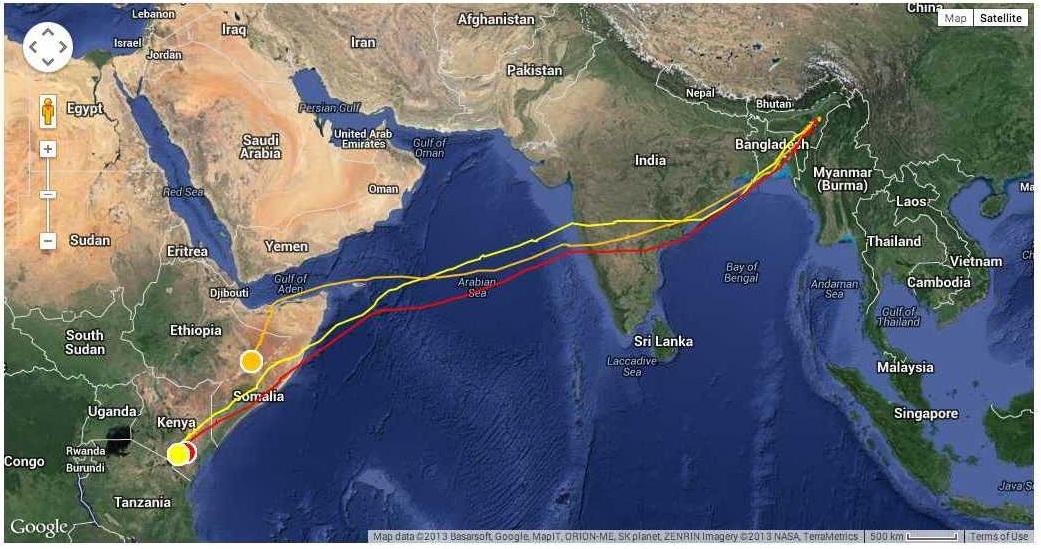
Naga, Wokha and Pangti have reached Africa last week, Center for Conservation, Education and Research has confirmed. They left Doyang in Nagaland (India) on and after November 7. Naga and Pangti were detected over the Arabian sea on November 14 morning and Wokha was way behind poised to enter Odisha air space from the Bay of Bangal on that morning. The trio of Amur falcons and their group are now on the 'largest and most hazardous ' stretch of their migration as they head towards the warmer climate of South Africa.

The trio of Amur falcons were named after local places and fitted with the sattelite devices on November 7 in Pangti village (Doyang) of Wokha district in Nagaland. The three birds left Doyang after their release and were tracking with sattelite tagging. The birds arrive the forest on the banks of the water reservoir of Doyang hydroelectric project in Wokha district of Nagaland every year from Mongolia, North of China and Siberia (Eastern Russia) to roost for some days before moving on.

Naga flew over Assam and Bangladesh, crossed the Bay of Bangal before entering the sky of Andhra Pradesh and Kernataka from there, before leaving the mainland to soar over the Arabian sea. Pangti followed the same route till Andhra Pradesh, but then flew over Maharastra in India. Wokha has crossed Somalia on last Friday and entered Kenya. Pangti, already has arrived the new continent and now in Tanzania. Naga is whirling away time in Kenya's Tsavo National Park. Amur falcon moves in folk of thousands. Since trio have reached Africa, it is clear that other birds of the folk also have reached the new continent safely. So it certain that other Amur Falcons from Nagaland and Assam also have reached the new winter safely. They left Assam on second and third week of November 2013.
The Amur falcons keep coming in small groups from the first week of October till the end of November with the ones coming early leaving first. There are still thousands of Amur falcons at the roosting site at Doyang and they are expected to move by the end of this month. The marathon migrationof the species was a mystery and one route has been confirmed this time with sattelite tagging. But the route of return has not been confirmed yet and it is expected to be confirmed it with sattelite devices in trio. The new technology will shed more light on these birds and their complete migratory route. The cost of each device is about Rs 7 lakh.

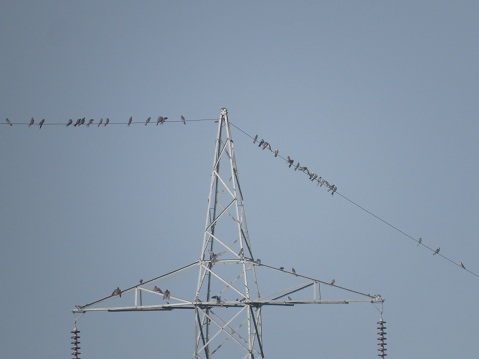
Migratory birds are learning to adapt with changed environment on transit. A large number of Amurn Falcons are seen in Borbori (Nellie) and Umrangchu in Assam taking shelter on electric wires rather than trees to get their prey or food. In this state it is observed that the bird prefers to sit and search for food sitting in the high voltage electric wire during the day time. Amur Falcons live in folks prefer to sit in the electric wire because the number of trees are decresing and they can sit together in the wire.The bird takes food or hunt its prey sitting on wire over the paddy field easily. Moreover the bird prefer electric wire as safe and less disturbed place.

Except this year thousand of Amur falcons had been slughtered in the state of Nagaland for years. For some years it has been observed that a lage number of birds taking shelter in the state of Assam, neighbouring to Nagaland. The bird take shelter in Assam as passage migratory birds for one and half month or two months. For last few years it has been noticed taking them shelter on high and long electric wire over the paddy fields.

Fortunately, it is remarkable that marking a significant milestone for conservation of Amur falcons in the northeast Indian state of Nagaland, three villages in Wokha district have been working to save the migratory raptor in Doyang Reservoir - its largest roosting site in the world. With mass annual hunt potentially threatening the species, a resolution has been cleared by the villages to penalise offenders, this year onward.

Nick P Williams, Program Officer, Birds of Prey, UNEP who has been monitoring the conservation and scientific activities including the tagging of satellite transmitters at roosting site in Doyang, Nagaland. Concerned authority and organisations in Nagaland were informed that the UNEP was closely observing the safe passage of the migratory birds. On hearing the news of the mass massacre last year here at Nagaland, the executive secretary of UNEP wrote to the Minister of forest and environment, Government of India. Principal Chief Conservator and Head of the Forest Department of Nagaland Mr M Lokeshwara Rao stated that the villagers of Wokha helped tapping the birds for tagging. It delighted him that the people who once hunted the birds have now turned conservationist.

Add new comment

Other Contents by Author

A team of experts from ICIMOD (International Centre for Integrated Mountain Development, Kathmandu, Nepal) have installed flood early warning systems (FEWS) enabled by wireless technology along the Jiadhal and Singara rivers in Assam, India. The installation was carried out under the Himalayan Climate Change Adaptation Programme (HICAP) and is intended to minimize the flood risks and enhance the adaptive capacity of the communities. Before being installed, the FEWS were tested for six months at the ICIMOD Knowledge Park at Godavari in the Kathmandu Valley, Nepal. Two main lessons can be drawn from the Mahakali and Uttarakhand flood disasters: The severity of the disaster could have been...
No doubt, it is one of the most beautiful places in the state of Assam, India. Lampi or Langpih—as the Khasi people calls it—is a hamlet cradled in the hilly terrains of Assam bordering Meghalaya,a neighbouring state. Surrounded by hills where the humming of cascading streams fills the silence, Lampi is yet to witness the boons and banes of a modern life. So pollution, thankfully, is absent. But also absent are the basic amenities like health services, schools, electricity, good cooking fuel, sanitation and nutrition that deprive its residents of the rights which are constitutionally guaranteed to them. With a population of about eleven thousand, mostly Nepalis and Khasis, Lampi falls...
Poisoning rhino horns may be the best measures in Kaziranga National Park (KNP) to check unabated rhino poaching and save the species in the brink of extinction. Since rhino horn or horn-washed water is consumed mostly in China and Southeast Asian countries as medicine and with some superstition. So if horns of live rhinos be poisoned in live rhinos it will be useless. If someone takes or consumes such poisoned horn, that person will be seriously ill rather than any cure or superstitious feeling. Of course, the poisoning must be in such a way which will not harm the rhino itself and when one rhino squeeze other rhinos.The poisoning method has already been applied to save...
It is not the mainland India, but a little happening Golaghat district in Assam in the nooks of the Northeast where the zero (sunya) originated. Ashok Sarma, a language history researcher with the help of Dr H N Dutta, the former Director of Department of Archeology, Government of Assam and Dr Dharmashwar Chutia, a retired professor of Department of Sanskrit, Gauhati University has established that the numerical zero was first discovered and used in written script by a civilization of Assam between 2nd and 3rd century.The uses of zero happened in Assam long before the birth of both Ayarthabhatta and Brahmagupta, Sarma said. The evidence of the practice of using zero in Assam came to light...
If timely measures are not taken the Muga (Antheria assamensis) heritage of Assam may face extinction in the next three decades or within 2040. The production of famous Muga silk of Assam has not been augmented. The state has a demand of more than than 5000 MT of Muga silk anually, but the state has been producing average 90 MT per year. In 2010-11 the state produced113.28 MT Muga and in 2011-12 this amount was 114.56 MT. According to Sericulture Department sources production in the year of 2013 may be same as the average production, not more.The decline of Som and Soalo plantation areas in government sericulture farms have pushed Muga silk towards the verge of extinction, the report said....
The Balipara Reserve Forest, which was once barren and void of trees, now begins to bring back the greens again by dint of a noble effort of some ex-servicemen of Assam. There has been drastic changes spanning four years in Balipara Reserve Forest of Sonitpur district of Assam. In fact, the district happens to be one of the world’s most deforested districts. Enter Eco Task Force (ETF) of the Ecological Territorial Army, a part of the Indian Army envisages plantation drive for aforestation in devastated areas including the one at Sonitpur district of Assam in the Balipara Reserve Forest.The unit has so far planted 2.8 million saplings, covering an area of 2,750 hectares since September...
Fishery and mustard cultivation may be best adaptation measures as livelihood for flood affected people in Assam. Rice cultivation (Hali Kheti) the main livelihood of people has been affected by flood waters and erosion for years and there has been no exception this year. The state is ravaged by flood waters severely and acres of land are covered with sand carried by flood waters. A study carried out by Center for Conservation Education...
A good number of students, researcher and scientists from the northeastern part of the country engaged in different fields, acquired tremendous achievements in foreign countries. Very recently an Assamese scientist working in USA, has shown a new path that can help cure any viral disease like influenza, herpes or HIV. Dr. Ankoor Roy and his colleagues’ achievement has been recognized worldwide by Structure, a prestigious scientific journal.In an interview Dr. Roy said they used P22 bacteriophage as a model system for the research. The researcher and his team have identified small protein which plays a critical role in identifying its own DNA and pumps its own DNA to form a new virus...
Despite large-scale devastation of cropland and paddy fields in the recent waves of flood followed by erosion, the ex-gratia for flood-affected people covers only house and other property. Flood relief usually does not cover agricultural loss and damage in this part of the country. The measures taken by state agriculture department in also not adequate for the flood-hit farmers. Moreover, the state is not brought under natural calamity mitigation programmse because the union government provides facilities to only drought –hit states. Rainfall is key to Assam’s agricultural production. However, irregular rainfall is taking a toll on the state’s agricultural produce....
As weeks passed, rumors began to brew. Scientists from the world’s most expensive experiment called Large Hadrons Collider of CERN announced what they claim was the discovery of a “missing” particle that adds mass to matter (the Higgs boson, or so-called God particle). But people don’t want to know the detail of the Higgs. Not yet. They want to know why it is important and how this changes human history.Not only me, the first week of the month of July must have been a bit of a roller coaster ride for science community. Now most of people aware that on July 4th scientists of CMS and ATLAS detectors of Large Hadron Collider (LHC) at CERN, Geneva announced the discovery of a new particle. I...