

Upper Assam NGOs, CSOs Call for Locally Led, Standards-Based Flood Response
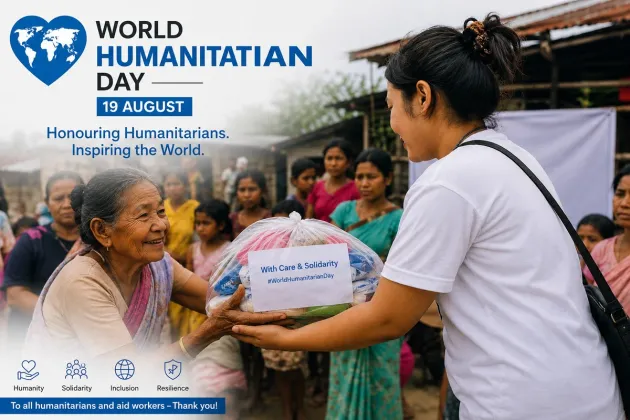

GUWAHATI, August 19, 2026 — More than 35 NGOs and civil society organisations working with flood-affected communities across Upper Assam have called for a locally led, standards-based, accountable and dignified response to the region's recurring flood crisis.
In a collective position issued on World Humanitarian Day, the organisations said the recent floods in Sivasagar, Charaideo, Jorhat, Golaghat and adjoining districts caused significant damage to homes, household assets, agricultural land and livelihoods. The disaster also disrupted access to safe water, sanitation, healthcare, education and other essential services.
They said the crisis does not end when floodwaters recede, with many families continuing to face a long and difficult recovery.
The organisations called for humanitarian action to move beyond short-term relief towards safe recovery, preparedness, climate resilience and a “Build Back Better” approach. They urged greater investment in climate-resilient housing, livelihood restoration, WASH, public-health preparedness, protection, education continuity, disaster risk reduction and early warning systems.
At the same time, they cautioned against treating “Build Back Better” as a standardised approach imposed on affected communities.
Recovery and reconstruction, they said, should take into account local socio-cultural practices, traditional knowledge, locally available materials, settlement patterns and the preferences of affected people while improving safety, accessibility and resilience to future hazards.
The groups also urged humanitarian agencies and organisations to follow internationally recognised standards, including the Core Humanitarian Standard on Quality and Accountability, the Humanitarian Charter, Protection Principles and the Sphere Handbook. Assistance, they said, must be timely, appropriate, safe, accessible, inclusive and accountable to affected communities.
Tirtha Prasad Saikia, Director of the North-East Affected Area Development Society (NEADS), said humanitarian action must recognise the capacities and knowledge already present within affected communities.
“People affected by floods are not passive recipients of humanitarian assistance. They are the first responders, knowledge holders and key actors in their own recovery,” he said.
“Our responsibility is to ensure that humanitarian action strengthens their capacities, protects their dignity and creates space for their voices in decisions that directly affect their lives. Localisation is meaningful only when local actors and communities have the trust, resources and decision-making space to lead solutions relevant to their own realities,” Saikia added.
Luit Goswami, Director of the Rural Volunteers Centre (RVC), stressed the need to connect emergency response with longer-term recovery.
“The focus must move beyond relief to preparedness, livelihood recovery and resilience so that repeated floods do not push vulnerable families deeper into poverty. Every response should create a pathway towards greater preparedness for the next flood,” he said.
Niyar Gogoi, Convenor of the District Inter-Agency Group (IAG), Sivasagar, called for stronger coordination among local humanitarian actors.
“The District IAG brings together local organisations already rooted in communities and familiar with realities on the ground. A stronger, coordinated local response can ensure that needs are identified quickly, resources reach the most vulnerable and assistance is complementary rather than fragmented,” he said.
The organisations said localisation must go beyond using local NGOs merely as implementing partners. Local organisations and community institutions should have greater access to direct and flexible funding, technical support, decision-making spaces and equitable sharing of operational risks, they said.
They also called for stronger coordination among the Assam government, district administrations, local and national NGOs, international humanitarian organisations, UN agencies, donors and other stakeholders. Greater regional cooperation across Northeast India on disaster preparedness, climate adaptation and resilience was also urged.
The collective position further called for increased investment in anticipatory action and community preparedness, saying communities should not have to wait for the next disaster before resources and support are mobilised.
It stressed that disaster-affected people must be treated as rights-holders and partners in their own recovery, with meaningful participation in assessment, planning, implementation, monitoring and feedback.
“The waters may recede, but humanitarian responsibility cannot recede with them. Affected families deserve not only immediate relief, but safety, dignity, protection, participation and a resilient pathway to recovery—one that builds back better without losing the socio-cultural identity, knowledge and practices of the communities themselves,” the collective statement said.
Assam Times Staff. editor@assamtimes.org
Comments (0)
No comments yet. Be the first to share your thoughts.
Leave a Comment