
Skip to content Skip to navigation

Tigers population increases in the Manas Tiger Reserve

The increase in tiger population in the Manas National Park is a milestone in country-wide tiger conservation efforts. Since peace returned to Manas after a prolonged insurgency, dedicated conservation intervention to secure the population of tigers was in place. The annual monitoring of tigers, co-predators, and prey animals is a prime mandate set by the Government of India to all tiger reserves designated as tigers‟ source population sites. With each passing year, Manas is adorning new feathers to its cap. This time „Manas Tiger Reserve‟ has been successful in a three-fold increase in tiger number in the last ten years (2011-2021). It is worth mentioning that this is an outcome of the continuous efforts of the Manas Directorate, and the conservation organisations who have been working ardently.

The annual survey in Manas using camera-traps is led by the Field Director, MTR and supported by Aaranyak and WWF India and has been continuing since 2010 in Manas for monitoring the tigers, co-predators, and prey animals, with constant support from various donors and collaborators. This year Manas is celebrating the 12th year of collaboration with Aaranyak and WWF India for the annual camera trapping survey dedicated to assessing the population status of tigers in the area.
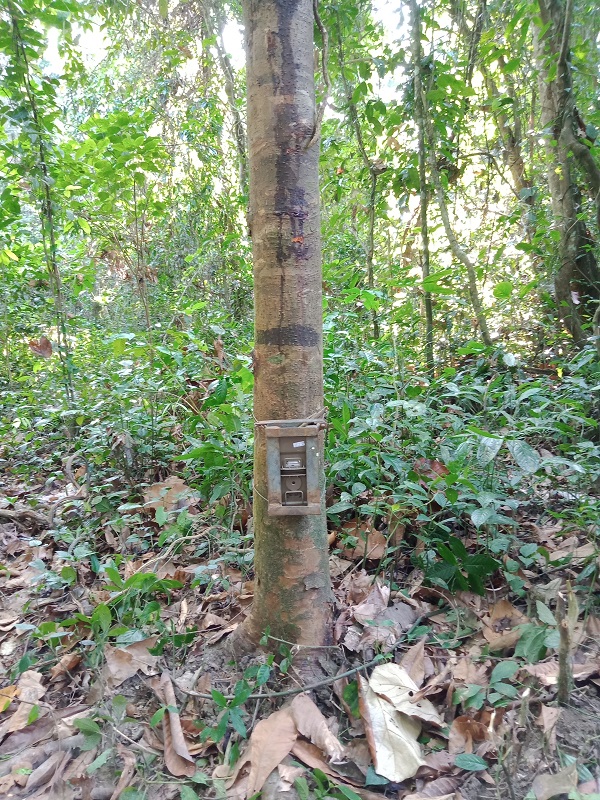
The extensive systematic camera trapping survey was carried out, for the first time in Manas Tiger Reserve covering the Manas National Park, First Addition to Manas National Park and Barnadi Wildlife Sanctuary, with a trapping effort of 8388 trap-days in approximately 876 sq. km area. The survey recorded the presence of 48 tigers in the Tiger Reserve, of which 38 were adult tigers, 3 sub-adults, and 7 cubs. Among the adult tigers, 21 are female, 16 male and sex of one adult tiger remained unidentified. The survey also recorded 37 leopards in Manas Tiger Reserve of which 31 were adults and six sub-adults. Besides, other elusive mammals such as the Himalayan Serow (Capricornis sumatraensis) and Goral (Naemorhedus sp.) were recorded for the first time from Manas Tiger Reserve during the survey.
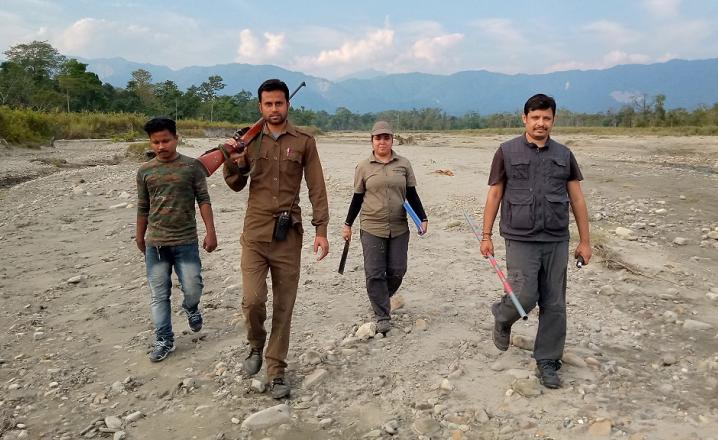
Moreover, to ensure stringent protection a patrolling team, “Manas Tiger Teams” was formed and provided capacity building trainings to patrol in the eastern range of the park (Bhuyanpara Range). This included patrol observations recording training, GPS usage, Map reading, Compass reading and Navigation, First Aid training, Emergency Medical Situation Handling, Crime Scene Handling, Camera Trap Deployment training, Snake Bite management, Snare Combing Tactics, drawing of Wildlife Crime offences and Forensics by Aaranyak with support from other project partners, Forest Department BTC, Wildlife Conservation Trust, Panthera, IUCN-KfW and USFWS.

“Better management and protection measures have resulted in an increase in tigers in Manas, which is a positive sign. But in coming years, the focus should be given on the management of the prey base, so that deaths due to infighting don‟t take place”, said Dr. Bibhab Kumar Talukdar, CEO, Aaranyak. Dr. M Firoz Ahmed, Scientist F and Head, Tiger Research and Conservation Division, said,

“Manas is a unique landscape that offers tremendous scope for conservation of Tigers and another biodiversity in a transboundary conservation landscape. The future of conservation of the landscape lies with both India and Bhutan as the forest on either side of the international boundary complements with each other, which was proved by new understandings how individual tigers share transboundary space.”

Dr. Dipankar Lahkar, Manager, Tiger Research and Conservation Division, Aaranyak said, “Tigers are potentially flourishing in Manas, and this significant recovery becomes a global example. Over time we have seen a potential increase of the breeding females and cubs signify that now Manas proved to be a healthy breeding ground for the booming tiger population.

Add new comment

Other Contents by Author

GUWAHATI: Jadu Deka can’t waste even an hour these days. Same it is in the cases of Jitu, Lakheswar, Pranab, Bitupan et al since Rongali Bihu is on the threshold. Only a couple of hours is left. With traditional Assamese Dhul on their shoulders they are busy with the preparation of huchori performance to mark the most vaunted spring festival commencing from Saturday. Achyut, the holder of the buffalo horn pipe is all set to mesmerize the onlookers in the nook and corner of the state in the Bihu Huchori performance in the house yards, shopping mall yards. Munna is well prepared with his flute like Dulu with his traditional cymbals to add huge value in the performance. Christened as...
The vexed illegal migrants issue in Assam has reached the United Nations when the Prabajan Virodhi Manch has screened an eye opening documentary at the ongoing UNHRC summit in Geneva on Thursday. Produced by the organization entitled Assam: The Silent Genocide, the documentary has highlighted the impact of the unabeted influx of the Bangladeshi nationals from across the border. The border influx, according to the documentary, has upset the delicate demography of state and if these are allowed to go unchecked, the indigenous lot would be alien in their own home.For the last couple of months, the organization led by noted lawyer Upamanyu Hazarika has been demanding immediate deportation of...
The brimful worries of north eastern region’s farming community seem to have struck UN attention when B Thomas from Liberation, a London-based human rights organization addressed the 34th session of UN Human Rights Council for the princely north eastern state on the issue of Right to Food in Geneva on Thursday.He said the enforcement of the Armed Forces Special Power Act 1958 has been affecting the farmers who keep producing food the feed the millions of the people in the state and abroad. But, he said, 97 farmers were killed during army’s counter insurgency operation against ULFA rebels under the draconian law.He said farmers were killed after ruthless torture and hectors of cropland were...
Geneva March 10: Food poisoning is now a global phenomenon. But India has reasons to be worried where the country has been witnessing a series of incidents at regular intervals. Foods in the country is far from being fresh and healthy where pesticides and chemical fertilizers are used to boost the production. These are more or less of what a representative from India said at the ongoing UN Human Rights Conference in Geneva on Thursday. In his speech, Pankaj Jyoti Hazarika, who represented Prahar, a non governmental organization said Assam is one of the state where these incidents have been hitting media headlines. “In the promotion of health and prevention of disease the role of...
Geneva, March 9: A lesser known tribe and their pathetic plights in the Indian sub continent knocked at the doors of the United Nations which is holding its 34th session of Human Rights Council in Geneva.  The Fase Pardhi community is scattered in Maharashtra, Karnataka. In his speech at a side event "Women and Child RIghts" dalit rights activist Vishal Kamble precisely threw some lights on the sub human condition of the tribe who are still living outside the village areas without any access to education, healthcare and potable. According Kamble, the governments have no dearth of schemes. But all of these schemes' have failed to percolate any benefit for them. As a result, these...
The entire incident of bloodbath in Balajan, in fact, is shrouded in mystery. The ground situation seems to have suggested utter cluelessness. The picture is still hazy. The statement issued by NDFB-S has further made the state of affairs more confusing. Security forces smartly claimed to have killed one of the perpetrators minutes after he along with his fellow militants unleashed terror with firing and bombing in the weekly market. Then how his fellows have managed to vanished from the spot? Why an intensive combing operation has been failing to trace down the remaining perpetrators? These things need to be clear. Talking to a section of media, some eye witnesses maintained that police...
Who is behind the gory bloodbath in Balajan where 14 people died and several others sustained injury? Initially, the needle of suspicion pointed towards NDFB-S who out rightly rejected the claim. The inputs are now contradictory making the scene more confusing.Some circles tried to call it the handiwork of the fundamentalist forces. Some of them talked of a suicide squad attack. But dearth of concrete evidence makes it difficult to confirm it. Then who is behind the deadly attack?Police claimed to have killed one of the attackers minutes after the incident at a stone’s throw distance from the incident site. But how police killed the striker who managed to come to the market with arms and...
Assam is on the threshold of a massive agitation for exercising the rights over its own resources if somebody goes by the howls of startewide protest against the move to auction marginal oil fields.Many political parties and organizations are up in arms against the Narendra Modi Government at the Centre alleging a set of policies which is believed to have hurt the sentiment of the people who are proud of the state’s oil and tea.These agitating parties and organizations have not spared three month old BJP-led coalition government as they pledged massive agitation to stop the move.The massive agitation started erupting as soon as the Centre cleared the decks for auctioning a dozen of oil...
Only two words ‘secret killings’ struck no less storm across Assam 15 years back where the relatives and friends of a section of ULFA leaders went missing. The bodies were recovered later without any clue to follow the perpetrators. But strangely, protests refused to surface not to speak of police investigation.  Even nobody from the government was with the bereaved family members. One after another such incidents kept Assam’s socio political scene on the boil during the erstwhile Mahanta regime. Congress, in 2001, was quick to make it a poll issue blaming it all on the AGP-led four party alliance government for it. The anger and resentment among the people helped Congress regain...
The Climate Compatible Development Film Festival kickstarted the first of its regional screening in Guwahati on Friday December 19. Three  films produced by the Climate & Development Knowledge Network (CDKN), and in partnership with Television Trust for Environment and the Assam Times Foundation, the film screening’s objective was to galvanise discussion around climate change, it’s impact on indigenous communities in the North East, lack of representation of women in climate change negotiations and the power of film to spur discussion and action on climate change, especially amongst youth groups.  The 3 films: For a safer future – Insights on climate resilience from India;...