
Skip to content Skip to navigation

‘Dignified way for return of Kashmiri Pandits obligatory’

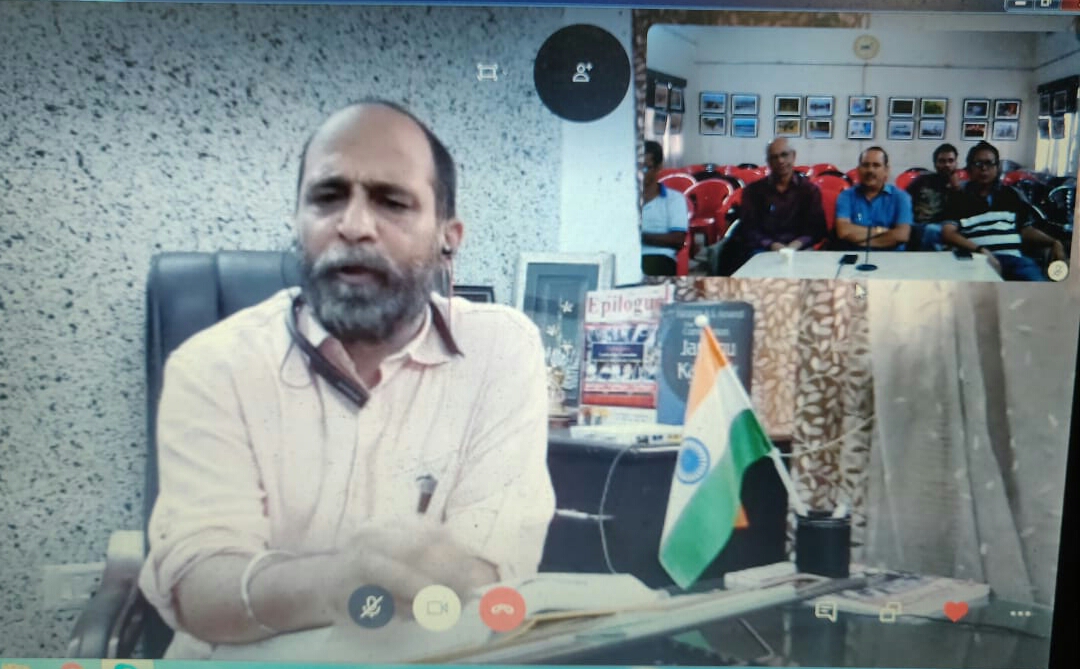
‘Dignified way for return of Kashmiri Pandits obligatory’ Guwahati: The return of Kashmiri Pandits to Kashmir valley must be addressed in terms of historical aspect than a cosmetic contemporary understanding. This community has suffered a genocide for last 700 years and has been eventually reduced from cent percent presence in the valley to hardly three percent now, commented a senior journalist of Jammu & Kashmir.

Tito Ganju, editor-in-chief of Epilogue, an English newsmagazine published from Jammu, while interacting with Guwahati Press Club member-scribes through the video-conference facility on 23 August 2019, also added that safety, dignity and opportunity should for the cardinal of any policy on return and rehabilitation of those evicted Pandit families.

Replying to queries on the successful return of Kashmiri Pandits to the valley, Ganju however commented that time and situation are yet to be conducive for their return. Though Kashmiri Pandits are the aboriginals of the valley with first and uncontested claim over the resources, their demand for a centrally administered region carved out of Kashmir Valley should be acknowledged, he asserted.

Organized in the backdrop of historic decision by the Union government in New Delhi to revoke Article 370 & 35A and reorganization of Jammu & Kashmir, Ganju mentioned that the ideology of Panun Kashmir stands today vindicated as everyone knows, it was Panun Kashmir which demanded the abrogation of these articles and reorganization of the State.

Commenting on Article 370, the outspoken journalist termed it as a temporary provision of the Constitution of India and architects of the Constitution were clear about its temporary position. Those who say that it forms the basic structure of our Constitution are simply trying to mislead the nation, stated Ganju adding that temporary provision is the weakest one among three provisions (other two being Special Provision and Transitory Provision).

Recognized as an expert on the Constitution, Ganju categorically pointed out that the government had the legal and constitutional mandate to deal it with the manner it deems fit. Jammu & Kashmir was under President’s rule and hence the legislative power of the State in accordance with the constitutional provisions lied with the Parliament and the Centre took the route of Parliament to bring in the bill to make necessary changes in Article 367 and Article 372.

Narrating the political history of Jammu & Kashmir, Ganju claimed that J&K Maharaja Hari Singh had all moral, ethical and legal rights to decide upon the accession of Jammu & Kashmir with either dominions (India and Pakistan) and the king duly signed the treaty of accession with Indian Dominion on 26 October 1947.

J&K Maharaja was seeking a better deal with both the Dominions before finally making its mind. The unwanted aggression of Islamabad through Pakistani Army regulars and tribal forces into the erstwhile province of Jammu & Kashmir later compelled the king to seek assistance from New Delhi and eventually he signed the Instrument of Accession.

Talking about the petition filed by India in the United Nations after Pakistan’s aggression, Ganju made it crystal clear that it was strictly on the aggression of Pakistan into Jammu & Kashmir, which had already become a legal territory of India following the official consent of J&K Maharaja.

Adding further he revealed that the Centre till date was pampering the separatists of Srinagar valley through a kid glow treatment prostrating interest of the nation and the supremacy of its Constitution to the whims of Kashmir region. The nation-state over 70 years now unfortunately incentivized separatists including the so-called mainstream political parties of Kashmir region and ultimately continued penalizing the nationalists of the region.

Author info

AT News's picture

Assam Times Staff. editor@assamtimes.org

Add new comment

Other Contents by Author

A three-day workshop titled “Youth Leaders for Rivers: Learning Workshop” concluded today at the Cachar Club Conference Hall, bringing together young leaders from across the region to collaborate on river governance, water rights and community resilience. Organized by the North-East Affected Area Development Society (NEADS) with support from the International Union for Conservation of Nature, the event was held from March 24 to 26 under the Youth Basin Ambassadors (YBA) initiative. It aimed to connect youth working across the Ganges–Brahmaputra–Meghna Basin and deepen their understanding of river systems, governance challenges and community-driven solutions. Participants included...
Tinsukia, March 22:  Suspected militants of the banned outfit United Liberation Front of Asom (Independent) (ULFA-I) launched a pre-dawn attack on an Assam Police commando camp in the Jagun area of Tinsukia district, leaving at least four security personnel injured. According to reports, the militants attacked the camp around 2 a.m., allegedly lobbing several grenades and opening fire with automatic weapons. Security forces retaliated, leading to an exchange of fire that lasted for several minutes before the attackers fled the scene. The injured personnel were later shifted to a hospital in Dibrugarh for treatment. Following the attack, Army and police units launched a joint...
WWF-India, in collaboration with Samagra Shiksha Assam, felicitated five top-performing schools under the ‘Mission Prakriti’ programme for 2025–26 at a ceremony in Guwahati. The initiative promotes environmental awareness among students through themes like biodiversity, water, waste, food, and energy. In Assam, the programme covers over 4,700 schools across all districts. The award-winning schools include Natun Fatasil Town HS (Kamrup Metro), Sakai Khangia High School (Jorhat), Bishnu Jyoti MES (Sonitpur), PM Shri Jamira HS School (Hailakandi), and PM Shri Gossaigaon Girls HS School (Kokrajhar). Tinsukia district was also recognised as the best-performing district. Officials...
Jorhat: Tirtha Prasad Saikia, Director of the North-East Affected Area Development Society (NEADS), an indigenous civil society organisation based in Jorhat, Assam, has been appointed as the Constituency Focal Point for the People Affected by Conflict and Disaster Constituency of the Asia Pacific Regional CSO Engagement Mechanism (APRCEM). APRCEM is a regional civil society platform that brings together organisations across Asia and the Pacific to engage with intergovernmental processes on sustainable development, particularly the implementation and review of the 2030 Agenda for Sustainable Development and the Sustainable Development Goals (SDGs). Through this organisational role,...
SHILLONG, Mar 11: The Meghalaya government has postponed the elections to the Garo Hills Autonomous District Council (GHADC) that were scheduled to be held on April 10, 2026, following violent clashes in West Garo Hills that left two people dead. Chief Minister Conrad K. Sangma announced the decision on Wednesday, saying the state government reviewed the prevailing law-and-order situation in the Garo Hills region before deciding to defer the polls. The unrest erupted during the nomination process in Chibinang in West Garo Hills, where clashes broke out between groups supporting and opposing the participation of non-tribal candidates in the GHADC elections. Two persons were killed...
The Meghalaya High Court has set aside a controversial notification that made possession of a Scheduled Tribe (ST) certificate mandatory for candidates contesting the upcoming elections to the Garo Hills Autonomous District Council (GHADC). Delivering the judgment on March 10, Justice H. S. Thangkhiew ruled that the February 17, 2026 notification issued by the GHADC Executive Committee lacked legal authority and did not follow the procedure required under the Assam and Meghalaya Autonomous Districts (Constitution of District Councils) Rules, 1951. The court observed that the notification effectively barred non-tribal voters and candidates from participating in the council elections...
TURA, Meghalaya – March 11, 2026: Tensions surrounding the upcoming elections to the Garo Hills Autonomous District Council (GHADC), scheduled for April 10, have triggered violent clashes in the West Garo Hills district of Meghalaya, leaving two people dead and several others injured. The unrest has also resulted in widespread vandalism and arson in several areas of the district. The tensions stem from a controversial notification requiring candidates contesting the council elections to possess valid Scheduled Tribe (ST) certificate documentation. The rule has effectively prevented many non-tribal residents—particularly Bengali-speaking Muslims living in the plains belt areas such as...
North East Affected Area Development Society (NEADS), a grassroots development organisation based in Jorhat working with people’s struggles and community development initiatives, observed International Women’s Day at Chumoni Chapori village under the Jhanjimukh area in Jorhat district on Sunday, bringing together local women, community leaders and youth to celebrate the achievements and contributions of women in society. The programme was organized with the participation of women from riverine communities who shared their experiences, challenges and aspirations for greater social and economic empowerment. The event focused on raising awareness about women’s rights, gender equality and...
A significant milestone for literature from Northeast India has been marked with the publication of The Yellow Metaphor, a collection of poems by Assamese poet Jiban Narah, now released by Penguin Random House India. The book is a translated anthology of Narah’s poetry and is considered a rare achievement for the region. It is reportedly the first translated poetry collection by a single poet from Northeast India to be published by Penguin, and among only a handful of works in a regional Indian language to receive such recognition from the global publishing house. The Yellow Metaphor brings together 99 selected poems written over a span of 33 years, reflecting Narah’s long poetic...
Sivasagar, March 6: A meeting of organisations associated with the religious and intellectual affairs of the Tai-Ahom community was held on Thursday (March 5) at the public auditorium of Bakata Parijat Panchayat in Sivasagar district. The meeting was chaired by Jibeshwar Mohan Deva, founding principal of Tingkhang College. Several prominent personalities attended the meeting, including Manaranjan Baruah, president of the Mohan-Deodhai-Bailung Sanmilan; Vidya Phukan, president of the Mohan-Deodhai-Bailung Pandit Parishad; former president of Phra-Lung-Moung Assam Golap Gohain; secretary Pranjal Mohan; noted Tai cultural researcher Kamal Jyoti Mohan; Tai-Ahom scholar Nripen Mohan;...