
Skip to content Skip to navigation

Questions of Agricultural Sustainability need to be addressed

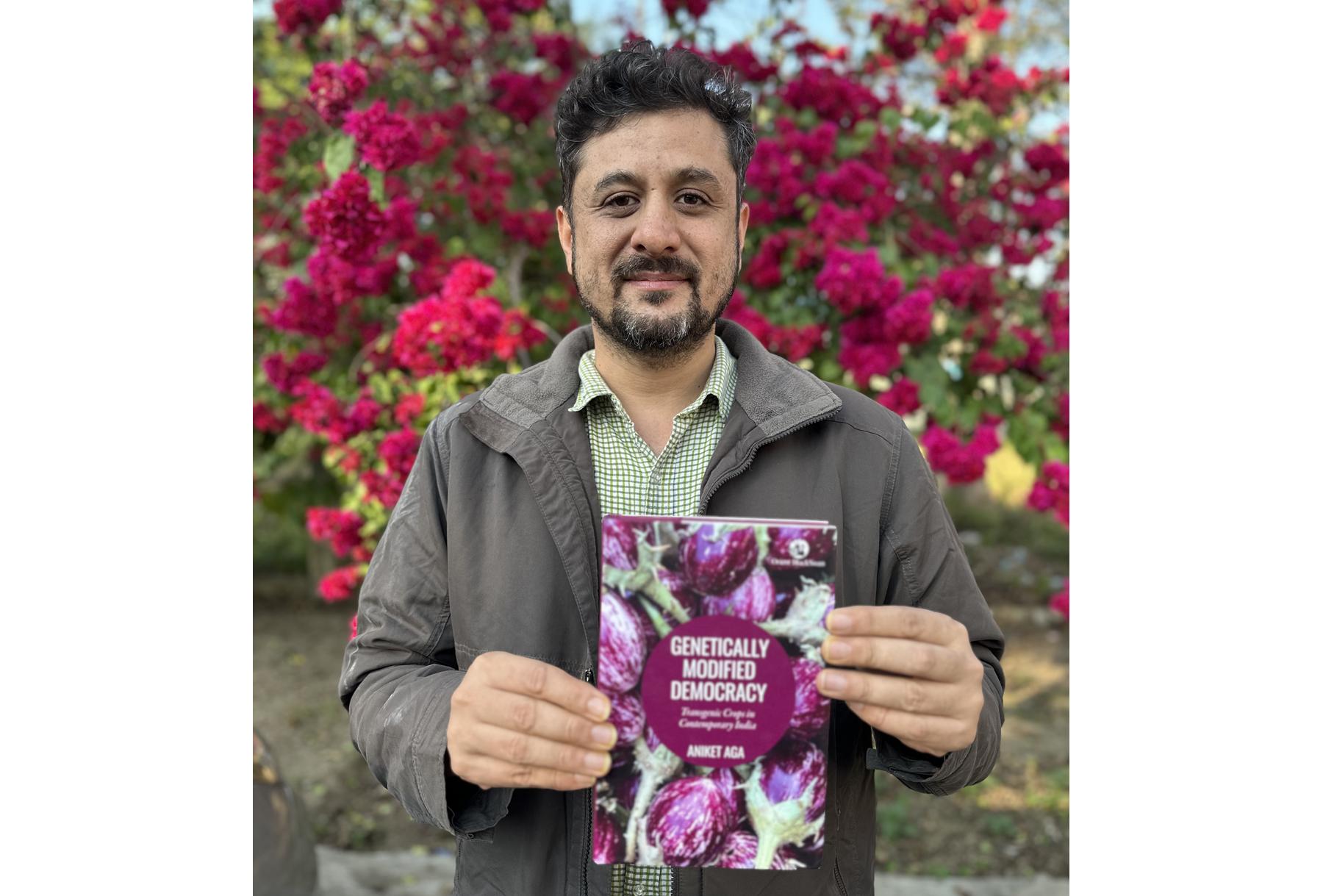
Dibrugarh: Prof. Chandan Kumar Sharma from Tezpur University hosted the Northeast release of Yale University Press' award-winning Genetically Modified Democracy at Dibrugarh University on Friday. The book release was part of a three-day workshop called Sustainable Futures: Agriculture, Ecology and Conservation in Northeast India. It took place on December 14-16 in Guwahati and Dibrugarh University.

Dr. Aniket Aga is an associate professor of environmental studies at Ashoka University. His research interests are in science and technology studies, democratic politics, and agrarian studies. He works on questions of environmental justice, food democracy, and sustainable agriculture. The South Asian edition of his book was released by Orient BlackSwan in December 2021. Since its publication, the book has been exceptionally well received. Anthropologist Jacob Richardson suggests that the book provides “plenty of food for thought and a fresh perspective on a long-studied debate”; and Abby Kinchy, sociologist of science, suggests that the book should be “required reading” for anyone making political points about GM crops based on the Indian experience.

In November 2022, Genetically Modified Democracy won the ‘Fleck Prize’ awarded by the international Society for Social Studies of Science which recognizes outstanding work in the area of Science and Technology Studies. In its award citation, the prize committee stated that the book “is a masterful and thoroughly researched account of the making of GMO biotechnology in India and the concurrent emergence of novel matters of concern and governance forms fueled by calls for equity and justice.”

At the book release, reiterating words from his book, Dr. Aniket Aga said, “Our focus must remain on urgent questions of food democracy, agricultural sustainability, health, and justice, rather than any one particular technology.” In his book discussion, Prof. Chandan Kumar Sharma added, “Land is becoming commodified increasingly in the region. It poses a great challenge to the biodiversity in the hills, the crops that people cultivate, and will accentuate the problem of food insecurity. The production, consumption, and preservation of food often involves the local community. Therefore, the whole rhythm of the community might also be affected when food cultures disappear.”

Last month, the Assam Government launched the Assam Millet Mission encouraging farmers to diversify crops and expand into palm farming, lemon, bhut jholokia, and joha rice. While crop diversification is important for farm resilience, it must be guided by agro-ecological suitability, and must build on the working knowledge of farmers and farm labourers, especially women, and their culture of seeds, biodiversity, and food.

This year, the Assam government aims to procure 10 lakh MT of rice directly from farmers with a minimum support price of INR 2040 per quintal. In 2021-22, it procured over 5.65 lakh MT of rice to boost farmer income and assure a fair price. However, this accounted for a meagre 43,000 farmers vis-à-vis over 27 lakh farmers in the state. The government needs to find ways to better support farmers, particularly those growing food crops: through schemes, subsidies, insurance, and prices. Shattered supply chains during the pandemic have left many farmers and their families struggling to cope. 


Photo: Mirza Zulfiqur Rahman


Author info

AT News's picture

Assam Times Staff. editor@assamtimes.org

Add new comment

Other Contents by Author

SHILLONG, Mar 11: The Meghalaya government has postponed the elections to the Garo Hills Autonomous District Council (GHADC) that were scheduled to be held on April 10, 2026, following violent clashes in West Garo Hills that left two people dead. Chief Minister Conrad K. Sangma announced the decision on Wednesday, saying the state government reviewed the prevailing law-and-order situation in the Garo Hills region before deciding to defer the polls. The unrest erupted during the nomination process in Chibinang in West Garo Hills, where clashes broke out between groups supporting and opposing the participation of non-tribal candidates in the GHADC elections. Two persons were killed...
The Meghalaya High Court has set aside a controversial notification that made possession of a Scheduled Tribe (ST) certificate mandatory for candidates contesting the upcoming elections to the Garo Hills Autonomous District Council (GHADC). Delivering the judgment on March 10, Justice H. S. Thangkhiew ruled that the February 17, 2026 notification issued by the GHADC Executive Committee lacked legal authority and did not follow the procedure required under the Assam and Meghalaya Autonomous Districts (Constitution of District Councils) Rules, 1951. The court observed that the notification effectively barred non-tribal voters and candidates from participating in the council elections...
TURA, Meghalaya – March 11, 2026: Tensions surrounding the upcoming elections to the Garo Hills Autonomous District Council (GHADC), scheduled for April 10, have triggered violent clashes in the West Garo Hills district of Meghalaya, leaving two people dead and several others injured. The unrest has also resulted in widespread vandalism and arson in several areas of the district. The tensions stem from a controversial notification requiring candidates contesting the council elections to possess valid Scheduled Tribe (ST) certificate documentation. The rule has effectively prevented many non-tribal residents—particularly Bengali-speaking Muslims living in the plains belt areas such as...
North East Affected Area Development Society (NEADS), a grassroots development organisation based in Jorhat working with people’s struggles and community development initiatives, observed International Women’s Day at Chumoni Chapori village under the Jhanjimukh area in Jorhat district on Sunday, bringing together local women, community leaders and youth to celebrate the achievements and contributions of women in society. The programme was organized with the participation of women from riverine communities who shared their experiences, challenges and aspirations for greater social and economic empowerment. The event focused on raising awareness about women’s rights, gender equality and...
A significant milestone for literature from Northeast India has been marked with the publication of The Yellow Metaphor, a collection of poems by Assamese poet Jiban Narah, now released by Penguin Random House India. The book is a translated anthology of Narah’s poetry and is considered a rare achievement for the region. It is reportedly the first translated poetry collection by a single poet from Northeast India to be published by Penguin, and among only a handful of works in a regional Indian language to receive such recognition from the global publishing house. The Yellow Metaphor brings together 99 selected poems written over a span of 33 years, reflecting Narah’s long poetic...
Sivasagar, March 6: A meeting of organisations associated with the religious and intellectual affairs of the Tai-Ahom community was held on Thursday (March 5) at the public auditorium of Bakata Parijat Panchayat in Sivasagar district. The meeting was chaired by Jibeshwar Mohan Deva, founding principal of Tingkhang College. Several prominent personalities attended the meeting, including Manaranjan Baruah, president of the Mohan-Deodhai-Bailung Sanmilan; Vidya Phukan, president of the Mohan-Deodhai-Bailung Pandit Parishad; former president of Phra-Lung-Moung Assam Golap Gohain; secretary Pranjal Mohan; noted Tai cultural researcher Kamal Jyoti Mohan; Tai-Ahom scholar Nripen Mohan;...
Guwahati, Feb 28: The Assam government’s decision to seek a 5 per cent stake in Oil India Limited (OIL) has triggered discussion on the State’s long-term approach to the oil and gas sector in the Northeast. The proposal, under which Assam has sought a minority share in OIL — where the Government of India holds 56 per cent — will be examined by the Centre, Union Petroleum Minister Hardeep Singh Puri said. Chief Minister Himanta Biswa Sarma stated that the State is extending full cooperation to oil sector companies and urged that shares be allocated to Assam to support smoother functioning and stronger coordination. Reacting to the development, Shantikam Hazarika — former Chairman of...
New Delhi, March 1: Concerns have been raised over the national HPV vaccination campaign launched on February 28, 2026, with a citizen questioning its scientific basis, operational preparedness, and public health prioritisation. In a public statement, Donthi N. Reddy said that not a single state has published baseline data on cervical cancer incidence or HPV prevalence prior to the rollout. Without such baseline indicators, he argued, outcomes cannot be measured, and without measurable outcomes, the reported annual expenditure of ₹1,300 crore cannot be properly evaluated. The campaign involves administration of the HPV vaccine Gardasil-4 to 14-year-old girls across the country, aiming...
North-East Affected Area Development Society (NEADS), a grassroots civil society organisation based in Jorhat, Assam, participated in the 13th Asia-Pacific Forum on Sustainable Development (APFSD), convened by the United Nations Economic and Social Commission for Asia and the Pacific (UNESCAP) from 24–27 February, 2026, at the United Nations Conference Centre in Bangkok. Tirtha Prasad Saikia, Director of NEADS, represented the organisation at the Forum. He also participated in his capacity as the Constituency Focal Point for People Affected by Conflicts and Disasters and as a Regional Coordinating Committee Member of the Asia Pacific Regional CSO Engagement Mechanism (APRCEM). During...
The Assam Pradesh Congress Committee (APCC) on Wednesday submitted a detailed “Chargesheet 2026” against the BJP-led Assam government, symbolically placing it before what it termed the “People’s Court of Assam.” The chargesheet targets the government headed by Chief Minister Himanta Biswa Sarma, covering the period from May 10, 2021 to February 18, 2026. In a press briefing in Guwahati, APCC leaders alleged large-scale corruption, economic mismanagement, constitutional violations, and failure to protect the rights of indigenous communities. The document lists 20 major charges, including the alleged operation of a “syndicate raj,” accumulation of illegal wealth, rising public debt, and...