

Assam’s Floods in a Warming World
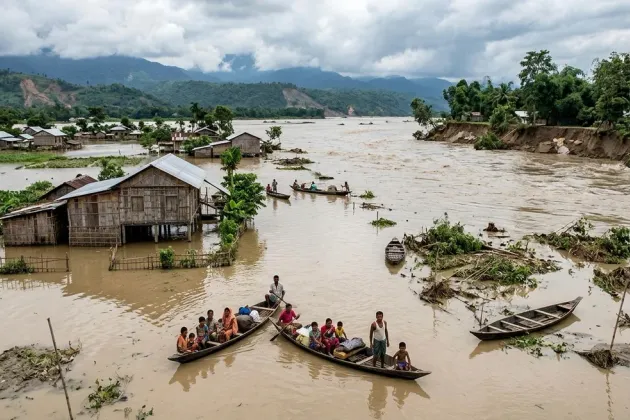

Floods in Assam are no longer explained simply by the arrival of the monsoon. Flooding has always been part of life in the Brahmaputra and Barak valleys, but a changing climate, shifting river behaviour and growing human pressure on vulnerable landscapes are making the challenge increasingly complex.
The emerging concern is not that every flood has a single cause. Rather, several factors can now interact at the same time: intense rainfall, runoff from upstream catchments, changing sediment loads, erosion and the growing concentration of people and infrastructure in flood-prone areas. When these pressures coincide, the consequences can be far more severe.
Scientists increasingly describe such interactions as compound events. A period of intense rainfall, for example, can combine with high upstream flows and sediment-choked channels, reducing the capacity of a river system to absorb additional water. The result may be sudden or prolonged flooding across areas that are already highly vulnerable.
Assam's exposure is enormous. According to the Assam Water Resources Department, about 31.05 lakh hectares, or 39.58 per cent of the State's land area, is flood-prone. Records cited by the department put the average annual area affected by floods at 9.31 lakh hectares. The department has also historically estimated average annual flood losses at around ₹200 crore, although the real economic and social costs of individual disasters can be far higher.
Climate projections add another layer of concern. A recent World Bank technical note says extreme rainfall events in Assam could increase by 5 to 38 per cent relative to the baseline, while flood events are projected to rise by more than 25 per cent in 33 of the State's 35 districts. Such projections should not be read as a forecast for any particular flood. They do, however, point towards a future in which extreme hydrological events may become a more serious and widespread risk.
This matters because average rainfall alone does not tell the full story. Assam has seen concern over the changing distribution and intensity of rainfall, including heavy downpours over short periods. The State's climate and health action plan notes that average monsoon rainfall has shown a declining trend over a long historical period even as extreme rainfall and sudden downpour days associated with flooding have increased.
The Brahmaputra's future behaviour is another major concern. A scientific review of climate change impacts on the Brahmaputra floodplain cited projections of around a 13 per cent increase in annual streamflow under one climate-change scenario. The same review noted projections of a 40 per cent rise in annual sediment load by the end of the 2075–2100 period, compared with an earlier baseline. These are long-term model projections, not measurements of present-day change, but they underline the scale of uncertainty facing one of the world's most dynamic river systems.
Sediment is particularly important in Assam. The Brahmaputra is a highly mobile, sediment-rich river. Changes in sediment supply, erosion and deposition can alter channels, affect riverbanks and influence how water spreads across the floodplain. More recent modelling also points to the possibility of intensified high flows in the Brahmaputra basin under future climate scenarios.
Climate change, however, is only one part of the story.
Human activity can turn a natural hazard into a larger disaster. Encroachment on floodplains and wetlands, loss of natural drainage channels, deforestation, poorly planned infrastructure and settlement in highly exposed areas can all increase vulnerability. The Ministry of Jal Shakti has itself noted that Assam's recurring flood problem is compounded by factors including embankment breaches, encroachments, deforestation and poor drainage.
This is where the question of exposure becomes critical. Floodwater entering an open floodplain and floodwater entering a densely populated settlement do not produce the same disaster. As more homes, roads, businesses and public infrastructure occupy vulnerable landscapes, the potential human and economic losses rise.
The answer, therefore, cannot be limited to responding after the water arrives.
Assam needs a stronger long-term approach to living with its rivers. That means better understanding river and sediment dynamics across the entire basin, protecting wetlands and natural drainage systems, restoring degraded catchments and regulating construction in high-risk areas. Floodplain management and land-use planning must become as important as embankments and emergency relief.
Urban areas require particular attention. In Guwahati and other expanding towns, rapid construction and the loss or obstruction of natural drainage can turn intense rainfall into severe urban flooding. Protecting water channels, wetlands and low-lying drainage routes must be treated as essential infrastructure rather than as an obstacle to development.
There is also a need to move from a largely reactive model towards risk-based planning. Better forecasting and early warning remain vital, but they must be linked to evacuation planning, resilient housing, protection of livelihoods and support for communities repeatedly displaced by floods and erosion.
Assam cannot stop the monsoon or eliminate flooding from a landscape shaped by great rivers. Nor should every flood be automatically attributed to climate change. But the scientific evidence increasingly suggests that climate change is altering the risks surrounding rainfall and river flows, while human actions are increasing exposure and vulnerability.
That is the real challenge facing Assam.
The future of flood management will depend not simply on how quickly relief reaches people after a disaster, but on whether the State can reduce avoidable risks before the next extreme event arrives. In a warming world, learning to live with the Brahmaputra and its tributaries—without further weakening the ecological systems that sustain them—may be one of Assam's most urgent development challenges.
Comments (0)
No comments yet. Be the first to share your thoughts.
Leave a Comment