

Kaziranga Under Pressure: Rethinking Protection in an Age of Development
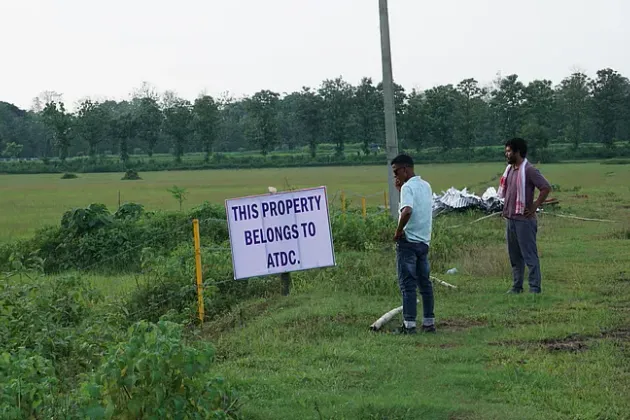

The debate over the proposed reduction of the Eco-Sensitive Zone (ESZ) around Kaziranga National Park—from 10 kilometres to just one kilometre—has raised a larger and more difficult question: how should Assam balance ecological protection with the growing demands of development?
What is at stake is not merely a regulatory boundary. It is the future of one of the world's most important wildlife landscapes.
Kaziranga, a UNESCO World Heritage Site, is globally known for its extraordinary biodiversity. It supports the world's largest population of the one-horned rhinoceros and is home to tigers, elephants, wild buffalo, swamp deer and a rich variety of birds.
But Kaziranga's ecological life does not end at the boundary of the national park.
The park is part of a much larger living landscape of grasslands, wetlands, floodplains, forests and hills. Wildlife moves through this wider ecosystem, particularly during the annual floods, when many animals leave the flooded plains and move towards higher ground, including the Karbi Anglong hills.
These landscapes and corridors are not empty land surrounding a protected area. They are part of the ecological system that allows Kaziranga to survive.
That is where the importance of an Eco-Sensitive Zone lies.
ESZs are intended to act as a buffer between protected areas and intensive human activity. They regulate certain forms of land use and seek to reduce environmentally harmful development around ecologically sensitive regions.
In the case of Kaziranga, the surrounding zone serves as a protective interface between the park and growing pressures from roads, construction, commercial activity and other forms of development.
Reducing that buffer to one kilometre raises serious questions about whether such a narrow boundary can adequately protect a landscape as dynamic as Kaziranga.
Nature does not follow administrative lines.
Floodwaters do not stop at a one-kilometre boundary. Wildlife corridors cannot be defined simply by drawing a fixed line on a map. The ecological processes that sustain Kaziranga extend across a much wider landscape.
During floods, wildlife movement becomes particularly critical. Any fragmentation of corridors towards higher ground could increase the risks faced by animals and intensify human-wildlife conflict in surrounding areas.
At the same time, the concerns of people living around Kaziranga cannot be ignored.
Communities need better roads, connectivity, housing, healthcare, education and economic opportunities. Tourism and other development activities are seen as important sources of livelihood. Conservation policies that ignore the needs of local people are unlikely to succeed in the long run.
But the real question is whether reducing ecological safeguards is the only way to address these development needs.
Development and conservation need not be treated as opposing choices.
Poorly planned development can create long-term environmental and economic costs. Kaziranga itself supports livelihoods and is one of Assam's most important tourism assets. Its wildlife, landscape and global reputation generate employment and economic activity across the region.
Weakening the ecological systems that sustain Kaziranga could ultimately damage the very economic opportunities that development seeks to expand.
A more sensible approach would be to examine the wider landscape scientifically and identify areas of different ecological sensitivity. Development could be regulated according to local conditions, allowing necessary activities in less sensitive areas while providing stronger protection to wildlife corridors, wetlands, floodplains and other critical habitats.
This is particularly important at a time of increasing climate uncertainty.
Assam is experiencing serious environmental pressures, including increasingly intense rainfall events and destructive floods. Kaziranga's ecology has evolved with seasonal flooding, and floods play an important role in maintaining its grasslands and wetlands.
But changes in the surrounding landscape can affect this natural system. Encroachments, unplanned construction, altered drainage and other land-use changes may interfere with ecological and hydrological processes.
The challenge, therefore, is not to stop development. It is to ensure that development understands the limits of the landscape in which it takes place.
Local communities must also be central to that process.
People living around Kaziranga should not be seen merely as obstacles to conservation. They are among the most important stakeholders in its future. Sustainable livelihood opportunities, including responsible tourism, community-based conservation and other locally appropriate economic activities, can help link ecological protection with economic security.
Any major change to the ESZ should also be based on transparent and informed decision-making.
Ecologists, local communities, conservation experts and other stakeholders should have an opportunity to contribute. Decisions about ecological boundaries should be supported by rigorous scientific assessment of wildlife movement, floodplains, wetlands, forests and land-use pressures.
Kaziranga is more than a protected area. It is a symbol of Assam's natural heritage and one of the world's most important conservation landscapes.
The ESZ debate should therefore not be reduced to a simple argument between development and conservation.
The real challenge is to find a model of development that does not destroy the natural systems on which both wildlife and people depend.
The proposed reduction is ultimately a test of Assam's environmental vision. Can development be planned around ecological realities rather than administrative convenience? Can communities receive the infrastructure and opportunities they need without sacrificing critical habitats and wildlife corridors?
The decisions taken today will have consequences far beyond a line drawn around a national park.
Protecting Kaziranga is not simply about protecting rhinos, tigers or elephants. It is about protecting an entire living landscape—and ensuring that development does not come at the cost of a legacy that cannot easily be rebuilt once lost.
Comments (0)
No comments yet. Be the first to share your thoughts.
Leave a Comment